
- Catalogs
- Rohde Schwarz
- R&S®CMW Wideband Radio Communication Tester Specifications


- Company
- Products
- Catalogs
- News & Trends
- Exhibitions
R&S®CMW Wideband Radio Communication Tester Specifications

R&S®CMW Wideband Radio Communication Tester Specifications
The document provides detailed specifications for the R&S®CMW Wideband Radio Communication Tester, including models R&S®CMW500, R&S®CMW290, and R&S®CMW270. It covers components such as RF generators, analyzers, power meters, and spectrum measurements.
The RF generator includes options for arbitrary waveform generation, while the RF analyzer offers detailed signal analysis capabilities, essential for testing radio communication signals.
Audio testing capabilities include audio analyzers, generators, and measurement tools like THD+N and AF voltmeters, prerequisites for the R&S®CMW-B400B option.
Details on GSM, WCDMA, and LTE testing for mobile stations and small cells are provided, including RF generation, modulation analysis, and spectrum measurements. Specific options like R&S®CMW-KG200, R&S®CMW-KM200, R&S®CMW-KW500, and R&S®CMW-KM500 are necessary for these tests.
Bluetooth® testing includes RF generation and analysis, modulation analysis, and signaling requirements, with options such as R&S®CMW-KW610 and R&S®CMW-KM610 highlighted.
The document outlines configurations with two or four RF paths, detailing RF TRX and RF frontend options for basic and advanced setups. Timebase options include TCXO and OCXO for enhanced stability.
This comprehensive specification sheet provides essential information for setting up and utilizing the R&S®CMW Wideband Radio Communication Tester across various communication standards, ensuring accurate and reliable testing capabilities.
- GPS and DVB Specifications: Details the GPS RF generator requirements and the use of the GPS WinIQSIM2™ option, as well as DVB RF generator prerequisites for digital video broadcasting testing.
- FM Stereo Radio and WLAN Specifications: Describes FM stereo radio generator options and WLAN RF generator and analyzer options, including modulation analysis and spectrum measurements for various WLAN standards.
- WiMAX™ and TD-SCDMA Specifications: Provides details on WiMAX™ and TD-SCDMA RF generator and analyzer options, including power measurement, modulation analysis, and spectrum measurements.
- CDMA2000® Specifications: Includes details on CDMA2000® 1xRTT and 1xEV-DO RF generator and analyzer options, with emphasis on modulation analysis and spectrum measurements.
- Data Application Unit and Digital I/Q Interface: Describes options for enabling IP data interfaces and digital I/Q interface options for signal processing and analysis.
- General Data and Ordering Information: Provides general data about the tester and information on how to order various options and accessories.
The document outlines the specifications for the R&S®CMW Wideband Radio Communication Tester, applicable to models R&S®CMW500, R&S®CMW290, and R&S®CMW270. Specifications are valid under specific conditions, including a 24-month calibration interval and a warm-up time of at least 15 minutes.
- Frequency Range: 70 MHz to 3300 MHz, extendable to 6000 MHz with an option.
- Frequency Resolution: 0.1 Hz.
- Output Level Range: Varies by frequency band, with specific dBm limits for CW and PEP.
- Output Level Uncertainty: Detailed for different temperature ranges and frequency bands.
- Output Level Linearity and Resolution: Linearity is specified for a fixed RF output attenuator setting, with a resolution of 0.01 dB.
- Memory Size: Options for 1.024 Gbyte and 4.096 Gbyte.
- Sample Rate: Minimum 400 Hz, maximum 100 MHz.
- Maximum RF Bandwidth: 80 MHz.
- VSWR: Specified for different frequency ranges.
- Inherent Spurious Response: Detailed for various conditions and frequency bands.
- Harmonic and Nonharmonic Attenuation: Specific dB levels for attenuation of harmonics and nonharmonics.
- Frequency Range: 70 MHz to 3300 MHz, extendable to 6000 MHz.
- Level Range: Detailed for continuous power and peak envelope power.
- Level Uncertainty: Specified for different temperature ranges.
- FFT Spectrum Analyzer: Frequency range and span options, with dynamic range specifications.
- RF Spectrum Analyzer: Frequency range, span, and resolution bandwidth options, with dynamic range specifications.
- Hardware and options for configurations with two RF paths are detailed, including RF frontend and TRX options.
- Specifications for routing RF paths to separate or common connectors are provided.
- Measurement Specifications: The document outlines various measurement parameters including level uncertainty, power versus time measurement, and dynamic range filters. Key specifications include Gaussian filters of 500 kHz or 1 MHz, and dynamic range settings for GMSK and 8PSK signals.
- Burst Power Measurement: The level range is specified from -50 dBm to +42 dBm, with level uncertainty filters available at 500 kHz or 1 MHz.
- Spectrum Measurement: The document details spectrum measurements due to modulation and switching, with expected nominal power settings and dynamic range offsets for GMSK and 8PSK signals.
- Frequency Range: The document lists frequency ranges for various WCDMA bands, from band 1 to band S190.
- Signal Quality: Error vector magnitude (EVM) is specified to be less than 2% RMS for various waveform files and options.
- Modulation Analysis: Includes analysis modes for QPSK, WCDMA, and HSPA, with measured parameters such as EVM, magnitude error, and phase error.
- Frequency Range: Covers E-UTRA bands for both FDD and TDD, detailing specific frequency ranges for each band.
- Maximum permissible continuous power is +34 dBm due to thermal limits.
- Various options and prerequisites are required for specific tests and measurements, such as R&S®CMW-KG400 for WCDMA generation.
- Error Vector Magnitude (EVM): Inherent EVM for average ≥ 10 subframes is less than 1.5% RMS for input levels between -20 dBm and +30 dBm.
- Frequency Error: Measurement range is ±80 kHz with an uncertainty of less than 20 Hz plus timebase drift.
- Spectrum Measurements: Includes adjacent channel leakage ratio (ACLR) with various filter specifications and dynamic range requirements for different frequency bands.
- Spectrum Emission Mask (SEM): Frequency span of 70 MHz with noise floor specifications based on frequency and power levels.
- Supports Bluetooth® Core Specification Version 2.1 + EDR and Version 4.0 + LE.
- Frequency range from 2402 MHz to 2480 MHz.
- Includes modulation index uncertainty and differential error vector magnitude (DEVM) specifications.
- Frequency range includes GPS bands L1 and L2.
- Output level specifications depend on the arbitrary waveform file used.
- Frequency range covers VHF and UHF bands with specific channel allocations.
- Output level and signal quality specifications are provided for DVB-T.
- Frequency range from 70 MHz to 110 MHz.
- Includes signal quality and deviation error specifications.
- Supports IEEE 802.11 standards including a, b, g, n, and ac.
- Frequency range for 2.4 GHz and 5 GHz bands with specific output level and EVM requirements.
- Includes detailed modulation analysis and measurement parameters for DSSS and OFDM.
- Includes EVM, frequency accuracy, frequency drift, and spectrum flatness measurements.
- Provides statistical analysis capabilities with a count range from 1 to 1000.
- Frequency Range: Supports IEEE 802.11a/g/n/ac standards across 2.4 GHz and 5 GHz bands, with specific frequency ranges for each standard.
- Power Levels: Nominal power settings range from +2 dBm to +42 dBm, with a maximum continuous power of +34 dBm due to thermal limits.
- Modulation Analysis: Supports various modulation schemes including BPSK, QPSK, 16QAM, 64QAM, and 256QAM, with bandwidths up to 160 MHz.
- Error Vector Magnitude (EVM): EVM measurements are provided for different bandwidths, with inherent EVM typically less than -40 dB RMS.
- Trigger Sources: Includes WLAN IF power and external triggers for WiMAX™.
- Statistical Analysis: Provides statistical counts from 1 to 1000, with values for current, average, maximum, and standard deviation.
- IEEE Compliance: Aligns with IEEE 802.11 and IEEE 802.16e-2005 standards for WLAN and WiMAX™ testing.
- Spectrum Measurements: Includes transmit spectrum mask and spectrum flatness measurements, with specific level uncertainties for different bandwidths.
- Center Frequency Error: Measurement uncertainty is less than 35 Hz plus timebase drift for symbols greater than 100.
- Symbol Clock Error: Uncertainty is less than 1 ppm.
- I/Q Offset: Inherent I/Q offset is less than -45 dB for average measurements.
- Frequency Range: Covers WiMAX™ bands 1, 2, and 3, with specific frequency ranges and prerequisites.
- Signal Quality: EVM for WiMAX™ is less than -40 dB RMS, with specific modulation types and coding rates.
The device features a front panel without a display or keypad and includes a DVI-D connector. The rear panel provides two USB 2.0 type A connectors for keyboard, mouse, or USB stick, a DVI-D connector for an external monitor, and two BNC connectors for trigger input/output.
Operating temperature ranges from +5 °C to +45 °C, while storage temperature ranges from –25 °C to +60 °C. It can withstand damp heat conditions at +40 °C and 80% relative humidity, compliant with EN 60068-2-78.
The product complies with the EU EMC Directive 2004/108/EC and the Low Voltage Directive 2006/95/EC. It meets standards such as EN 61326-1, EN 61326-2-1, EN 55011, EN 61010-1, UL 61010-1, and CAN C22.2 No. 61010.1. It also holds international safety approvals from VDE and CSA.
In non-operating mode, it can endure sinusoidal vibrations from 5 Hz to 150 Hz and random vibrations from 10 Hz to 300 Hz. It is also designed to withstand shocks up to 40 g, in line with MIL-STD-810E.
The device operates on a rated voltage of 100 V to 240 V AC and a frequency of 50 Hz to 60 Hz. Maximum power consumption is 850 VA, with standby power at 13 W.
Available configurations include a front panel with a display and keypad. The display is a 21 cm TFT color screen with an 800 × 600 pixel resolution.
The overall dimensions are 465.1 mm × 197.3 mm × 517.0 mm, and the weight is approximately 14 kg for a single tester.
A 12-month calibration interval is recommended for highest accuracy, with a 24-month interval adding 0.2 dB to specified uncertainties.
Various models are available, including the R&S®CMW500, R&S®CMW270, and R&S®CMW290, each with specific accessories.
Extended warranty options range from one to four years, with additional calibration coverage available.
Rohde & Schwarz is a leading electronics group offering solutions in test and measurement, broadcast and media, secure communications, cybersecurity, and radiomonitoring. The company is headquartered in Munich, Germany, with regional offices worldwide.
Catalog excerpts
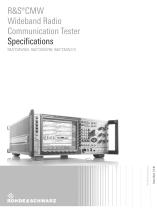
R&S®CMW Wideband Radio Communication Tester Specifications Test & Measurement
Open the catalog to page 1
Rohde & Schwarz R&S CMW Wideband Rad
Open the catalog to page 2
Rohde & Schwarz R&S CMW Wideband Radi
Open the catalog to page 6
Version 13.01, September 2015 Specifications apply under the following conditions: ® Data valid for the R&S CMW500, the R&S CMW290 and the R&S CMW270 unless otherwise stated. Data without tolerance limits is not binding. Based on a 24-month calibration interval unless otherwise stated. At least 15 minutes warm-up time at ambient temperature, specified environmental conditions met, calibration cycle adhered to, and all internal automatic adjustments performed. Typical values are designated with the abbreviation “typ.”. These values are verified during the final test but are not assured by Rohde...
Open the catalog to page 7
General technical specifications RF generator Frequency range 70 MHz to 3300 MHz, up to 6000 MHz with the ® R&S CMW-KB036 option 0.1 Hz same as timebase + frequency resolution Frequency resolution Frequency uncertainty Output level range RF1 COM, RF2 COM 70 MHz to 100 MHz continuous wave (CW) peak envelope power (PEP) overranging (PEP) 100 MHz to 3300 MHz continuous wave (CW) peak envelope power (PEP) overranging (PEP) 3300 MHz to 6000 MHz continuous wave (CW) peak envelope power (PEP) overranging (PEP) maximum input DC level 70 MHz to 100 MHz continuous wave (CW) peak envelope power (PEP) overranging...
Open the catalog to page 8
Output level linearity with fixed RF output attenuator setting RF1 COM, RF2 COM Output level resolution Output level repeatability in temperature range +20 °C to +35 °C, GPRF generator list mode, level range 0 dB to –30 dB no overranging typical values after 1 h warm-up time, always returning to same level and frequency, no temperature change, insignificant time change output level ≥ –80 dBm output level < –80 dBm > 5 kHz offset from carrier, for output level > –40 dBm, for full scale CW signal 400 MHz to 3300 MHz, except fnonharmonic = 3900 MHz – fcarrier, except fnonharmonic = 3900 MHz, except...
Open the catalog to page 9
Modulation source: arbitrary waveform generator (ARB) (R&S®CMW-B110A/R&S®CMW-B110D option) ® Memory size Word length Sample length Sample rate Maximum possible RF bandwidth R&S CMW-B110A ® R&S CMW-B110D I Q marker with 4-bit marker minimum maximum depending on arbitrary waveform file Trigger Trigger sources 1.024 Gbyte 4.096 Gbyte 16 bit 16 bit 4 bit to 16 bit up to 227.55 Msample 400 Hz 100 MHz 80 MHz BASE: external TRIG A, BASE: external TRIG B 70 MHz to 3300 MHz 3300 MHz to 5000 MHz 5000 MHz to 6000 MHz without input signal, 70 MHz to 6000 MHz, except 4000 MHz, 4800 MHz, 5162.5 MHz, 5600 MHz,...
Open the catalog to page 10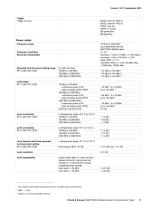
Trigger Trigger sources BASE: external TRIG A, BASE: external TRIG B, GPRF: free run, GPRF: IF power, BB generators, BB signaling Power meter Frequency range 70 MHz to 3300 MHz, up to 6000 MHz with the ® R&S CMW-KB036 option 0.1 Hz Gaussian, 1 kHz to 10 MHz, in 1/3/5 steps, bandpass, 1 kHz to 30 MHz, in 1/3/5 steps, RRC, α = 0.1, 3.84 MHz, RRC, α = 0.22, WCDMA filter, 1.2288 MHz, CDMA filter Frequency resolution Resolution bandwidths Expected nominal power setting range RF1 COM, RF2 COM 70 MHz to 100 MHz continuous power (CW) peak envelope power (PEP) 100 MHz to 3300 MHz continuous power (CW)...
Open the catalog to page 11
Dynamic range 70 MHz to 3300 MHz, RBW → 1 kHz, with fixed expected nominal power setting Expected nominal power setting for full dynamic range RF1 COM, RF2 COM Dynamic range 3300 MHz to 6000 MHz, RBW → 1 kHz, with fixed expected nominal power setting Expected nominal power setting for full dynamic range RF1 COM, RF2 COM Spectrum measurements FFT spectrum analyzer Frequency range 70 MHz to 3300 MHz, up to 6000 MHz with the ® R&S CMW-KB036 option 1.25 MHz, 2.5 MHz, 5 MHz, 10 MHz, 20 MHz, 40 MHz 1k, 2k, 4k, 8k, 16k peak, RMS Dynamic range 70 MHz to 3300 MHz, for FFT length → 16k and span → 5 MHz...
Open the catalog to page 12
Level range Level uncertainty see general technical specifications for center frequency and detector → peak see general technical specifications Inherent spurious response see general technical specifications Spurious response see general technical specifications Harmonic response see general technical specifications Phase noise see general technical specifications Rohde & Schwarz R&S CMW Wideband Radio Communication Tester
Open the catalog to page 13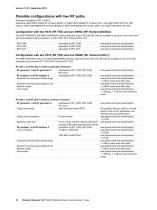
Possible configurations with two RF paths Necessary hardware (H570, H590X): ® ® ® Selections: R&S CMW-S590A RF frontend (BASIC) or R&S CMW-S590D RF frontend (ADV.) and R&S CMW-S570 RF TRX. ® ® ® Options: R&S CMW-B590A RF frontend (BASIC) or R&S CMW-B590D RF frontend (ADV.) and R&S CMW-B570 RF TRX. Configuration with two H570 (RF TRX) and two H590A (RF frontend (BASIC)) ® The R&S CMW-B570 and R&S CMW-B590A options make the second RF path (RF path 2) available on the front of the instrument with three additional RF connectors, i.e. RF3 COM, RF4 COM and RF3 OUT. RF3 COM RF4 COM RF3 OUT equivalent...
Open the catalog to page 14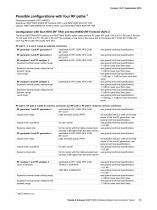
Possible configurations with four RF paths 6 Necessary hardware (H570 H590D): ® ® Selections: R&S CMW-S590D RF frontend (ADV.) and R&S CMW-S570 RF TRX. ® ® Options: R&S CMW-B590D RF frontend (ADV.) and three R&S CMW-B570 RF TRX. Configuration with four H570 (RF TRX) and two H590D (RF frontend (ADV.)) ® The three R&S CMW-B570 options and R&S CMW-B590D option make the four RF paths (RF path 1 RX and TX, RF path 2 RX and TX, RF path 3 RX and TX, RF path 4 RX and TX) available on the front of the instrument at connectors RF1 COM, RF2 COM, RF1 OUT and RF3 COM, RF4 COM, RF3 OUT. RF path 1, 2, 3 and...
Open the catalog to page 15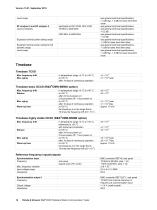
Level range RF analyzer 2 and RF analyzer 4 Level uncertainty Expected nominal power setting range Expected nominal power setting for full dynamic range Level range see general technical specifications, + 3 dB (typ. + 2 dB) for lower level limit value see general technical specifications see general technical specifications, + 0.2 dB see general technical specifications, + 0.3 dB see general technical specifications, + 3 dB for lower level limit value see general technical specifications, + 3 dB for lower level limit value see general technical specifications, + 3 dB (typ. + 2 dB) for lower level...
Open the catalog to page 16All Rohde Schwarz catalogs and technical brochures
 R&S®ZNL vector network analyzer
18 Pages
 R&S®MXO 4 Oscilloscope
40 Pages
 R&S®RTE1000 oscilloscope
40 Pages
 R&S®FPL1000
20 Pages
 R&S®ZNA vector network analyzers
52 Pages
 R&S®HF907
2 Pages
 R&S®RO129 Antenna Rotator
6 Pages
 R&S®PR100 Portable Receiver
30 Pages
 R&S®ETC Compact TV Analyzer
12 Pages
 R&S®RSC Step Attenuator
10 Pages


Archived catalogs
 R&S®RTA4000 Oscilloscope
22 Pages
 R&S®NRP Power Meter Family
40 Pages
 R&S®EVSF1000
12 Pages
 R&S®UMS175
10 Pages
 R&S®AVHE100
24 Pages
 HM8030
2 Pages
 R&S®HMC8015 Power Analyzer
10 Pages
 R&S®HM8118 LCR-Bridge
2 Pages
 Digital Multimeter HMC8012
3 Pages
 R&S®TSMX-PPS2 GPS Module
4 Pages
 Mobile network testing solutions
20 Pages
 Value Instruments Catalog
69 Pages
 Test & Measurement Catalog 2016
266 Pages
 Test & Measurement Catalog 2013/2014
214 Pages
 R&S®BBA150 Broadband Amplifier
16 Pages
 R&S®UPZ Audio Switcher
6 Pages
 R&S®SMZ Frequency Multiplier
8 Pages
 R&S®CMW-CU Control Unit
6 Pages
 R&S®FSQ Signal Analyzer
14 Pages
 R&S®FSU Spectrum Analyzer
16 Pages
 R&S®RTE-B1 Mixed Signal, 400 MHz
26 Pages
 R&S®RTO Digital Oscilloscopes
32 Pages
 R&S®ZVB Vector Network Analyzers
20 Pages
 R&S®IQR I/Q Data Recorde
16 Pages
 R&S®CMA180 Radio Test Set
16 Pages
 R&S®CBT/CBT32 Bluetooth® Tester
20 Pages
 R&S®UPV Audio Analyzer
24 Pages
 R&S®RTE Digital Oscilloscope
26 Pages
 R&S®CMW500 Platform overview
20 Pages
 R&S®EM010 VXI HF Receiver
10 Pages
 EMC Precompliance Solutions
79 Pages
 UMS120 Monitoring Syste
8 Pages
 R&S®FPC Spectrum analyzer
16 Pages
 Broadcasting Catalog
144 Pages
 Secure communication Catalog
274 Pages
 T & M Product Catalog
146 Pages
 R&S®RF Step Attenuators
2 Pages
 Q8384 Optical Spectrum Analyzer
10 Pages
 R&S®NRP Power Meter
22 Pages
 Audio Analyzers ¸UP 300/¸UP 350
16 Pages
 R&S®ZVL Vector Network Analyzers
14 Pages
 SMU200A Vector Signal Generator
44 Pages
 R&S®EVS300 ILS/VOR Analyzer
12 Pages
 SMU200A Flyer
2 Pages
 WiMAX Communication Tester
16 Pages
 Network Operators Catalog
18 Pages


- Rohde & Schwarz power supply
- Rohde & Schwarz DC power supply
- AC/DC power supply
- Test cabinet
- Monitoring analyzer
- Automatic analyser
- Temperature test chamber
- Benchtop analyser
- Single-output power supply
- Quality control test cell
- Portable tester
- Power supply for industrial applications
- Portable analyzer
- Environmental test chamber
- Compact power supply
- Signal amplifying integrated circuit
- Automatic tester
- Rohde & Schwarz tabletop power supply
- Transceiver module