
- Catalogs
- Römheld GmbH Friedrichshütte
- PROGRAM SUMMARY Work supports


- Company
- Products
- Catalogs
- News & Trends
- Exhibitions
PROGRAM SUMMARY Work supports

PROGRAM SUMMARY Work supports
Hydraulic work supports are designed to stabilize workpieces during machining by preventing vibration and deflection. They utilize spring force and can be either single or double-acting, with double-acting supports offering precise retraction timing.
Specifications
- Pneumatic contact force: 20.1 to 196 N/bar.
- Elastic deformation: 0.7 to 4.5 µm/kN.
- Various models have specific body cross-section dimensions and external thread specifications.
Functionality
These supports use a locking bush or piston to secure the support plunger when pressurized with hydraulic oil, compensating for axial forces and maintaining contact with the workpiece after unclamping.
Advantages
- Safe loading and unloading processes.
- Functional safety regardless of flow rate.
- Allows workpiece loading from all directions.
- Quick retraction with double-acting supports.
Technical Information
- Positive air pressure protection prevents penetration by liquids and particles.
- Admissible flow rates must be followed to avoid premature locking.
- Air bleeding is necessary to prevent extended clamping times.
- Contact force should be adjustable to avoid deforming the workpiece.
Recommendations
- Increase safety factors or operating pressure to manage vibrations.
- Ensure proper venting to prevent coolant ingress.
- Use sharp-edged orifices for even flow distribution.
Materials and Construction
- Support plungers: stainless steel, hard chrome-plated.
- Bodies: free-cutting steel, black-oxide.
- Seals and hydraulic fluids are detailed in data sheet A 0.100.
Mounting and Usage
- Supports can be mounted in any position, but data is valid for vertical mounting.
- Special contact bolts should be hard and dome-headed for uneven surfaces.
- Protection caps are available to shield against strong coolant jets.
Limitations
- Supports can only absorb forces along the plunger axis.
- Side loads should be managed by fixed supports or horizontal stops.
Conclusion
Hydraulic work supports are crucial for maintaining stability and precision in machining. Proper installation, operation, and maintenance are essential for optimal performance.
Catalog excerpts
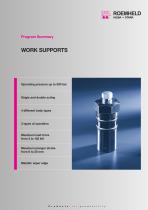
Program Summary WORK SUPPORTS Single and double acting 4 different body types Maximum load force from 3 to 102 kN Maximum plunger stroke from 6 to 20 mm Metallic wiper edge
Open the catalog to page 1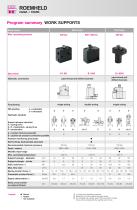
Program summary WORK SUPPORTS Block-type Body design Data sheet Hydraulic connection single acting Functioning Off-position pipe thread and drilled channels pipe thread and drilled channels single acting Hydraulic symbols Support plunger operation F = spring force H + F = hydraulics + spring force P = pneumatics A = contact control, pneumatic S = positive air pressure connection possible Position monitoring pneumatic Recommended minimum pressure Self-locking, hydraulically operated Metallic wiper edge Seals / wipers Support plunger - diameter Support plunger - stroke Spring contact force (2)...
Open the catalog to page 2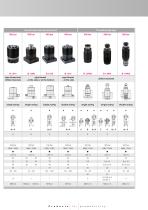
Round body with external thread Threaded-body type pipe thread and drilled channels pipe thread - at the side or at the bottom single acting single acting single acting pipe thread - at the side double acting drilled channels single acting single acting double acting
Open the catalog to page 3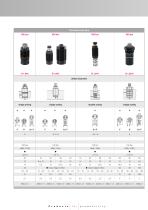
double acting single acting drilled channels single acting single acting
Open the catalog to page 4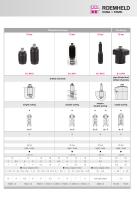
Threaded-body type B 1.9474 pipe thread and drilled channels drilled channels single + double acting single acting double acting single acting
Open the catalog to page 5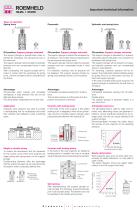
Important technical information Types of operation Spring force Hydraulic and spring force Stroke Off-position: Support plunger retracted The support plunger contacts the workpiece by air pressure. The contact force is proportional to the air pressure less spring force. The support plunger will be locked by hydraulic pressure and can compensate forces in axial direction. For retraction, hydraulic and air pressure will be released. The support plunger retracts by spring force relatively slowly to its off-position. Off-position: Support plunger retracted The support plunger is extended by a hydraulically...
Open the catalog to page 6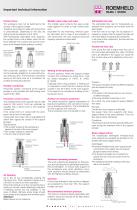
Important technical information Contact force The workpiece must not be deformed by the contact of the support plunger. Therefore, the contact is made with spring force or pneumatically. Depending on the size, the spring forces are between 4 and 100 N. With hydraulically extendable work supports, the contact force is the smallest, when the distance between the contact bolt and the workpiece is the largest before getting in contact. Max. distance to the workpiece reduces the contact force Metallic wiper edge and wiper The metallic wiper protects the wiper underneath against hot swarf or high coolant...
Open the catalog to page 7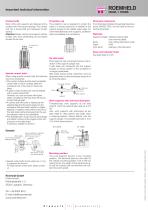
Important technical information Contact bolts Most of the work supports are delivered with a contact bolt in the support plunger. This contact bolt has a dome-head and hardened contact surface. Attention ! Never use the work support without contact bolt, since penetrating dirt and liquids impede the function. Protection cap The protection cap is designed to protect the wiper, if a strong coolant jet is directed at the support plunger or the metallic wiper edge. For some threaded-body work supports, protection caps are available as an accessory. Contact bolt Seal Dimension tolerances If not otherwise...
Open the catalog to page 8All Römheld GmbH Friedrichshütte catalogs and technical brochures
 PROGRAM SUMMARY Swing clamps
8 Pages
 Threaded-body cylinders
4 Pages
 ROEMHELD program summary
6 Pages
 Program summary ROEMHELD Group
20 Pages


