
- Catalogs
- RODRIGUEZ GmbH
- Linear Technology


Linear Technology

Linear Technology
This catalogue introduces linear-roundrail-components crucial in machine design across various engineering fields. It includes precision shafts, linear ball bushings, slide bushings, housing units, and construction components, with options for custom designs based on technical parameters.
Linear technology products are used in industries such as food, printing, packaging, medical, optical scanning, robotics, textiles, semiconductors, woodworking, and handling systems.
- Speed and Acceleration: Linear ball bushings have varying maximum speeds and accelerations, some reaching up to 4 m/s.
- Temperature and Friction: Suitable for -20 to +80°C, with a friction coefficient between 0.001 to 0.005.
- Construction and Materials: Linear housings are made from aluminum or graphite/aluminum mouldings, with specific tolerances for bearings.
- Operating Life and Load: Factors like load direction, shaft hardness, and dynamic load conditions affect bearing life.
- Load Calculation: Load position and center are crucial for product selection.
- Shaft Deflection: Tables provide deflection values for shafts with end supports.
- Lubrication: Essential for function, with recommendations for grease and oil types.
- Chapter 1 - Linear Ball Bushings: Details various types of ball bushings including standard, flanged, and self-aligning models.
- Chapter 2 - Linear Bearing Housings: Covers aluminum profile housings with different configurations like closed, open, and tandem versions.
- Chapter 3 - Graphite/Aluminum Mouldings: Describes housings made from graphite and aluminum with radial adjustments.
- Chapter 4 - Construction Components: Includes shaft supports, end-blocks, and other components.
- Chapter 5 - Precision Guide Shafts: Discusses various shaft types, including hardened and ground precision shafts.
The catalogue provides comprehensive technical data and guidelines for selecting and using linear technology components, emphasizing proper assembly and lubrication for optimal performance.
- Super-Smart Linear Ball Bearing™: Features universal self-alignment with tilt, roll, and rotation capabilities to optimize load capacity and reduce friction.
- Frelon® Slide Bushings: Composed of Teflon® and other materials for self-lubrication, high rigidity, and reduced abrasion. They offer chemical resistance and operate in temperatures from -240°C to +260°C.
- Assembly Instructions: Emphasizes precise alignment and parallelism of shafts. Detailed steps are provided for mounting housings and shafts to ensure smooth operation.
- Load and Friction Calculations: Provides formulas for calculating load distribution and friction forces, emphasizing maintaining specified ratios to prevent clamping.
- PV-Values: Defines maximum pressure and speed parameters for slide bushings to ensure optimal performance.
- Includes detailed ordering codes for various types of linear housings and ball bushings, specifying options for shaft diameter, seal types, and special customer specifications.
- Load capacities and dimensions for different models of linear ball bushings are provided, highlighting the importance of using hardened and ground shafts for accurate load ratings.
This document provides detailed specifications and dimensions for various shaft supports and components used in linear technology applications. The components are primarily made from high-quality aluminum alloy and are designed to support precision steel shafts.
The document lists several part numbers for shaft supports, including WUH-12 to WUH-40, with dimensions provided in millimeters. These supports are suitable for precision steel shafts and are available in lengths up to 600 mm. The supports can also be supplied with assembled shafts.
Two types of twin shaft blocks are detailed: TAA (fixed) and TAB (moveable). Both types are made from aluminum alloy and are designed to accommodate different shaft diameters, ranging from 8 mm to 40 mm.
Several shaft block models are described, including WBC, WBA, WBAS, WBS, FWBA, and FWBG. Each model has specific dimensions and weight, with materials ranging from aluminum alloy to steel and graphite molding.
The document includes a table of tolerances for internal and external dimensions, adhering to DIN 1686 - GTB 15 standards. Tolerance zones are specified for both hole and shaft dimensions.
Various types of precision guide shafts are outlined, including solid and tubular options. These shafts are induction-hardened and precision-ground, with materials such as Cf 53, X46Cr13, and X90CrMoV18. The shafts are designed for high surface hardness and corrosion resistance.
Customers can order support rails with specific dimensions and features, such as axial threading and end machining. The document emphasizes the flexibility in customizing shaft lengths and configurations to meet specific application needs.
The document provides detailed specifications for various precision guide shafts, including shaft diameter, weight per meter, material code, production length, hardness depth, and standard tolerance. The shafts are categorized under different material codes such as WV, WV1, WRS1, WRS2, and WH, each with specific properties and dimensions.
The document outlines machining options for precision shafts, including axial threads and radial hole patterns. It specifies standard machining options and provides ordering codes for customization.
The hardness depth is defined by DIN 50190, and standard tolerances are specified as ISO h6 or h7, depending on the shaft type.
The document recommends utilizing the company's machining facilities for cost-effective, ready-to-install precision shafts. It highlights the benefits of using modern CNC machines for finish-machined shaft units.
The document lists additional products such as linear motors, guideways, worm drives, ballscrews, trapezoidal screws, and linear actuators, emphasizing their applications in various industrial sectors.
Rodriguez GmbH is presented as a leading supplier of precision bearings and components, with a focus on customer-specific solutions and high-quality construction. The document includes contact information for offices in Germany, France, and the USA.
Catalog excerpts
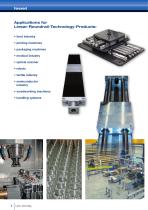
Applications for Linear-Roundrail-Technology-Products: Products: • food industry • printing machines • packaging machines • medical industry • optical scanner • robots • textile industry • semiconductor industry • woodworking machines • handling systems
Open the catalog to page 2
Linearguidings are used to solve linearmovement-requirements in various fields of engineering and machine building. As they contribute significantly in designing a machine technically and commercially, linearguidings gained in importance these days. This catalogue introduces powerful linear-roundrail-components, mainly precision shafts, linear ballbushings, linear slidebushings, linear housing units and construction components, in 5 chapters. Besides the mentioned standardcomponents, also special designs are available. These will be manufactured following a customer-drawing or will be designed...
Open the catalog to page 3
Linear Technology KH linear ball bushing 19 LME linear ball bushing, standard 20 SDE linear ball bushing, all steel 21 LMEF/K linear ball bushing, flanged 22 LMEF/K-L linear ball bushing, long, flanged 23 SPM linear ball bushing, self-aligning 24 SSE linear ball bushing, self-aligning, high load capacity 25 FMT linear slide bushing, compact 26 FM linear slide bushing 27 TAGC closed, compact, tandem version 29 ALGS standard, closed 30 ALGS-OP standard, open 31 AG-AJ single closed, radial adjustment 33 AG-OP single, open 34 AG-OPAJ single open, radial adjustment 35 AGS-AJ open on side, radial adjustment...
Open the catalog to page 4
Chapter 3 - Linear Bearing Housings graphite/aluminium mouldings GG-AJ graphite closed, radial adjustment 50 GG-OP graphite open 51 GG-OPAJ open, radial adjustment 52 MAG-AJ aluminium closed, radial adjustment 55 MAG-OPAJ aluminium open, radial adjustment 56 Chapter 4 - Linear Construction Components Shaft supports, end-blocks etc. WUF flat shaft support 57 WUFD flat shaft support, double fixing row 58 WUM medium shaft support 60 WUH high shaft support 61 TAA twin shaft block, type A 63 TAB twin shaft block, type B 64 WBC shaft block, compact 65 WBAS standard shaft block 67 WBS standard shaft...
Open the catalog to page 5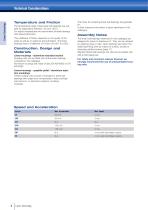
Technical Considerations Linear Technology Temperature and Friction The temperature range, these linear ball bearings are suitable for applications between -20 and +80°C. For higher temperatures we recommend all-steel bearings with special lubricants. The coefficient of friction depends on the quality of the seals as well as on pressure and lubrication. The linear bearings have a Coefficient of Friction of 0.001 to 0.005. Construction, Design and Materials Linear housings - aluminium extruded section Housing units can be fitted with all the linear bearings contained in this catalogue. Aluminium...
Open the catalog to page 6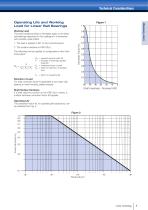
Technical Considerations Operating Life and Working Load for Linear Ball Bearings Linear Technology 1. The load is applied at 90° to the horizontal plane 2. The surface hardness is HRC 62±2. The following formula applies to configurations other than those given: WR = required dynamic load (N) P = resultant of externally applied loads (N) KS = hardeness factor of shaft K = factor for direction of resultant load Working Load The load conditions listed in the tables apply to the linear ball bearings described in this catalogue in combination with precision steel shafts. KL = factor for operating...
Open the catalog to page 7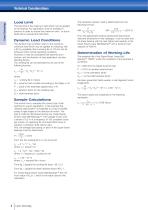
Technical Considerations Linear Technology Load Limit The load limit is the maximum load which may be applied to the bearing. Any application must be analysed in advance in order to ensure that maximum and / or shock laods will not exceed the load limits. Dynamic Load Conditions The dynamic load condition refers to the maximum continuos load which may be applied to a bearing, with a 90 % propability that a working life of 100 km can be achieved under normal operating conditions. However, it must be considered that extremly short strokes, and the direction of load application, are also deciding...
Open the catalog to page 8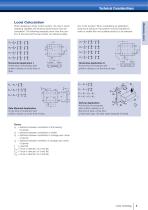
Load Calculation When designing a linear motion system, the way in which operating variables will influence performance must be considered. The following examples show how the posi- tion of the load and the load center can influence selec- tion of the product. When considering an application, every force acting on the system must be evaluated in order to enable the most suitable product to be selected. At the time of movement with uniform velocity or at the time of At the time of movement with uniform velocity or at the time of stop. Side Mounted Application At the time of movement with uniform...
Open the catalog to page 9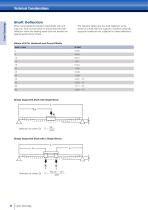
Technical Considerations Linear Technology Shaft Deflection When using hardened precision steel shafts with end supports, care must be taken to ensure that the shaft deflection within the bearing travel does not exceed the bearing performance criteria. The following tables give the shaft deflection at the center of a shaft with end supports. Systems using fully supported shafts are not subjected to these deflections. Values of El for Hardened and Ground Shafts Shaft ∅ (mm) Simply Supported Shaft with Single Block Simply Supported Shaft with 2 Single Blocks
Open the catalog to page 10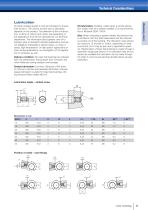
Technical Considerations Linear Technology Lubrication Oil-lubrication: Possible. Useful when a central lubrication system with oil is already installed. Our recommendation is Klüberoil GEM 1-68 N. All Linear Guiding Systems must be lubricated to ensure their function. The volume and the way of lubrication depends on the product. The definition of the re-lubrication, in terms of volume and cycles, are depending on the applications and can be calculated by our technical department. The information about grease- and oil-lubrication refer to standard industrial applications and are not obligatory....
Open the catalog to page 11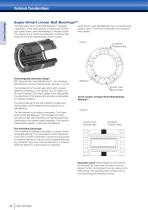
Technical Considerations Linear Technology Super-Smart Linear Ball Bearings™ The SSE Super-Smart Linear Ball Bearings™ represent a significant, world-wide advance in linear guide technology. Super-Smart Linear Ball Bearings™ provide double the capacity and 8 times the working life, compared with Super-Smart Linear Ball Bearings used in industry. Super-Smart Linear Ball Bearings have 3 times the load capacity and 27 times the working life of conventional linear guides. Technologically advanced design With Super-Smart Linear Ball Bearings™, four hardened steel elements carry the bearing forces,...
Open the catalog to page 12All RODRIGUEZ GmbH catalogs and technical brochures
 RTB-Bearings/Unitec Bearings
76 Pages
 Linearsystems
12 Pages
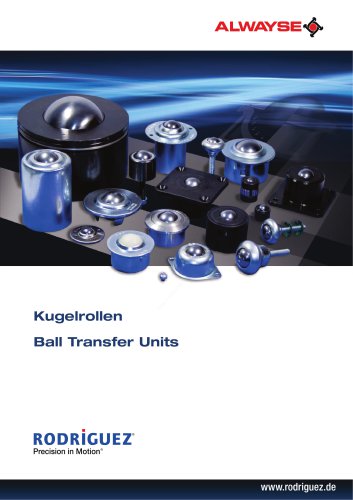 Balltransferunits
32 Pages
 OCS buckle®
1 Page
 Linear guideways
32 Pages
 Linear Actuators
12 Pages
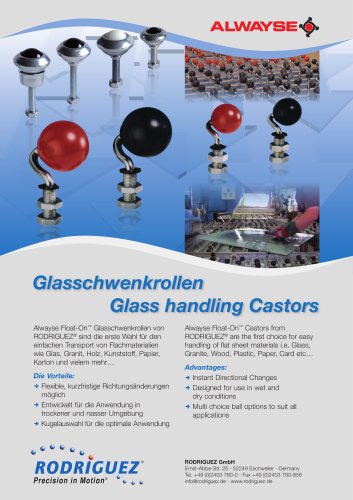 Float-On Castors
2 Pages


