
- Catalogs
- RKB Europe
- RKB Multi-Level Quality Control System for Rolling Bearings


- Products
- Catalogs
- News & Trends
- Exhibitions
RKB Multi-Level Quality Control System for Rolling Bearings

RKB Multi-Level Quality Control System for Rolling Bearings
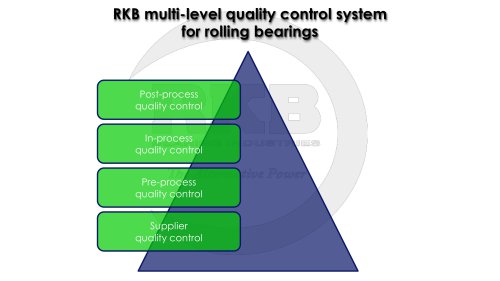
The document describes the RKB Group's comprehensive quality control system for rolling bearings, highlighting the integration of quality control with advanced manufacturing technology to ensure reliable and high-performance products. The system encompasses multiple control levels from raw material procurement to post-process checks.
- Raw Material Supplier Quality Control: Emphasizes the selection of high-quality bearing steel, particularly for large, high-tech bearings. Suppliers must comply with RKB Material Guidelines and hold ISO certifications. Multi-test inspections ensure adherence to international standards.
- Pre-Process Quality Control: Utilizes highly accurate prototypes for calibrating measuring instruments, produced with ultra-high precision to enhance reliability and minimize manufacturing errors.
- In-Process Quality Control: Involves quality checks during manufacturing stages such as forging, heat treatment, and machining to maintain consistency and quality.
- Post-Process Quality Control: Conducts non-destructive and destructive tests to ensure the final product meets quality standards, using advanced measuring instruments for detailed inspections.
RKB offers additional quality certifications upon customer request, ensuring products meet international standards and providing supplementary information for manufacturing-related components.
The document discusses special quality protocols and concludes by emphasizing the importance of a comprehensive quality control system in producing high-quality rolling bearings.
The Inspection Certificate Data Sheet (ICDS) is a technical certificate required for industries with specific regulations, serving as a third-party certification. It includes visual, dimensional, and hardness evaluations of bearings. Each packed bearing comes with a Certificate of Inspection, confirming compliance with standards and providing handling, lubrication, and usage precautions for RKB products.
The RKB Group has developed supplementary quality protocols for specific applications, such as Victory Line, Wind Class, ROVSX for vibrating machinery, and Made to Order or Application Optimized Bearings. These protocols leverage advanced knowledge in micro-geometry, surface topography, software engineering, material engineering, and manufacturing technology, including special heat treatments and high precision machining.
Protocols involve using the best bearing steels, advanced software and material engineering, and improved manufacturing technology. Specific treatments like bainite treatment and dimensional stabilization for rings, and precision class higher than standard for certain series, are employed.
RKB's total quality policy aligns with ISO 9001 and ISO 14001 standards, guided by Total Quality System principles. The RKB Quality Control Bureau manages quality procedures, ensuring adherence at all organizational levels. This system guarantees superior product and service quality. Further details are available in the General Quality Program on the RKB website.
Catalog excerpts
RKB BEARING KNOWLEDGE COLLECTIONS RKB Multi-Level Quality Control System for Rolling Bearings
Open the catalog to page 1
RKB MULTI-LEVEL QUALITY CONTROL SYSTEM FOR ROLLING RKB BEARING KNOWLEDGE COLLECTIONS - No. 4/11 2 RKB MULTI-LEVEL QUALITY CONTROL SYSTEM_4 2.1 Raw material supplier quality control 4 2.2 Pre-process quality control 6 2.3 In-process quality control 10 2.3.1 Forging quality control 12 2.3.2 Heat treatment quality control 12 2.3.3 Machining quality control 13 2.4 Post-process quality control 14
Open the catalog to page 2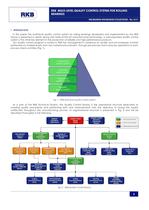
RKB MULTI-LEVEL QUALITY CONTROL SYSTEM FOR ROLLING BEARINGS RKB BEARING KNOWLEDGE COLLECTIONS - No. 4/11 3 1 INTRODUCTION In this paper the multi-level quality control system for rolling bearings developed and implemented by the RKB Group is presented in detail. Along with state-of-the-art manufacturing technology, a well-organized quality control system is the other key element in the production of reliable and high performance products. Our quality control program is rooted in RKB top management’s insistence on quality and encompasses controls performed on multiple levels, from raw material...
Open the catalog to page 3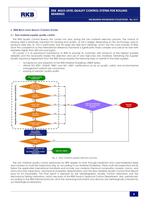
RKB MULTI-LEVEL QUALITY CONTROL SYSTEM FOR ROLLING BEARINGS RKB BEARING KNOWLEDGE COLLECTIONS - No. 4/11 4 2 RKB MULTI-LEVEL QUALITY CONTROL SYSTEM 2.1 Raw material supplier quality control The RKB Quality Control Bureau first comes into play during the raw material selection process. The choice of bearing steel is extremely important for bearing end quality, as this is largely depending on the technology used to produce steel (Fig. 3). This is particularly true for large size high-tech bearings, which are the core business of RKB, since the compliance to the international reference standards...
Open the catalog to page 4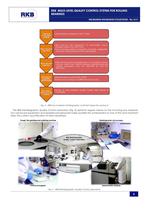
RKB MULTI-LEVEL QUALITY CONTROL SYSTEM FOR ROLLING BEARINGS RKB BEARING KNOWLEDGE COLLECTIONS - No. 4/11 5 Fig. 4 – RKB raw material metallographic multi-test inspection protocol The RKB Metallographic Quality Control Laboratory (Fig. 5) performs regular checks on the incoming raw materials. Our advanced equipment and experienced personnel make possible the achievement of one of the most important tasks: the correct quantification of steel cleanliness. Fig. 5 – RKB Metallographic Quality Control Laboratory
Open the catalog to page 5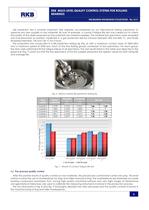
RKB MULTI-LEVEL QUALITY CONTROL SYSTEM FOR ROLLING BEARINGS RKB BEARING KNOWLEDGE COLLECTIONS - No. 4/11 6 Life prediction test is another important task regularly accomplished by our Mechanical Testing Laboratory to approve any new supplier of raw materials. By way of example, a contact fatigue life test was carried out to check the quality of the steels proposed by five potential raw material suppliers. The material test specimens were annealed and manufactured as washers, hardened in a gas protected electro-furnace between 835 and 845 „aC, and finally tempered between 150 and 160 „aC for 3...
Open the catalog to page 6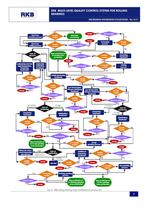
RKB MULTI-LEVEL QUALITY CONTROL SYSTEM FOR ROLLING BEARINGS RKB BEARING KNOWLEDGE COLLECTIONS - No. 4/11 7 Fig. 8 – RKB rolling bearing rings masterpieces production
Open the catalog to page 7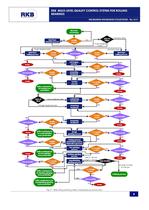
RKB MULTI-LEVEL QUALITY CONTROL SYSTEM FOR ROLLING BEARINGS RKB BEARING KNOWLEDGE COLLECTIONS - No. 4/11 8 Fig. 9 – RKB rolling bearing rollers masterpieces production
Open the catalog to page 8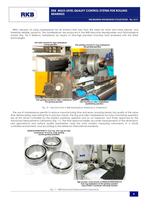
RKB MULTI-LEVEL QUALITY CONTROL SYSTEM FOR ROLLING BEARINGS RKB BEARING KNOWLEDGE COLLECTIONS - No. 4/11 9 RKB’s decision of using masterpieces for all product lines rises from the need for more and more precise, and therefore reliable, products. The masterpieces are produced in the RKB Executive Headquarters and Technological Center (Fig. 10) in Balerna, Switzerland, by means of ultra-high precision machine tools endowed with the latest technologies. Fig. 10 – Machine tools in RKB Masterpiece Workshop in Switzerland The use of masterpieces permits to reduce manufacturing time and errors, ensuring...
Open the catalog to page 9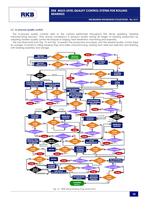
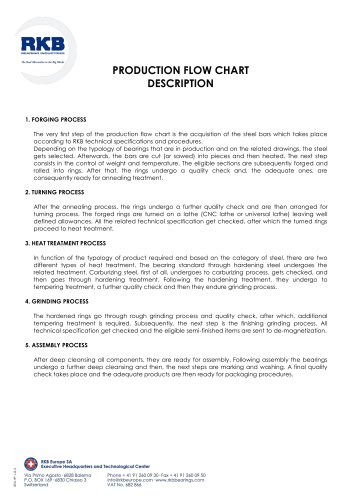
RKB MULTI-LEVEL QUALITY CONTROL SYSTEM FOR ROLLING BEARINGS RKB BEARING KNOWLEDGE COLLECTIONS - No. 4/11 10 2.3 In-process quality control The in-process quality controls refer to the controls performed throughout the strictly speaking “bearing manufacturing process”. They ensure consistency in product quality during all stages of bearing production by adopting modern quality control techniques in forging, heat treatment, machining and assembly. The two flowcharts from Fig. 12 and Fig. 13 present the production processes, and the related quality control steps (in orange), involved in rolling...
Open the catalog to page 10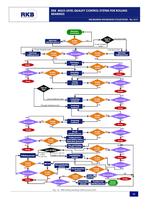
RKB MULTI-LEVEL QUALITY CONTROL SYSTEM FOR ROLLING BEARINGS RKB BEARING KNOWLEDGE COLLECTIONS - No. 4/11 11 Fig. 13 – RKB rolling bearing rollers production
Open the catalog to page 11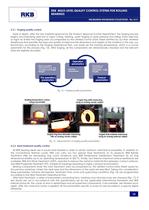
RKB MULTI-LEVEL QUALITY CONTROL SYSTEM FOR ROLLING BEARINGS RKB BEARING KNOWLEDGE COLLECTIONS - No. 4/11 12 2.3.1 Forging quality control More in depth, after the raw material approval by the Product Approval Control Department, the forging process begins, encompassing steel bar or ingot cutting, heating, upset forging or upset pressing and rolling. Every steel bar or ingot lot enters the forging area accompanied by the related Control Data Sheet emitted by our Raw Material Warehouse that specifies the type and quality of steel and the dimensions and weight of the material. In this way, our technicians,...
Open the catalog to page 12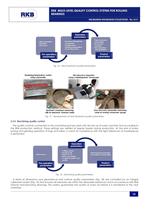
RKB MULTI-LEVEL QUALITY CONTROL SYSTEM FOR ROLLING BEARINGS RKB BEARING KNOWLEDGE COLLECTIONS - No. 4/11 13 Fig. 16 – Heat treatment quality parameters Fig. 17 – Measurement of heat treatment quality parameters 2.3.3 Machining quality control The quality controls connected to the machining process starts with the set-up of every machine tool according to the RKB production method. These settings are verified at regular breaks during production. At the end of every turning and grinding operation of rings and rollers, a check for compliance with the tight tolerances of masterpieces is performed....
Open the catalog to page 13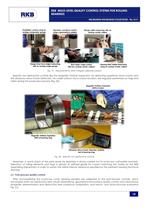
RKB MULTI-LEVEL QUALITY CONTROL SYSTEM FOR ROLLING BEARINGS RKB BEARING KNOWLEDGE COLLECTIONS - No. 4/11 14 Fig. 19 – Measurements within integral calibrated system Specific non-destructive controls like the Magnetic Particle Inspection, for detecting superficial micro-cracks, and the Ultrasonic Micro-Crack Detection, for under-surface micro-cracks location, are regularly performed on rings and rollers during the production process (Fig. 20). Fig. 20 – Specific non-destructive controls Moreover, a visual check of the parts ready for assembly is always carried out to avoid any noticeable anomaly....
Open the catalog to page 14All RKB Europe catalogs and technical brochures
 Cylindrical rolelr bearings
2 Pages
 Technological bearings
2 Pages
 Project S12
2 Pages
 RKB Product Table
2 Pages
 This Is RKB
24 Pages
 RKB Phosphate Treatment
2 Pages
 RKB General Information Form
12 Pages
 Project "241 KPP VL"
2 Pages
 Project "EPB"
2 Pages
 Project "MDU"
2 Pages
 Project "ABI"
2 Pages
 TQOS Maintenance
3 Pages
 AF2D Multiroll Cage Design
2 Pages
 RKB_Europe_SA_ISO_9001
1 Page
 RKB_Europe_SA_ISO_14001
1 Page
 RKB_Europe_SA_ISO_27001
1 Page
 RKB_Europe_SA_ISO_10002
1 Page
 RKB General Quality Program
50 Pages
 RKB Special Projects
68 Pages
 RKB Metals Industry Leaflet
2 Pages
 RKB Company Snapshot
2 Pages
 RKB Brief Company Profile
2 Pages
 RKB_Taper_Roller_Bearings_Assy
39 Pages
 RKB Bearings Production Range
34 Pages
 RKB Bearings Catalogue
168 Pages
 Made in RKB
1 Page
 RKB Taper Roller Bearings Assy
39 Pages
 Why RKB
1 Page
 RKB Basic Load Ratings
14 Pages
 Bearing Industry Matrix
2 Pages
 RKB_Business_Card_T3
1 Page
 RKB_Business_Card_T2
1 Page
 RKB Message of the President
2 Pages
 RKB Brief Introduction
2 Pages
 RKB Digital Presentation
50 Pages
 Company name and motto
6 Pages










- Steel bearing
- Ball bearing
- Radial bearing
- Single-row bearing
- Roller bearing
- Precision bearing
- Axial bearing
- Double-row bearing
- High-speed bearing
- Cylindrical roller bearing
- Deep groove ball bearing
- Bearing with cage
- Angular-contact bearing
- Tapered roller bearing
- Sealed bearing
- Bearing for heavy-duty applications
- Axial deep groove ball bearing
- High-precision bearing
- Combined bearing