

CHOOSING BLIND RIVETS

CHOOSING BLIND RIVETS
Catalog excerpts

HOW TO READ THE RIVET CODE ? Body material Body Head LARGE HEAD SEALED RIVETS MULTIGRIPRIV FIORIV A Aluminum F Steel R Copper X Cupronickel I Stainless steel T Dome S Countersunk L Large STRUCTURAL RIVETS [ TENSILE STRENGTH ] [ SHEAR STRENGTH ] [ VIBRATION RESISTANCE" LEGEND OF THE MATERIAL TO BE ASSEMBLED Stainless steel (*) This document provides helpful information for the choice of the blind rivet that satisfies the application need. Whenever the blind rivet has to provide highly demanding mechanical performance, please contact Rivit for a professional consultancy and practical tests. Fast clamping of two materials with no access to the rear, requiring watertight characteristics. High tightening range, vibration resistance and applications with irregular and misaligned holes. Soft and composite materials where the clamping pressure must be minimal. Soft materials that require a clamping pressure spread over a large surface area. Soft materials that require a clamping pressure spread over a large surface area and good weather resistance. Blind holes in soft material, usually a wooden surface. Semi-structural clamping, in stainless steel. Applicable to irregolar holes or materials with misaligned holes. Fast clamping of two materials with no access to the rear, requiring high stress and vibration strengths. Fast clamping of two materials with no access to the rear, requiring high stess strengths. Fast clamping of two materials with no access to the rear, requiring high stress strengths. Applications that require high execution speed. HOW CHOOSING CORRECTLY A BLIND RIVET HOW TO USE CORRECTLY A BLIND RIVET Pay attention to the hole diameter and tightening range as written in the catalogue. Each hole and thickness range shall have the correct blind rivet, to prevent uncorrect fastening. Pay attention to the blind rivet type selection and choose the rivet that satisfies your need, even if not a standard one, to prevent potential problems with vibrations and overall resistance. Keep into consideration possible corrosion related issues, when choosing the blind rivet and the material to be assembled. A smaller tightening range may result in an incorrect fastening, like a wrong mandrel removal during pulling operation. A greater tightening range may result in an incorrect fastening, like loosing the setting head or a wrong mandrel removal. A wider hole may result in an incorrect fastening, like loosing the setting head or the whole blind rivet. The selection of the correct noozle in the fastening tool is another point of attention to avoid wrong removal of the blind rivet mandrel and an incorrect fastening process. The selection of the correct nosepiece in the fastening tool is another point of attention to avoid wrong removal of the blind rivet mandrel and a not correct fastening process. Batteries, cabinet, protection electrical control panel. SUGGESTED TOOLS Variable tightening ranges. Variable tightening Heavy carpentry, Loudspeakers, electrical circuits, automotive, furniture.
Open the catalog to page 1
BLIND RIVETS TOOLS Rivit offers a wide choice of tools and accessories to cover all needs from Ø 3.0 to Ø 6.4, for all the main alloys. The ergonomics and simplicity of our hand riveters facilitate the work and make it safe and reliable to every operator. Rivit offers tools designed to maximize the tightening performance of each type of blind rivet, both standard and structural. Simple and practical to adjust, ergonomic and safe, the Rivit pneumatic riveters can be used in all production fields, up to the most complex and challenging industrial applications, in a range of blind rivets up to Ø...
Open the catalog to page 2All RIVIT catalogs and technical brochures
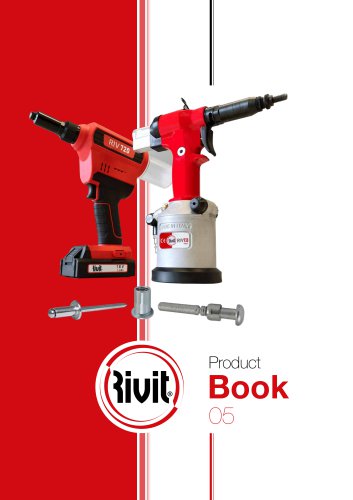 Product book
20 Pages
 FASTENERS&TOOLS CATALOGUE 2025
388 Pages
 Tools for fasteners
12 Pages
 CHOOSING RIVET NUTS
2 Pages
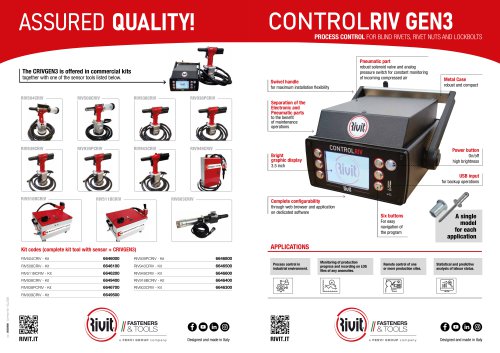 CRIVGEN3
2 Pages
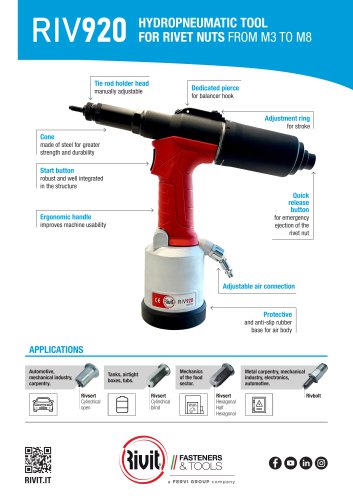 RIV920 datasheet
2 Pages
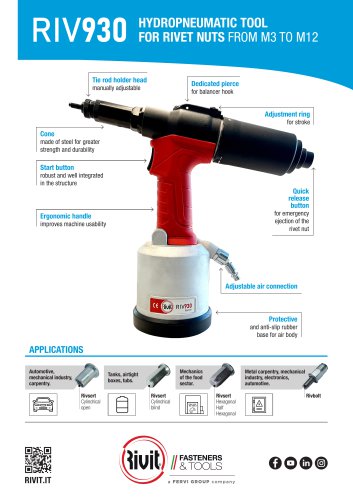 RIV930 data sheet
2 Pages
 FASTENERS FOR ROOFING
20 Pages
 SCREWS LINE
54 Pages
 PLUGS LINE
16 Pages
 RIVET NUTS LINE
64 Pages
 RAPID NUTS LINE
10 Pages
 LOCKBOLTS LINE
10 Pages
 WELDING STUDS LINE
18 Pages
 HOSE CLIPS LINE
8 Pages


Archived catalogs
 Catalogo Fasteners&Tools
556 Pages
 ROOFING COMPLETE CATALOG
431 Pages
