1. Catalogs
  2. Riverdi
  3. FT800 (Embedded Video Engine)

FT800 (Embedded Video Engine)

FT800 (Embedded Video Engine)
1 / 53 PagesView full catalog

FT800 (Embedded Video Engine)

Product catalog summary
Overview: The FT800 is a versatile graphic controller designed for embedded applications, facilitating the creation of high-quality Human Machine Interfaces (HMIs). It integrates graphic, audio, and touch control functionalities, simplifying system architecture for advanced HMIs.
Key Features:
  • Graphic controller with audio processing and resistive touch controller.
  • Embedded Video Engine (EVE) supports widgets and offloads the system MPU.
  • 4-wire touch-screen controller with median filtering and touch force sensing.
  • Standard serial interface with SPI up to 30MHz or I²C up to 3.4MHz.
  • Programmable interrupt controller and built-in 12MHz crystal oscillator.
  • Video RGB parallel output with configurable resolution up to 512x512.
  • Support for WQVGA and QVGA LCD formats.
  • Mono audio channel output with PWM and 64 voice polyphonic sound synthesizer.
  • Low power consumption suitable for portable applications.
  • Advanced object-oriented architecture for low-cost MPU/MCU hosting.
  • Extended operating temperature range from -40°C to 85°C.
Applications: The FT800 is suitable for a wide range of applications including point of sales machines, multi-function printers, home security systems, medical appliances, GPS/SatNav, vending machine control panels, and more.
Part Numbers: The FT800 is available in a 48 Pin VQFN package with options for taped and reel or tray packing.
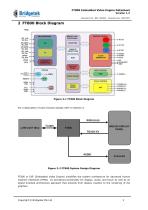
Block Diagram: The FT800 simplifies system design by integrating display, audio, and touch functionalities into a single chip, supporting an object-oriented approach to graphics rendering.
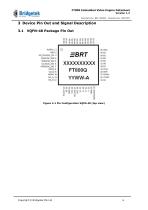
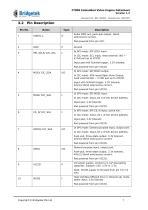
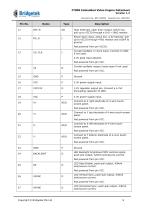
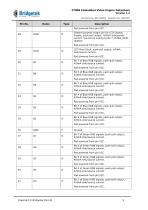
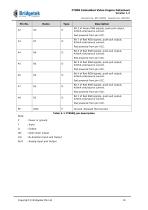
Device Pin Out and Signal Description: The FT800 features a VQFN-48 package with detailed pin descriptions for audio, SPI/I2C interfaces, power supply, and touch-screen connections.
Power Management: The FT800 includes power mode controls for power down, sleep, and standby states, supporting host interface I/O voltage from 1.8V to 3.3V.
Memory Map and Device Characteristics: The datasheet provides detailed information on memory mapping, device characteristics, and ratings, including absolute maximum ratings and DC/AC characteristics.
Package Parameters: The FT800 is available in a compact Pb-free, VQFN-48 package, compliant with RoHS standards.
Pin Descriptions: The document provides detailed descriptions of the FT800Q pin configurations, including power, input, and output specifications for RGB signals and other functionalities. Each pin is powered from the VCC pin, with specific current sink/source capabilities.
Function Description: The FT800 is a single-chip embedded graphic controller with several function blocks: Serial Host Interface, System Clock, Graphics Engine, Parallel RGB video interface, Audio Engine, Touch-screen Engine, and Power Management. Each block's functions are briefly described.
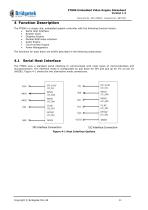
Serial Host Interface: The FT800 supports both SPI and I²C interfaces for communication with microcontrollers. The interface mode is configurable via the MODE pin. The SPI interface operates up to 30MHz, while the I²C interface supports up to 3.4MHz. The document details the protocol for memory read, write, and command transactions.
System Clock: The FT800 can use an internal relaxation oscillator, an external 12MHz crystal, or an external 12MHz square wave clock as its clock source. The internal PLL outputs the clock to all internal circuits. The system clock can be switched between 48MHz and 36MHz.
Graphics Engine: The graphics engine executes display lists for each horizontal line, supporting primitive objects like lines, points, rectangles, and bitmaps. It includes features like anti-aliasing, bitmap transformations, and a variety of built-in widgets and functionalities. The engine uses a 4 Kbyte FIFO for command execution.
Interrupts: The FT800 supports interrupts, which are enabled by REG_INT_EN. Various interrupt sources are detailed, including touch-screen events and audio playback completion.
Additional Features: The document also covers ROM and RAM fonts, JPEG decoding, inflate functionality, and built-in animated functionalities like screen savers and calibration.
Font Specifications: The document describes the font metric block, which includes a 148-byte font table defining font parameters and pointers to font images. The font table format includes parameters such as character width, bitmap format, line stride, font width, height, and image data pointer. ROM fonts are stored in a specific memory space, with tables for basic and extended ASCII characters. Font indices 16, 18, and 20-31 are for basic ASCII, while 17 and 19 are for extended ASCII, with a fixed width of 8 pixels.
Font Table Details: Tables 4-6 to 4-9 provide detailed information on font formats, line strides, widths, heights, and image pointers for various font indices. The document also lists ASCII character widths for different font indices.
Parallel RGB Interface: The RGB interface consists of 23 signals and is configured through several registers. Key configurations include PCLK frequency, clock polarity, RGB signal transitions, color dithering, and output bit width. The REG_SWIZZLE register controls the arrangement of output color pins.
Miscellaneous Control: Includes backlight control via PWM signals, DISP control pin for LCD enable/reset, general-purpose IO pins, and drive current control for output pins. The document specifies how to configure these features using various registers.
Audio Engine: The FT800 provides mono audio output through a PWM pin, supporting sound synthesis and audio file playback. The sound synthesizer uses a ROM library of wave tables, with sound effects controlled by the REG_SOUND and REG_PLAY registers. Volume is controlled by REG_VOL_SOUND, and specific sound effects are listed in Table 4-12.
Specifications: The FT800 operates with a single 3.3V supply and supports various power modes including ACTIVE, STANDBY, SLEEP, and POWERDOWN. It features a 1.2V internal regulator for core circuits and requires specific capacitors for stability. The device supports mono audio formats such as 8-bits PCM, 8-bits uLAW, and 4-bits IMA-ADPCM.
Audio Playback: The FT800 can play recorded sound by loading sound data into its RAM and setting specific registers. Key registers include REG_PLAYBACK_START, REG_PLAYBACK_LENGTH, REG_PLAYBACK_FREQ, REG_PLAYBACK_FORMAT, REG_PLAYBACK_LOOP, REG_PLAYBACK_PLAY, and REG_VOL_PB. The audio format supports 8-bits PCM, 8-bits uLAW, and 4-bits IMA-ADPCM.
Touch-Screen Engine: The touch-screen engine includes ADC, axis-switches, and an ADC input multiplexer. It captures raw X and Y coordinates, which are transformed into screen coordinates using a matrix in registers REG_TOUCH_TRANSFORM_A-F. The touch pressure is measured by REG_TOUCH_RZ.
Power Management: The FT800 supports multiple power states: ACTIVE, STANDBY, SLEEP, and POWERDOWN. The ACTIVE state enables normal operation with the system clock active. STANDBY retains register contents but disables the system clock. SLEEP disables the clock and retains register contents. POWERDOWN disables the internal regulator and resets registers.
Memory Map: The FT800 features a 22-bit address space with memory mapped registers. Key memory areas include RAM_G for graphics, ROM_CHIPID for chip identification, ROM_FONT for font data, RAM_DL for display lists, and RAM_CMD for command buffers.
Registers: The FT800 includes various registers for identification, frame counting, clock cycles, rendering modes, and more. Notable registers include REG_ID, REG_FRAMES, REG_CLOCK, REG_FREQUENCY, and REG_RENDERMODE.
Register Specifications: The datasheet provides a comprehensive list of registers, including their addresses, names, bit sizes, access types, reset values, and descriptions. Key registers include those for PCLK frequency divider, tag query coordinates, volume control, GPIO pin direction, interrupt flags, audio playback settings, and touch-screen parameters.
Device Characteristics:
  • Absolute Maximum Ratings: Defines the limits for storage temperature, floor life, ambient temperature, and supply voltages. Exceeding these may cause permanent damage.
  • DC Characteristics: Details operating supply voltages, power consumption in various modes, and digital I/O pin characteristics for different VCCIO levels.
  • Touch Sense Characteristics: Includes parameters like drive on/off resistance, pull-up resistance, detection thresholds, and hysteresis.
  • ADC Characteristics: Provides resolution, nonlinearity, and offset error specifications.
AC Characteristics:
  • System Clock: Specifies crystal and external clock input frequencies and capacitance.
  • Host Interface Timing: Covers SPI and I2C mode timings, including clock frequencies, setup and hold times, and rise/fall times.
  • RGB Video Timing: Details pixel clock period, duty cycle, and sync setup/hold times.
Application Examples: Includes reference design schematics for LCD interface connections and PWM audio circuits.
Package Parameters:
  • VQFN-48 Package Dimensions: Provides top and bottom side dimensions and marking guidelines.
  • Solder Reflow Profile: Recommends soldering profiles for Pb and non-Pb free processes, including ramp rates, preheat temperatures, and peak temperatures.
Contact Information: Lists Bridgetek's headquarters and branch offices in Singapore, Taiwan, the UK, and Vietnam, along with contact details for sales and support.
Specifications: The datasheet includes comprehensive technical specifications such as pin configurations, memory maps, and interface options. It details the characteristics of digital I/O pins, touch sense, ADC, and system clock.
Procedures: The document outlines procedures for interfacing with the FT800 using SPI and I2C protocols. It provides timing specifications and connection diagrams for various components like oscillators and touch screens.
Standards and Compliance: Manufacturers and designers are responsible for ensuring compliance with safety and regulatory standards. The document disclaims liability for system designs and applications assistance.
Revisions: The document has undergone several revisions, with the latest version 1.3 dated 2017-06-30, reflecting updates in branding and document references.
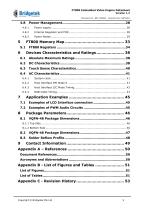
Figures and Tables: The datasheet includes numerous figures and tables that illustrate block diagrams, pin configurations, interface options, and timing specifications. Key tables include pin descriptions, memory maps, and power supply details.
Appendices: The appendices provide references to additional documents and a list of acronyms and abbreviations used throughout the datasheet.
See more

Catalog excerpts

FT800 (Embedded Video Engine)-1

FT800 Embedded Video Engine Datasheet Version 1.3 Document No.: BRT_000039 Bridgetek Pte Ltd FT800 (Embedded Video Engine) The FT800 is an easy to use graphic controller targeted for embedded applications to generate high-quality Human Machine Interfaces (HMIs). It has the following features: Support for LCD display in WQVGA (480x272) and QVGA (320x240) formats with data enable (DE) support mode and VSYNC/HSYNC mode FT800 functionality includes graphic controller, audio processing, and resistive touch controller. The FT800 calculates for 8-bit colour despite only providing pins for 6-bit (RGB-6,6,6); this improves the half tone appearance Embedded Video Engine (EVE) with widget support can offload the system MPU and provide a variety of graphic features Display enable control output to LCD panel Mono audio channel output with PWM output 64 voice polyphonic sound synthesizer Audio wave playback for mono 8-bit linear PCM, 4-bit ADPCM and µ-Law coding format at sampling frequency from 8 kHz to 48 kHz. Built-in digital filter reduces the system design complexity of external filtering PWM output for backlight dimming control for LED Low power consumption for portable application, 24mA active (typical) and 10-25 uA sleep (typical) No frame buffer RAM required Built-in graphics operations allow users with little expertise to create high-quality display Integrated with 4-wire touch-screen controller incorporating median filtering and touch force sensing. Hardware engine can recognize touch tags and track touch movement. It provides notification for up to 255 touch tags. Standard serial interface to host MPU/MCU with SPI up to 30MHz or I²C clocking up to 3.4MHz Programmable interrupt controller provides interrupts to host MPU/MCU Built-in 12MHz crystal oscillator with PLL providing 48MHz or 36MHz system clock Video RGB parallel output (default RGB data width of 6-6-6) with 2 bit dithering; configurable to support resolution up to 512x512 and LCD R/G/B data width of 1 to 6 Advanced object oriented architecture enables low cost MPU/MCU as system host using I2C and SPI interfaces Power mode control allows chip to be put in power down, sleep and standby states Supports host interface I/O voltage from 1.8V to 3.3V Internal voltage regulator supplies 1.2V to the digital core Available in a compact Pb-free, VQFN-48, 7mm X 7mm X 0.9mm package, RoHS compliant Programmable timing to adjust HSYNC and VSYNC timing, enabling interface to numerous displays Neither the whole nor any part of the information contained in, or the product described in this manual, may be adapted or reproduced in any material or electronic form without the prior written consent of the copyright holder. This product and its documentation are supplied on an as-is basis and no warranty as to their suitability for any particular purpose is either made or implied. Bridgetek Pte Ltd will not accept any claim for damages howsoever arising as a result of use or failure of this product. Your statutory rights are not affected. This product or any variant of it is not intended for use in any medical appliance, device or system in which the failure of the product might reasonably be expected to result in personal injury. This document provides preliminary information that may be subject to change without notice. No freedom to use patents or other intellectual property rights is implied by the publication of this document. Bridgetek Pte Ltd, 178 Paya Lebar Road, #07-03, Singapore 409030. Singapore Registered Company Num

 Open the catalog to page 1

FT800 (Embedded Video Engine)-2

FT800 Embedded Video Engine Datasheet Version 1.3 Document No.: BRT_000039 Clearance No.: BRT#001 1 Typical Applications • Point of Sales Machines • Multi-function Printers • Instrumentation • Home Security Systems • Graphic touch pad - remote, dial pad • Tele / Video Conference Systems • Phones and Switchboards • Medical Appliances • Blood Pressure displays • Heart monitors • Glucose level displays • Breathalyzers • Gas chromatographs Table 1- Video Controller Part Numbers Note: Packaging codes for x is: -R: Taped and Reel, (VQFN in 2500 pieces per reel) -T: Tray packing, (VQFN in 250 pieces...

 Open the catalog to page 2
FT800 (Embedded Video Engine)-3

FT800 Embedded Video Engine Datasheet Version 1.3 Document No.: BRT_000039 Figure 2-1 FT800 Block Diagram For a description of each function please refer to Section 4. Figure 2-2 FT800 System Design Diagram FT800 or EVE (Embedded Video Engine) simplifies the system architecture for advanced human machine interfaces (HMIs) by providing functionality for display, audio, and touch as well as an object oriented architecture approach that extends from display creation to the rendering of the graphics.

 Open the catalog to page 3
FT800 (Embedded Video Engine)-4

FT800 Embedded Video Engine Datasheet Version 1.3 Document No.: BRT_000039 Clearance No.: BRT#001

 Open the catalog to page 4
FT800 (Embedded Video Engine)-5

FT800 Embedded Video Engine Datasheet Version 1.3 Document No.: BRT_000039

 Open the catalog to page 5
FT800 (Embedded Video Engine)-6

Bridqetek FT800 Embedded Video Engine Datasheet Version 1.3 3 Device Pin Out and Signal Description 3.1 VQFN-48 Package Pin Out ccac ococoea: <300000 =BRT xxxxxxxxxx FT800Q YYWW-A Figure 3-1 Pin Configuration VQFN-48 (top view)

 Open the catalog to page 6
FT800 (Embedded Video Engine)-7

FT800 Embedded Video Engine Datasheet Version 1.3 Document No.: BRT_000039 Clearance No.: BRT#001

 Open the catalog to page 7
FT800 (Embedded Video Engine)-8

FT800 Embedded Video Engine Datasheet Version 1.3 Document No.: BRT_000039 Clearance No.: BRT#001

 Open the catalog to page 8
FT800 (Embedded Video Engine)-9

FT800 Embedded Video Engine Datasheet Version 1.3 Document No.: BRT_000039 Clearance No.: BRT#001

 Open the catalog to page 9
FT800 (Embedded Video Engine)-10

FT800 Embedded Video Engine Datasheet Version 1.3 Document No.: BRT_000039 Clearance No.: BRT#001 P : Power or ground I : Input OD : Open drain output I/O : Bi-direction Input and Output AI/O : Analog Input and Output

 Open the catalog to page 10
FT800 (Embedded Video Engine)-11

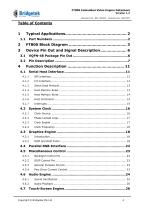
FT800 Embedded Video Engine Datasheet Version 1.3 Document No.: BRT_000039 4 Function Description The FT800 is a single chip, embedded graphic controller with the following function blocks:  Serial Host Interface  System Clock  Graphics Engine  Parallel RGB video interface  Audio Engine  Touch-screen Engine  Power Management The functions for each block are briefly described in the following subsections. 4.1 Serial Host Interface The FT800 uses a standard serial interface to communicate with most types of microcontrollers and microprocessors. The interface mode is configurable by pull...

 Open the catalog to page 11

All Riverdi catalogs and technical brochures

*Prices are pre-tax. They exclude delivery charges and customs duties and do not include additional charges for installation or activation options. Prices are indicative only and may vary by country, with changes to the cost of raw materials and exchange rates.