

Sediment Monitoring

Sediment Monitoring
The document discusses the RISONIC modular system for sediment monitoring with flow measurement, highlighting its benefits for hydropower plant operations and water resource management. Key advantages include continuous online monitoring, cost efficiency, equipment protection, and flood prevention.
Cost-efficient Monitoring
Effective sediment monitoring is crucial for maximizing productivity and ensuring revenue in hydropower plants. Sediments can damage turbines, leading to costly outages and repairs. Monitoring helps in early detection of potential risks, reducing turbine scuffing and storage sedimentation.
Technical and Ecological Importance
Research from ETH Zürich and the University of Lucerne indicates that ultrasound pulses can monitor suspended particles, offering technical, economic, and ecological benefits. This feature is applicable in closed pipe systems and open channels like canals and rivers.
Applications
The RISONIC modular system is applicable in hydro power, water supply, irrigation, and sewage water management.
System Features
The system uses a site-specific correlation table between signal attenuation and sediment concentration. Initial measurements are required to create this table, enhancing accuracy over time. Three threshold values can trigger alarms if sediment concentration is too high.
Configuration and Operation
No special hardware or software is needed for the new feature, only a simple configuration setup. The system uses the acoustic discharge measurement (ADM) method, with sensors sending and receiving ultrasonic waveforms to determine flow. Signal attenuation indicates sediment presence, which is evaluated by the RISONIC modular.
Alarm System
The system uses a window limit comparator to monitor signal strength. Three areas are defined: T3 for normal silt levels, T2 for high levels (warning issued), and T1 for dangerous levels (alarm issued). Thresholds can be set using reference instruments, operator experience, or offline analysis.
Conclusion
The RISONIC modular offers a cost-effective solution to reduce turbine abrasion due to sediment concentration, enhancing the efficiency and safety of hydropower operations.
Catalog excerpts

Sediment Monitoring With flow measurement RISONIC modular • continous online monitoring Hydro Power • cost efficient Water Supply Sewage Water • protection of equipment (turbine) • protection against flooding Cost-efficient monitoring When it comes to hydro power plant operation, maximum productivity and assured revenues come first. Therefor, it is essential to detect potential reasons for equipment damage at an early stage. This protects operators from the high costs due to power generation outage and the time-consuming and expensive replacement of damaged turbine parts. Sediments floating in the water are one of these potential risks for water turbines. They can scuff turbine parts and ultimately lead to a complete outage in the worst case. Monitoring sediment is important for the management of water resources, too. Sediment monitoring data can be used to determine effectiveness of sediment reduction actions in the watershed and guide adaptive sediment management. Research at the Swiss Federal Institute of Technology in Zurich (ETH Zürich) and the University of Lucerne have shown that the ultrasound pulses can also be used to monitor the amount of suspended particles in the water. This feature has many technical, economical and ecological importance for the operation of a hydropower plant as it can reduce turbine scuffing and storage sedimentation. In addition to closed pipe systems, this feature can also be used for sediment management programs for open channels such
Open the catalog to page 1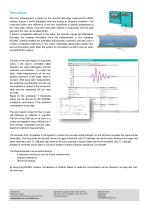
Description The flow measurement is based on the acoustic discharge measurement (ADM) method. Sensor A and B alternately send and receive an ultrasonic waveform. The measured transit time difference of the two waveforms is directly proportional to the mean path velocity. From the mean path velocity in conjunction with the pipe geometry the flow can be determined. If there is suspended sediment in the water, the acoustic signals get attenuated. Normally, this existing information from the measurement is not evaluated. RISONIC modular enables this evaluation and provides a powerful and easy way to...
Open the catalog to page 2All Rittmeyer catalogs and technical brochures
 We are Rittmeyer
16 Pages
 Rittmeyer BRUGG
2 Pages
 CLAMP-ON FLOW MEASUREMENT
2 Pages
 Flow Measurement
24 Pages
 Rittmeyer Consulting
1 Page
 RISONIC compact
2 Pages
 Tekapo Hydro Power Plant
2 Pages
 Instrumentation overview
6 Pages
 RIPOS / RIVERT
4 Pages


Archived catalogs
 Levelmeasurement
4 Pages
- Flowmeter
- Volume flow monitor
- Liquid flow monitor
- Angular encoder
- Pressure transmitter
- Analog pressure transmitter
- Waterproof flow meter
- Level probe
- Liquid level sensor
- Precision flow meter
- Absolute rotary encoder
- Relative pressure transmitter
- Water flow monitor
- Solid-shaft rotary encoder
- Analog level sensor
- Compact flow monitor
- Digital pressure transmitter
- DC flow monitor
- Flow meter with display
- Digital flow monitor