

6700 Remote Display

6700 Remote Display
The Ranger 6700 is a versatile remote display unit that can function as a simple display, a master for the Ranger 5000, or a summation device for multiple Ranger 5000s. It utilizes serially transmitted readings and supports RS232 or RS422/485 protocols. The manual includes instructions for basic and extended networking commands to control multiple units over a network.
This section provides wiring diagrams for connecting the 6700 in network slave mode, including pinout details for Serial Port 2 and configuration instructions such as setting the serial type, data source, baud rate, and address.
The basic command structure uses ASCII characters to simulate front panel key operations, including GROUP, ITEM, and SELECT key operations.
Extended commands offer comprehensive control over the 6700. Commands consist of three ASCII characters, while queries end with a question mark. Responses indicate command acceptance, with parameters being numeric or string-based.
This section details various commands such as setting unit addresses (ADR), enabling remote formats (AFE), altering remote format strings (AFT), and setting serial parameters (BDR), with parameter details and implementation examples.
The manual concludes with a section on ASCII codes used in command and query structures.
- CDL Set Zero: Sets zero dead load cancellation, affecting slave units, with a '?' returned if weight instability prevents operation.
- COF Set Output Format: Sets output format for MSV? query, with binary and ASCII options.
- CST? Get Serial Status: Queries serial port for received bytes, errors, and status indicators.
- DSR Set Serial Source: Configures serial data source for each port, supporting RS232 and RS422 protocols.
- ENU Set Units: Sets weight units for display and printing, including grams, kilograms, pounds, and tons.
- ESR? Query the Error Status: Retrieves current and latched error status, indicating communication errors.
- FLD Set/Query Data Fields: Allows setting and querying of data fields, including motion and status flags.
- IAD? Query Scale Build: Queries scale build parameters for remote units.
- IDN? Query Identification: Retrieves unit's identification string, including serial number, version, and model.
- MSV? Query Measured Weight Value: Queries weight readings with options for displayed, gross, and net weight, supporting continuous output mode.
- OPT Display Options: Sets the number of slave units connected to the master unit.
- RDT Run Display Test: Activates a dot test on the display to verify functionality.
- RES Reset: Performs a power-on reset of the unit.
- Sxx Select Unit: Selects units for communication, with functions for selecting all or no units.
- STP Stop Continuous Transfer: Stops continuous weight transmission initiated by the MSV?,0 command.
- TAR Tare: Forces a TARE operation, available in Network and Summing Master modes.
- TAS Gross / Net: Switches between gross and net weight display modes.
- TAV Set Tare Value: Sets a numeric tare value, applicable in Network Master mode.
- TDD Load/Save Setup: Saves or restores instrument settings, with options for loading default or previous settings.
- TYP Serial Type: Sets the serial type for each port, with options for Remote, Net Master, Sum Master, and other modes.
- WMD? Query Weighing Mode: Queries the weighing mode, indicating range settings for slave instruments.
- ASCII Codes: Provides a table of ASCII codes for control and printable characters, aiding in understanding data communication formats.
Catalog excerpts

6700 Remote Display Communications Manual For use with Software Version 3.0 6700-603 Rev 1.0
Open the catalog to page 1
RANGER 6700 - Reference Manual (6700-603 Rev 1.0)
Open the catalog to page 2
RANGER 6700 - Reference Manual (6700-603 Rev 1.0) The 6700 is a member of the latest generation of Ranger remote displays. The 6700 may be configured to operate as a simple remote display, a Master of the Ranger 5000 or a summer of several Ranger 5000s. The 6700 operates like a standard Ranger 5000 except that the weight information does not come from the load cell interface but from serially transmitted readings. The 6700 has two full duplex communications ports and one transmit only port providing the RS232 or RS422/485 protocols. The primary serial port is used to acquire weight readings,...
Open the catalog to page 3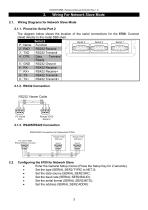
RANGER 6700 - Reference Manual (6700-603 Rev 1.0) Wiring For Network Slave Mode Wiring Diagrams for Network Slave Mode 2.1.1. Pinout for Serial Port 2 The diagram below shows the location of the serial connections for the 6700. Connect shield directly to the metal DB9 shell. Serial 2 Serial 3 Serial 2 Serial 1 P Name Function 1 2 3 4 5 1 2 3 4 5 1 2 3 4 5 2 RXD RS232 Receive 6 7 8 9 6 7 8 9 6 7 8 9 3 TXD RS232 Transmit 4 DTR Data Terminal Ready 5 GND RS232 Ground 6 RXRS422 Receive7 RX+ RS422 Receive+ 8 TXRS422 Transmit9 TX+ RS422 Transmit+ 2.1.2. RS232 Connection 2.1.3. RS485/RS422 Connection...
Open the catalog to page 4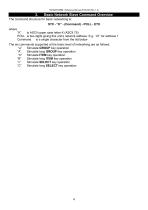
RANGER 6700 - Reference Manual (6700-603 Rev 1.0) Basic Network Slave Command Overview The command structure for basic networking is: STX - “K” - (Command) - POLL - ETX where “K” is ASCII upper case letter K (ASCII 75) POLL is two digits giving this unit’s network address. E.g. ‘01’ for address 1 Command is a single character from the list below The six commands supported at the basic level of networking are as follows: “a” Simulate GROUP key operation “A” Simulate long GROUP key operation “b" Simulate ITEM key operation “B” Simulate long ITEM key operation “c” Simulate SELECT key operation “C”...
Open the catalog to page 5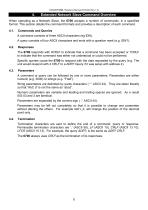
RANGER 6700 - Reference Manual (6700-603 Rev 1.0) Extended Network Slave Command Overview When operating as a Network Slave, the 6700 accepts a number of commands, in a specified format. This section details the command formats and provides a description of each command. 4.1. Commands and Queries A command consists of three ASCII-characters (eg IDN). A query consists of four ASCII characters and ends with a question mark (e.g. IDN?). Responses The 6700 responds with 0CRLF to indicate that a command has been accepted or ?CRLF to indicate that the command was either not understood or could not...
Open the catalog to page 6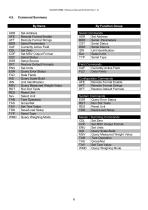
RANGER 6700 - Reference Manual (6700-603 Rev 1.0) Command Summary By Name Set Address Remote Format Enable Remote Format Strings Serial Parameters Currently Active Field Set Zero Set MSV Output Format Serial Status Serial Source Restore Default Formats Set Units Query Error Status Data Fields Query Scale Build Unit Identification Query Measured Weight Value Run Dot Tests Reset Unit Select Unit Tare Operation Gross/Net Set Tare Value Save/Load Setup Serial Type Query Weighing Mode Serial Commands ADR Set Address BDR Serial Parameters CST Serial Status DSR Serial Source IDN Unit Identification...
Open the catalog to page 7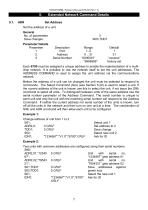
RANGER 6700 - Reference Manual (6700-603 Rev 1.0) Extended Network Command Details Set Address Set the address of a unit. General No. of parameters Save changes. Parameter Details Parameter 1 2 3 3 With TDD1 Description Port Address Serial Number Default 1 31 “xxxxxxx” factory set Each 6700 must be assigned a unique address to enable the implementation of a multidrop network. It is possible to use the network itself to set the unit addresses. The ADDRESS COMMAND is used to assign the unit address via the communications network. Before the address of a unit can be changed the unit must be selected...
Open the catalog to page 8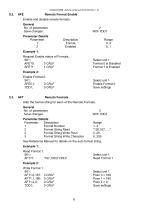
RANGER 6700 - Reference Manual (6700-603 Rev 1.0) Remote Format Enable Enable and disable remote formats. General No. of parameters Save changes. Parameter Details Parameter 1 2 2 With TDD1 Description Format Enabled Example 1: Request Enable status of Formats. S01; AFE?0; 0 CRLF AFE?1; 1 CRLF Select unit 1 Format 0 is Disabled Format 1 is Enabled Select unit 1 Enable Format 0 Save settings Remote Formats Alter the format string for each of the Remote Formats. General No. of parameters Save changes. Parameter Details Parameter Description 1 Format Number 2 Format String Read 2 Format String Write...
Open the catalog to page 9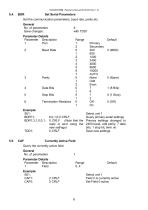
RANGER 6700 - Reference Manual (6700-603 Rev 1.0) Set the communication parameters, baud rate, parity etc. General No. of parameters Save changes. Parameter Details Parameter Description 1 Port 2 Baud Rate Data Bits Stop Bits Termination Resistors Select unit 1 6,0,1,0,0 CRLF Query primary serial settings 0 CRLF (Note that the Primary settings changed to reply is sent using the 2400 baud, odd parity, 7 data bits, 1 stop bit, term on. new settings) 0 CRLF Save new settings. Currently Active Field Query the currently active field. General No. of parameters Parameter Details Parameter Description...
Open the catalog to page 10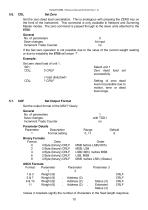
RANGER 6700 - Reference Manual (6700-603 Rev 1.0) Set the zero dead load cancellation. This is analogous with pressing the ZERO key on the front of the instrument. This command is only available in Network and Summing Master modes. The zero command is passed through to the slave units attached to the 6700. General No. of parameters Save changes. Increment Trade Counter If the Set zero operation is not possible due to the value of the current weight reading or due to instability the 6700 will return ‘?’. Example: Set zero dead load of unit 1. S01; CDL; 0 CRLF CDL; Select unit 1 Zero dead load...
Open the catalog to page 11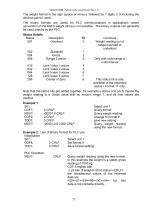
RANGER 6700 - Reference Manual (6700-603 Rev 1.0) The weight format is the sign (space or minus), followed by 7 digits 0..9 including the decimal point if used. The binary formats are useful for PLC communications in applications where conversion of the ASCII weight string is not possible. The binary outputs can generally be used directly by the PLC. Status Details Status 001 Description Overload Standstill Gross Range 2 active Limit Value 1 active Limit Value 2 active Limit Value 3 active Limit Value 4 active Center of Zero Comment Weight reading out of range overload or underload Only with...
Open the catalog to page 12All Rinstrum catalogs and technical brochures
 D730
D73012 Pages
 C500 Series
7 Pages
 H6G5 Single Point
1 Page
 H6F Single Point
1 Page
 H6G Single Point
1 Page
 H6E Single Point
1 Page
 B6Q Single Point
1 Page
 B6N Single Point
1 Page
 B6M6G Single Point
1 Page
 B6M6E Single Point
1 Page
 B6M6A Single Point
1 Page
 B6G5 Single Point
1 Page
 B6G Single Point
1 Page
 B6F Single Point
1 Page
 B6E3 Single Point
1 Page
 B6E Single Point
1 Page
 Hanging Scale
2 Pages
 D730 LED Remote Display
2 Pages
 R400 Series
14 Pages
 R300 Series Indicators
4 Pages
 D640
D6402 Pages
 D series
4 Pages
 XD30
XD302 Pages
 R300 Series
6 Pages



- LCD display panel
- Industrial display panel
- Real-time software
- IO module
- Digital indicator
- Analog I/O
- LED display panel
- Measurement software
- Stainless steel balance
- Platform balance
- Visualization software solution
- Weighing terminal
- Backlit display panel
- LED-backlit display panel
- Programmable display system
- Analog IO module
- Metal stand
- Digital weight indicator-transmitter
- Serial I/O