
- Catalogs
- RIGCHINA GROUP COMPANY
- 12 Speed Viscometer


- Products
- Catalogs
- News & Trends
- Exhibitions
12 Speed Viscometer

12 Speed Viscometer
The 12 Speed Electric Rheometer (Model RC-12D) is designed for assessing the rheological properties of both Newtonian and non-Newtonian fluids. It features a digital display, pre-programmed API tests, and a 12-speed range. Key components include the R1 Rotor Sleeve, B1 Bob, F1 Torsion Spring, and a stainless steel sample cup, all adhering to API RP 13B-1/ISO 10414-1 specifications.
Operators must adhere to safe laboratory practices. The instrument operates on 220V, 50/60 Hz power. Heated sample cups should not exceed 200°F (93°C), and proper hand protection is necessary to prevent burns.
The RC-12D Rheometer includes preprogrammed API tests, a secure fit for rotor and bob, and a pushbutton design. It operates within a temperature range of 40°F to 125°F and requires a power supply of 220 VAC, 50/60 Hz. The instrument's dimensions are 51 x 35 x 24 cm, and it weighs 15 kg.
The rheometer should be positioned for easy access to the power cord. Bob removal and installation involve turning the bob counterclockwise to remove and clockwise to install. Adequate storage for tools and consumables should be considered.
To operate, add 350 ml of sample to the sample cup. The instrument is controlled via a keypad with preset speeds. During testing, speed, dial reading, and viscosity are displayed. The rheometer should be turned off after use.
Calibration involves deadweight or fluid calibration methods. The shear stress measuring range and viscosity range are specified for different torsion springs and rotor-bob combinations.
Viscosity calculations follow API RP 13B-1/ISO 10414-1 standards. Newtonian viscosity is calculated using a specific equation involving speed factor, dial reading, spring factor, and rotor-bob factor. Plastic viscosity and yield point are determined using dial readings at different speeds.
Regular maintenance and troubleshooting guidelines are provided to ensure the instrument's optimal performance.
The document outlines the warranty terms and return procedures for the instrument.
Torsion springs are characterized by their constant (k1), factor (f), and maximum shear stress. The table provides specifications for different torsion springs, including their color codes, which range from green to orange, indicating varying levels of torsion spring constant and maximum shear stress.
The document details the use of a 12-speed electric rheometer (viscometer) for measuring viscosity. It includes equations for calculating viscosity using constants and conversion factors provided in tables. The equations consider factors like torsion spring factor, shear stress, and shear rate.
Viscosity is calculated using specific equations that incorporate constants for the instrument and torsion spring assembly. The document provides detailed equations and conversion factors necessary for accurate viscosity measurement.
Tables outline the measuring ranges for shear stress, shear rate, and viscosity for different rotor-bob combinations. These tables help in determining the appropriate settings and expected ranges for measurements.
For troubleshooting and maintenance, contact information for Rigchina Group Company is provided.
Details on spare parts and electronics assembly are mentioned, although specifics are not provided in the excerpt.
Rigchina Group Company offers a 12-month warranty on its products, covering defects in material and workmanship. The document outlines the process for returning items, including the need for authorization and proper packaging to prevent damage during shipment.
Contact details for Rigchina Group Company, including their address, phone number, and email for sales and after-sales service, are provided.
Catalog excerpts

DRILLNG FLUID TESTING INSTRUMENTATION 12 Speed Electric Rheometer(Viscometer) 12 Speeds Electric Rheometer Model RC-12D Instruction Manual
Open the catalog to page 1
DRILLNG FLUID TESTING INSTRUMENTATION 12 Speed Electric Rheometer(Viscometer)
Open the catalog to page 2
DRILLNG FLUID TESTING INSTRUMENTATION 12 Speed Electric Rheometer(Viscometer) 1. Introduction The 12 Speeds Electric Rheometer is a direct-reading instrument for evaluating the rheological properties of fluids, Newtonian and non-Newtonian. The advantages of the RC-12D viscometer are its digital display, pre-programmed API tests and speed range - 12 preset. This design includes a R1 Rotor Sleeve, B1 Bob, F1 Torsion Spring, and a stainless steel sample cup for testing according to American Petroleum Institute Recommended Practice for Field Testing Water Based Drilling Fluids, API RP 13B1/ISO...
Open the catalog to page 3
DRILLNG FLUID TESTING INSTRUMENTATION 12 Speed Electric Rheometer (Viscometer) 2. Safety Safe laboratory practices and procedures should be observed while operating and maintaining the 12 speed Rheometer. This section lists some precautions to follow. 2.1 Safe Electrical Operation This instrument is driven by 220V, 50/60 Hz electrical power. Heated sample cups and recirculating sample cups (optional) are electrically heated. Make sure the power and other wiring associated with this rheometer and electrically heated sample cups are in good condition and properly grounded. Keep hands, clothes...
Open the catalog to page 4
DRILLNG FLUID TESTING INSTRUMENTATION 12 Speed Electric Rheometer (Viscometer) The Model RC-12D 12 speed Rheometer comes with the standard R1 rotor sleeve, B1 bob, F1 torsion spring, and a stainless steel sample cup. Its features include the following: Preprogrammed API tests— API drilling fluid and API cement Secure fit, left-hand turn for rotor and right-hand turn for bob to help prevent disconnection when measuring high viscosity fluids Pushbutton design for easier operation Table 3-1 RC-12D Rheometer, Specifications
Open the catalog to page 5
DRILLNG FLUID TESTING INSTRUMENTATION 12 Speed Electric Rheometer (Viscometer) Table 3-3 Rotor-Bob Specifications
Open the catalog to page 6
DRILLNG FLUID TESTING INSTRUMENTATION 12 Speed Electric Rheometer (Viscometer) 4. Installation The RC-12D Rheometer should be placed where there is easy access to the power cord plug for disconnection. Bob Removal and Installation To remove or install the bob, urn the bob counterclockwise (left) to remove it and clockwise (right) to install it (righthand-threads). Consideration should be given to the location where samples are prepared and equipment is cleaned when the test is completed. There should be sufficient storage area nearby for commonly used tools, as well as consumables.
Open the catalog to page 7
DRILLNG FLUID TESTING INSTRUMENTATION 12 Speed Electric Rheometer (Viscometer) 5. Operation To start a test, add 350 ml of sample to the stainless steel sample cup. The sample cup has a line that marks 350 ml. A scribed line on the rotor indicates proper immersion depth. Damage to the bob shaft bearing may occur if the immersion depth is exceeded. If other sample holders are used, the space between the bottom of the rotor and the bottom of the sample holder should be one-half inch (1.27cm) or greater. This instrument is operated through a keypad (Figure 5-1). The keypad functions are summarized...
Open the catalog to page 8
DRILLNG FLUID TESTING INSTRUMENTATION 12 Speed Electric Rheometer (Viscometer) PIGCHINA Plug the power supply into a 220V, 50/60 HZ power source. Connect the power supply to rear of the rheometer. Turn on the power switch. The LED backlight will show and the following screens will appear. After a few seconds, the machine enters the operating mode. The LED backlight display lists the speed (RPM). 5.2 Manual Operating Instructions Choosing speeds Press white number keys to select preset speeds: 0.9, 1.8, 3,30,60,90,100,180, 200, 300 or 600 Shutting down the rheometer Turn the power switch (side...
Open the catalog to page 9
DRILLNG FLUID TESTING INSTRUMENTATION 12 Speed Electric Rheometer(Viscometer) 6. Initiating Sensor Calibration 6.1 Deadweight or fluid calibration. (Figure 6-1)
Open the catalog to page 10
DRILLNG FLUID TESTING INSTRUMENTATION 12 Speed Electric Rheometer (Viscometer)
Open the catalog to page 11
DRILLNG FLUID TESTING INSTRUMENTATION 12 Speed Electric Rheometer (Viscometer) Dial Range Dial Range Table 6-3 Shear Rate Measuring Range for Viscometers Rate of Revolution of Outer Cylinder, N (rpm) Shear Rate Range (sec-1), = k3N Rotor-Bob Combinations R1 B1 Table 6-4 Viscosity Range in Centipoise for RIGCHINA Direct Indicating Viscometers Viscosity (cP) (1) RIGCHINA Model All Models, 600 rpm max Minimum Viscosity (2) RC-35D 3 rpm min Maximum Viscosity(4) RC-12D 0.9 rpm min Maximum Viscosity(4)
Open the catalog to page 12
DRILLNG FLUID TESTING INSTRUMENTATION 12 Speed Electric Rheometer (Viscometer) Notes: 1) Computed for standard Torsion Spring (F1). For other torsion springs multiply viscosity range by f factor. 2) Minimum viscosity is computed for minimum shear stress and maximum shear rate. 3) For practical purposes the minimum viscosity is limited to 0.5 cP because of Taylor Vortices. 4) Maximum viscosity is computed for maximum shear stress and minimum shear rate. 6.2 Fluid Calibration Check From the list (Figure 5-9), press 1 to select fluid calibration.Use a 200 cp standard.
Open the catalog to page 13
DRILLNG FLUID TESTING INSTRUMENTATION 12 Speed Electric Rheometer (Viscometer) 7. Test Analysis This section explains how to obtain the test results, which includes reading values from the viscometer and performing calculations. The reference for measuring viscosity and performing calculations is API Recommended Practice for Field Testing Water Based Drilling Fluids, API RP 13B-1/ISO 10414-1. 7.1 Newtonian Viscosity Calculation The Newtonian viscosity in centipoise (cP) may be read directly from the dial when the viscometer speed is 300 rpm and the rotor-bob-torsion spring combination...
Open the catalog to page 14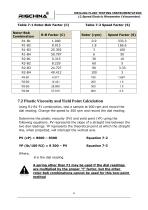
DRILLNG FLUID TESTING INSTRUMENTATION 12 Speed Electric Rheometer (Viscometer) Table 7-1 Rotor-Bob Factor (C) Table 7-2 Speed Factor (S) 7.2 Plastic Viscosity and Yield Point Calculation Using R1-B1-F1 combination, test a sample at 600 rpm and record the dial reading. Change the speed to 300 rpm and record the dial reading. Determine the plastic viscosity (PV) and yield point (YP) using the following equations. PV represents the slope of a straight line between the two dial readings. YP represents the theoretical point at which the straight line, when projected, will intercept the vertical...
Open the catalog to page 15All RIGCHINA GROUP COMPANY catalogs and technical brochures
 6 Speed Viscometer
23 Pages
 Garrett Gas Train
28 Pages
 Core Saturator
4 Pages
 Mechanical Dynamometer 2016
3 Pages
 Deadline Anchors
11 Pages
 Weight Indicator systems
11 Pages
 PRESSURE GAUGE MODEL 8
5 Pages
 MUD PUMP PRESSURE GAUGES
19 Pages
 DRILLING INSTRUMENTATION
38 Pages
 Oil and Water Retort Kit
19 Pages


- Kiln
- Dynamic agitator
- Chamber kiln
- Measuring device
- Electric furnace
- Heat treatment kiln
- Chiller
- Batch agitator
- Test stand
- Pressure gauge
- Calibration system
- Solids analyser
- Liquid recirculation chiller
- Liquid homogenizer
- Analog pressure gauge
- Stainless steel homogenizer
- Laboratory shaker
- Laboratory kiln
- Weighing terminal
- Real-time analyzer