
- Catalogs
- Riels Instruments
- Temperature Sensors

Temperature Sensors

Temperature Sensors
Temperature is a measure of a system's thermal state, indicating its ability to exchange heat. Measurements are typically indirect, using effects like thermal expansion.
The Thermocouple
Thermocouples, discovered by T.J. Seebeck, use the thermoelectric effect with two different metals to generate a current proportional to temperature differences. They are reliable and versatile, often insulated with mineral oxide.
Types of Thermocouples
Thermocouples are categorized by type, temperature range, and tolerance. For instance, Type T operates from -40°C to 350°C, while Type R/S can measure up to 1600°C. Specific cables are required for signal transmission.
Resistance Thermometer
Developed by H.L. Callender, the Platinum Resistance Thermometer (Pt100) is precise, using platinum's resistance change with temperature for measurement.
Accuracy and Standards
International standards like IEC 584 and IEC 751 define the characteristics of temperature sensors, providing conversion tables and accuracy classes.
Choosing the Right Sensor
Selection involves considering maximum temperature, conditions, and environmental factors. Sensors need protection from atmospheric damage.
Advantages and Disadvantages
Thermocouples are cost-effective but non-linear. Resistance thermometers are accurate but expensive. Thermistors respond quickly but have limited ranges.
Conclusion
Comites offers a range of sensors for industrial needs, ensuring reliable and precise temperature measurement.
- Thermocouple Models (T1-T11): Designed for specific applications with various sheath materials and configurations.
- Hot Junction Types: Options include isolated and grounded junctions, affecting response time and noise immunity.
- Process Connections: Includes sliding and welded flanges with different thread sizes.
- Signal Transmitters: Some models include a 4-20mA transmitter for system integration.
- Options and Accessories: Available for single-element configurations, with references for further details.
- Sheath Material: Crucial for compatibility with the environment and temperature range.
- Element Type: Specifies thermocouple types suitable for different ranges.
- Immersion Length: Critical for accurate measurement and installation.
- Flange Codes: Provided for process connections, with detailed specifications referenced.
- Model T12-T18: Various configurations for high-temperature and specific industrial applications.
- Model S1 and S2: Skin point thermocouples for high temperatures.
- Model R1-R4: Resistance thermometers with different configurations and applications.
- Sheath Diameter and Material: Ranges from 3mm to 15mm, with various materials.
- Element Types and Connections: Includes Pt100, Pt1000, and Ni100 with multiple connection options.
- Process Connections: Threaded and flanged options available.
- Signal Transmitters: Equipped with 4-20mA transmitters for system integration.
- Model Variations: Features like removable inserts and different head types.
- Applications: Suitable for industrial, food, and pharmaceutical environments.
- Options and Accessories: Includes single or double elements and various cable types.
- Model BA1-BA8: Various thermowell designs with specific material and connection options.
- Model TU1-TU5: Thermowells for specific industries with detailed specifications.
Devices for mounting on probes or DIN rails, amplifying signals with outputs of 4-20mA or 0-10V, offering features like linearization and PC programmability.
Used for thermocouples and thermoresistances, available with multiple terminal blocks.
Provide reliable connections for thermocouple cables, preventing spurious thermocouples.
Available with GAS and NPT threads, accommodating various sheath diameters.
Made from INOX ASTM A-105, available in various diameters and ratings.
Catalog excerpts

Sensori di Temperatura Temperature Sensors Temperature Sensors - Riels Instruments
Open the catalog to page 1
INTRODUZIONE / INTRODUCTION LA TEMPERATURA La temperatura è una grandezza fisica che esprime lo stato termico di un sistema e che descrive la sua attitudine a scambiare calore con l'ambiente o con altri corpi. Quando due sistemi sono posti a contatto termico, il calore fluisce dal sistema a temperatura maggiore a quello a temperatura minore fino al raggiungimento dell'equilibrio termico,in cui i due sistemi si trovano alla stessa temperatura. Per ottenere misure di temperatura si sfruttano generalmente metodi indiretti basati sugli effetti di processi di riscaldamento o raffreddamento; il metodo...
Open the catalog to page 2
TIPI DI TERMOCOPPIA La termocoppia è un sensore che può essere realizzato saldando i due conduttori tra loro, isolandoli opportunamente con materiale idoneo a sopportare la temperatura a cui è esposto, oppure con la tecnologia più evoluta dell'isolamento in "Ossido minerale". Quest’ultima modalità costruttiva, conferisce al sensore caratteristiche meccaniche e termoelettriche di massima affidabilità e facilità di applicazione consentendo così innumerevoli possibilità di impiego in tutti i settori. TYPES OF THERMOCOUPLE The Thermocouple is a sensor that can be either made welding the two conductors...
Open the catalog to page 3
I CAVI DI ESTENSIONE E COMPENSAZIONE EXTENSION AND COMPENSATING CABLES Ogni tipo di Termocoppia necessita di un adeguato mezzo di trasmissione del segnale per poter essere collegata alla strumentazione e specificatamente di cavi di estensione o di compensazione, come evidenziato nella tabella seguente. Every type of Thermocouple needs a suitable signal of transmission to be connected to the instrumentation and specifically of extension cables or compensating cables, as per following chart. CODICI COLORI PER CAVI DI ESTENSIONE E COMPENSAZIONE EXTENSION AND COMPENSATING CABLES COLOUR TABLE Tipo...
Open the catalog to page 4
RESISTANCE THERMOMETER Nel 1871 Sir William Siemens, fondatore dell'omonimo colosso industriale, descrisse durante una lezione presso la Royal Sciety di Londra il primo pirometro fondato sulla resistenza elettrica di un filo di Platino avvolto. Successivamente il fisico inglese H.L. Callender studiò e sviluppò il "Termometro a resistenza di Platino" realizzando uno strumento destinato a diventare il più preciso dei termometri oggi in uso, il cui principio di funzionamento si basa sulla variazione del valore di resistenza di un metallo al variare della temperatura a cui è sottoposto. Il valore...
Open the catalog to page 5
Le caratteristiche termoelettriche di ogni sensore sono definite dalle normative internazionali, International Electrotechnical Commission (IEC), 584-1 584-2 per le Termocoppie e 751 per i termometri a resistenza di Platino, all'interno delle quali ritroviamo le tabelle di conversione e le corrispondenti "Classi di tolleranza" The thermoelectric characteristics of every sensor are defined by the standards, International Electrotechnical Commission (IEC), 584-1 584-2 for the Thermocouples and 751 for platinum resistance thermometers where the Conversion tables and relative “Accuracy Classes” are...
Open the catalog to page 6
La Temperatura è la grandezza fisica più monitorata nei processi industriali, ne consegue che ogni sensore va scelto accuratamente, tenendo conto degli innumerevoli fattori presenti in ogni processo. Principalmente si devono considerare i valori di temperatura massima, temperatura di esercizio, pressione di esercizio e atmosfera di processo. A fronte di ciò si procede alla valutazione del sensore in tutte le sue caratteristiche termoelettriche e meccaniche. Ogni sensore di temperatura, deve essere protetto, con guaine specifiche anche di materiale pregiato o accoppiata a componenti meccaniche...
Open the catalog to page 7
MODELLO / MODEL T1 Termocoppia / Thermocouple Termocoppia per la rilevazione di temperatura in Thermocouple for industrial environment. Mineral oxide insulation with continuous external processi industriali. Esecuzione con isolamento in Ossido minerale (MgO) sheath for high temperature with terminal head. con guaina esterna continua in acciaio inossidabile per alte temperature con testa di collegamento. Cod. T1 ... Versione / Version Numero Elemento / Element Number Singolo / Single 1 Doppio / Duble 2 A Tipo Elemento / Element Type Cu-CuNi T Fe-CuNi J NiCr-CuNi E NiCr-Ni K NiCr-NiCrSi N Giunto...
Open the catalog to page 8
MODELLO / MODEL T2 Termocoppia / Thermocouple Termocoppia per la rilevazione di temperatura in processi industriali. Esecuzione con isolamento in Ossido minerale (MgO) con guaina esterna continua in acciaio inossidabile per alte temperature con connettore compensato. Thermocouple for industrial environment. Mineral oxide insulation with continuous external sheath for high temperature with compensating connector. Versione / Version Senza Raccordo Without fitting Raccordo Scorrevole Compression fitting Numero Elemento / Element Number Singolo / Single 1 Doppio / Double 2 Tipo Elemento / Element...
Open the catalog to page 9
Inserto Termometrico / Thermometric Insert Inserto termometrico. Esecuzione con isolamento in Ossido minerale (MgO) con guaina esterna continua in acciaio inossidabile per alte temperature con basetta in ceramica. Thermometric insert. Mineral oxide insulation with continuous external sheath for high temperature with ceramic socket. Numero Elemento / Element Number Singolo / Single 1 Doppio / Double 2 Tipo Elemento / Element Type Cu-CuNi T Fe-CuNi J NiCr-CuNi E NiCr-Ni K NiCr-NiCrSi N Giunto Caldo / Hot Junction Isolato / Ungrounded I A Massa / Grounded M Diametro Guaina / Sheath Diameter 2mm(*)...
Open the catalog to page 10
MODELLO / MODEL T4 Termocoppia / Thermocouple Termocoppia per la rilevazione di temperatura nei processi industriali. Esecuzione con isolamento in Ossido minerale (MgO) con guaina esterna continua in acciaio inossidabile per alte temperature con fili liberi. Versione / Version Senza Raccordo Without fitting Raccordo Scorrevole Compression fitting Thermocouple for industrial environment. Mineral oxide insulation with continuous external sheath for high temperature with free wires. Numero Elemento / Element Number Singolo / Single 1 Doppio / Double 2 Tipo Elemento / Element Type Cu-CuNi T Fe-CuNi...
Open the catalog to page 11All Riels Instruments catalogs and technical brochures
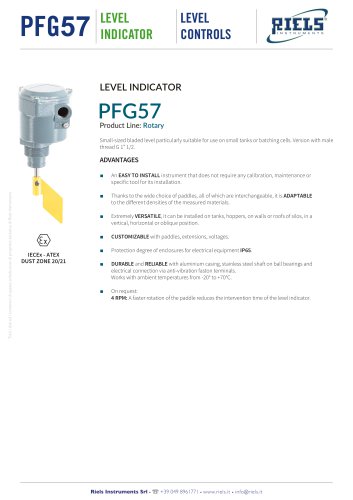 PFG57 LEVEL INDICATOR
2 Pages
 DEEPER
1 Page
 RIV110 Flow switch
2 Pages
 miniELCOR
4 Pages
 EL-USB-4
5 Pages
 EE33
EE336 Pages
 EE300Ex-HT
6 Pages
 AVFM 5.0
3 Pages
 EE 75
EE 755 Pages
 EE776
EE7766 Pages
 EE771/2
6 Pages
 TRICOR
15 Pages
 SE 404 X SE 406 X
2 Pages
 FFU
FFU7 Pages
 RIF600W
4 Pages
 RIF180
3 Pages
 MC 505
1 Page
 HM-R
HM-R3 Pages
 HD408T
2 Pages
 RIB300
3 Pages
 23/25 ED
2 Pages
 RIB180
4 Pages
 FLD48
FLD482 Pages
 CLM-36
6 Pages
 DLM-35
2 Pages
 DLS-27
7 Pages
 CLS-23
5 Pages
 PFG05/ATFHV60
2 Pages
 LFP
LFP2 Pages
 GRLM70
9 Pages
 RIL600
5 Pages
 LITTLE EX
1 Page
 MATIC/V/MC
2 Pages
 DCX22
DCX222 Pages
 RIV165 Paddle Flow Switches
2 Pages
 RIV170 Paddle Flow Switch
2 Pages
 RIV150 Flow switch
2 Pages
 Riels® Instruments Catalog
24 Pages
 MN03
MN031 Page
 LEO RECORD
2 Pages
 EV220B
13 Pages
 WWG
WWG1 Page
 FAM_Air_flowmeter_riels
1 Page


- Valve
- Control valve
- Stainless valve
- Flowmeter
- Ball valve
- Pneumatic valve
- Volume flow monitor
- Liquid flow monitor
- Force sensor
- Electrically operated valve
- Gas analyzer
- Regulating valve
- Concentration analyzer
- Data logger
- Resistance temperature sensor
- Electric valve
- Pressure transmitter
- Liquids analyzer
- Gas solenoid valve