
- Catalogs
- Riels Instruments
- RIV915 Flow control with floating ball Riels® Instruments

RIV915 Flow control with floating ball Riels® Instruments

RIV915 Flow control with floating ball Riels® Instruments
- Body Material: Brass with internal threading for connection.
- Floating Ball: Made of PP (Moplen) with a ring.
- Glass: Tempered for durability.
- Operating Temperature: Ranges from -10°C to +100°C.
- Maximum Operating Pressure: 16 bar.
- Seal: Standard Nitrile, with Viton available upon request.
- Ensure the valve is installed following the flow direction indicated by the arrow on the body.
- Use a material compatible with the fluid to seal the threads.
- Screw the valve onto the threaded tubes using the hexagonal parts for proper locking.
- Support piping with heavy clamps to prevent stress on the valve.
- Open upstream shutoff devices slowly to avoid water hammer.
- RIV915-10: 3/8" GAS connection
- RIV915-15: 1/2" GAS connection
- RIV915-20: 3/4" GAS connection
- RIV915-25: 1" GAS connection
Catalog excerpts

FLOW CONTROL WITH FLOATING BALL FLOW CONTROLS RIV915 brass sight glass with temperated glass and Moplen floating ball Made for the control of movement of liquids, they are suitable for the passage of water; oils, gasoline, diesel and all other liquids except for corrosive ones. - Brass made body and internal thread for the connection. - Mobile Sphere made of PP (Moplen) with ring. - Glass tempered. - Operating temperature : -I0+I00°C. - Maximum operating pressure : 16 bar - Nitrile Standard seal (Viton on request). For a correct mounting the valve must be installed following the flow direction indicated by the arrow engraved on the body Use to seal the threads of a material compatible with the fluid used. On order to mantain the watertight on the threads,a material compatible with the fluid must be used. Screw the valve on the threaded tubes by positioning the key exclusively on the special hexagonal parts up to the locking of the valve on the tube. After connecting the valve to the pipes, make sure the valve does not suffer stress due to piping, so use of heavy clamps to support the piping. Slowly open the upstream shutoff devices to prevent water hammer All data and contents of this sheet are the exclusive property of Riels Instruments
Open the catalog to page 1All Riels Instruments catalogs and technical brochures
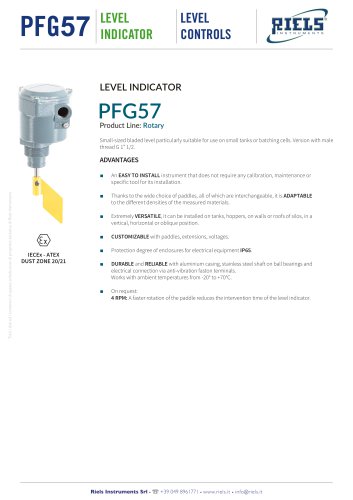 PFG57 LEVEL INDICATOR
2 Pages
 DEEPER
1 Page
 RIV110 Flow switch
2 Pages
 miniELCOR
4 Pages
 EL-USB-4
5 Pages
 EE33
EE336 Pages
 EE300Ex-HT
6 Pages
 Temperature Sensors
64 Pages
 AVFM 5.0
3 Pages
 EE 75
EE 755 Pages
 EE776
EE7766 Pages
 EE771/2
6 Pages
 TRICOR
15 Pages
 SE 404 X SE 406 X
2 Pages
 FFU
FFU7 Pages
 RIF600W
4 Pages
 RIF180
3 Pages
 MC 505
1 Page
 HM-R
HM-R3 Pages
 HD408T
2 Pages
 RIB300
3 Pages
 23/25 ED
2 Pages
 RIB180
4 Pages
 FLD48
FLD482 Pages
 CLM-36
6 Pages
 DLM-35
2 Pages
 DLS-27
7 Pages
 CLS-23
5 Pages
 PFG05/ATFHV60
2 Pages
 LFP
LFP2 Pages
 GRLM70
9 Pages
 RIL600
5 Pages
 LITTLE EX
1 Page
 MATIC/V/MC
2 Pages
 DCX22
DCX222 Pages
 RIV165 Paddle Flow Switches
2 Pages
 RIV170 Paddle Flow Switch
2 Pages
 RIV150 Flow switch
2 Pages
 Riels® Instruments Catalog
24 Pages
 MN03
MN031 Page
 LEO RECORD
2 Pages
 EV220B
13 Pages
 WWG
WWG1 Page
 FAM_Air_flowmeter_riels
1 Page


- Control valve
- Stainless valve
- Flowmeter
- Ball valve
- Temperature probe
- Pneumatic valve
- Volume flow monitor
- Liquid flow monitor
- Force sensor
- Electrically operated valve
- Gas analyzer
- Regulating valve
- Concentration analyzer
- Data logger
- Resistance temperature sensor
- Electric valve
- Pressure transmitter
- Liquids analyzer
- Gas solenoid valve