
- Catalogs
- Richter Chemie Technik
- Safety valves

- Products
- Catalogs
- News & Trends
- Exhibitions
Safety valves

Safety valves
- Set pressures range from 0.1 to 13 bar (1.45-188 psig).
- Operating temperature up to 180 °C (360 °F).
- Suitable for corrosive media where metallic materials are inadequate.
- Special design for chlorine plants and high-purity media.
- Direct-acting, spring-loaded, bellows safety valve with angle-type valve body.
- Complies with German AD 2000 Code for pressure vessels.
- High discharge coefficients and capacity due to streamlined flow parts.
- ASME/Sect. VIII, Div. 1 certified safety valve KSEA available.
- Valve body made of ductile cast iron with PTFE lining.
- Bellows made of modified TFM-PTFE for enhanced permeation resistance.
- Optional antistatic lining and highly permeation-resistant PFA-P lining available.
- Protection against excessive pressure in pressure vessels and plants.
- Suitable for chlorine electrolysis and metal-reactive media.
- Adaptable to discharge mass flow with lift reduction.
- Flanges to DIN EN 1092-2 shape B, PN 16, with optional ASME (ANSI) flanges.
- Certified discharge coefficients for high discharge capacities.
- Back pressures for vapours/gases max. 30%, for liquids max. 50% of set pressure.
- Formulas for valve sizing provided according to AD 2000 and DIN 3320 standards.
- Contact details for Richter Chemie-Technik GmbH included for further inquiries.
Catalog excerpts

Certified for vapours, gases and liquids Corrosion-resistant PTFE/PFA TFM-PTFE bellows sealed Special design for chlorine plants RICHTER Process Pumps & Valves #£sr
Open the catalog to page 1
KSE Safety in corrosive and high purity applications Only one certification for vapours, gases and liquids. Your advantages: increased flexibility, no mix-ups of single components, reduced storage requirement Range of application • Protection of pressure vessels and plants against excessive pressure, set pressures of 0.1 to 13 bar (1.45-188 psig) • Operating temperature up to 180 °C (360 °F) • Corrosive media where metallic materials cannot attain an adequate service life or special metals cause high costs • Chlorine electrolysis • Pure and high-purity media • Metal-reactive media, e.g. H2O2, electronic...
Open the catalog to page 2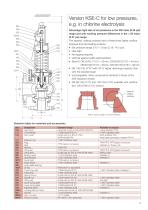
Version KSE-C for low pressures, e.g. in chlorine electrolysis Advantage: tight also at set pressures in the 250 mbar (0.36 psi) range and with working pressure differences in the < 50 mbar (0.07 psi) range The tapered sealing surfaces have a three times higher surface pressure than flat sealing surfaces. • Set pressure range 0.15-1.0 bar (2.18-14.5 psi) • Gas-tight • No lapping required • Optimal against solids sedimentation • Seat 0: DN 25/50 (1“/2“) = 22 mm, DN 50/80 (2“/3“) = 40 mm, DN 80/100 (3“/4“) = 50 mm, DN 100/150 (4“/6“) = 95 mm • DN 100/150 (4“/6“) with 40 % higher discharge capacity...
Open the catalog to page 3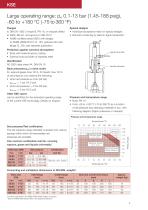
Flanges to DIN EN 1092-2 shape B, PN 16, on request drilled to ANSI, BS etc. and groove to DIN 2512 • ASME-certified series KSEA with flanges to ASME (ANSI) B16.5 Cl. 150, optional with inlet flange Cl. 300, see separate publication Protection against corrosive atmosphere • Body with external epoxy coating • External nuts and bolts of stainless steel Identification AD 2000 data sheet A4, DIN EN 19 Back pressures pa0 in valve outlet for vapours/gases max. 30 %, for liquids max. 50 % of set pressure, but observe the following: • when set pressure < 4 bar (58 psi), pa0 max. = 1 bar (14.5 psi) •...
Open the catalog to page 4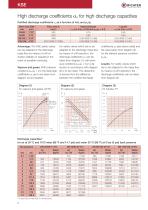
Advantage: The KSE safety valves can be adapted to the discharge mass flow by means of a lift reduction (details on request) in the event of possible oversizing. Vapours and gases: With pressure conditions p^M) > 0.2 the discharge coefficients ad are to be taken from diagram (2) and applied. For safety valves which are to be adapted to the discharge mass flow by means of a lift reduction, the discharge coefficients ad can be taken from diagram (1); with pressure conditions pa0/p0 > 0.2 a deduction in accordance with diagram (2) is to be made. This deduction is derived from the difference between...
Open the catalog to page 5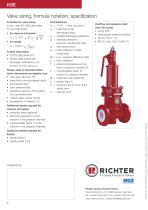
Valve sizing, formula notation, specification Formulas for valve sizing (in acc. with AD 2000 data sheet A 2 and DIN 3320) • for vapours and gases Further information • VdTUV data sheet 871 • Richter data sheets with discharge coefficients ad as function of h/d0 and p0-pa0 Please state in inquiries/orders (other dimensions acceptable, too): • valve type, DN size, PN • mass flow to be discharged (kg/h) • set pressure (bar) • back pressure (bar) • operating pressure of the system to be protected (bar) • medium (gas, vapour, liquid) • temperature of medium (°C) Formelzeichen A) = n4d°2 = flow area...
Open the catalog to page 6All Richter Chemie Technik catalogs and technical brochures
 Sight glasses
6 Pages
 Low-pressure safety valves
4 Pages
 Lined safety relief valves
4 Pages
 Control ball valves
6 Pages
 Pipeline Strainers
2 Pages
 Dangerous Goods
4 Pages
 Lined check valves
6 Pages
 Sampling valves PA/F, PA/S
6 Pages
 Tank Bottom Valve System
8 Pages
 Chlor-alkali Electrolysis
6 Pages
 Mechanical Seal Pump SCK
10 Pages


