
- Catalogs
- Rice Lake Weighing Systems
- Load Cell and Weigh Module

Load Cell and Weigh Module
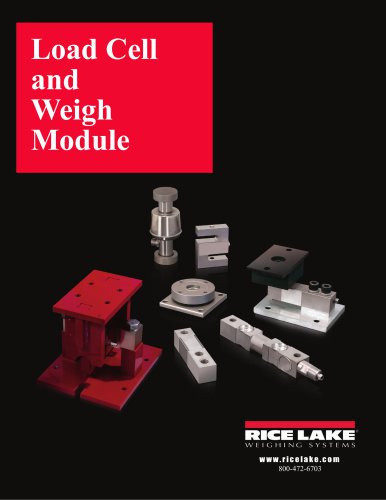
Load Cell and Weigh Module
This document provides an overview of load cells, devices used to measure weight or force, and discusses various types including canister, shear beam, cantilever beam, S-beam, and platform load cells. Each type has specific applications and characteristics.
- Canister: Suitable for high-capacity applications, hermetically sealed, made of stainless or high alloy steel.
- Single-Ended Shear Beam: Used in low-profile scales, requires flat surface mounting.
- Double-Ended Shear Beam: Common in truck scales, secured at both ends.
- Cantilever Beam: Similar to shear beams, with strain gauges along cavity edges.
- S-Beam: Used primarily in tension applications, available in bidirectional models.
- Platform Load Cell: Used in light capacity bench scales, typically made of aluminum.
Load cells are constructed from materials like aluminum, alloy steel, and stainless steel, each offering different benefits in terms of strength and environmental resistance.
Selection criteria include environmental protection, sealing methods, and ingress protection ratings. Considerations for painted and lightning-protected load cells are also discussed.
Proper load introduction is crucial for accurate measurements, covering ideal loading, angular loading, eccentric loading, side loading, and twisting loads.
Basic electrical concepts relevant to load cells, such as current, voltage, resistance, and the Wheatstone bridge, are explained.
Focuses on wiring, calibration data, and output characteristics of load cells.
Details the calibration process and certification provided by Rice Lake Weighing Systems.
Discusses different types of weigh modules, including single-ended beam, double-ended beam, compression canisters, and tension mounting (S-beam), each suited for specific applications.
Guidelines for designing bulk material weighing systems, maximizing accuracy, selecting supports and load cell capacity, and considering environmental factors like thermal expansion and wind effects.
Instructions for attaching piping to weigh vessels, including guidelines for piping and vessel restraint systems.
Provides tips for determining microvolts per graduation, safety guidelines for mounting hardware, load cell trimming, troubleshooting, and calibration guidelines.
Includes units of measure and a glossary of terms related to load cells and weighing systems.
Catalog excerpts
Load Cell and Weigh Module
Open the catalog to page 1
© Rice Lake Weighing Systems. All rights reserved. Rice Lake Weighing Systems® is a registered trademark of Rice Lake Weighing Systems. All other brand or product names within this publication are trademarks or registered trademarks of their respective companies. All information contained within this publication is, to the best of our knowledge, complete and accurate at the time of publication. Rice Lake Weighing Systems reserves the right to make changes to the technology, features, specifications and design of the equipment without notice. The most current version of this publication, software,...
Open the catalog to page 2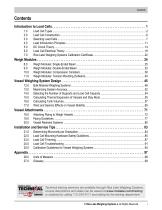
Vessel Weighing System Design . . . . . . . . . . . . . . . . . . . . . . . . . . . . . . . . . . . . . . . . . . . . . . . . 45 Installation and Service Tips . . . . . . . . . . . . . . . . . . . . . . . . . . . . . . . . . . . . . . . . . . . . . . . . . . . . 83 Technical training seminars are available through Rice Lake Weighing Systems. Course descriptions and dates can be viewed at www.ricelake.com/training or obtained by calling 715-234-9171 and asking for the training department. © Rice Lake Weighing Systems ● All Rights Reserved
Open the catalog to page 3
Load Cell and Weigh Module Handbook This Page Intentionally Blank. Rice Lake continually offers web-based video training on a growing selection of product-related topics at no cost. Visit www.ricelake.com/webinars Visit our website www.ricelake.com
Open the catalog to page 4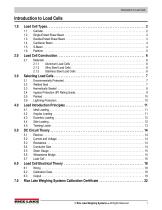
Introduction to Load Cells Introduction to Load Cells 1.0 Load Cell Types. . . . . . . . . . . . . . . . . . . . . . . . . . . . . . . . . . . . . . . . . . . . . . . . . . . . . . . . . . 2 Load Cell Construction. . . . . . . . . . . . . . . . . . . . . . . . . . . . . . . . . . . . . . . . . . . . . . . . . . . . 6 Selecting Load Cells . . . . . . . . . . . . . . . . . . . . . . . . . . . . . . . . . . . . . . . . . . . . . . . . . . . . . . 7 Load Introduction Principles . . . . . . . . . . . . . . . . . . . . . . . . . . . . . . . . . . . . . . . . . . . . . . 11 Load Cell Electrical Theory...
Open the catalog to page 5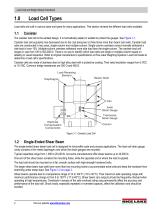
Load Cell and Weigh Module Handbook Load Cell Types Load cells are built in various sizes and types for many applications. This section reviews the different load cells available. The canister load cell is the earliest design. It is hermetically sealed or welded to protect the gauges. See Figure 1-1. Canister load cell popularity has decreased due to the cost being two to three times more than beam load cells. Canister load cells are constructed in two ways, single-column and multiple-column. Single-column canisters cannot normally withstand a side load of over 15%. Multiple-column canisters...
Open the catalog to page 6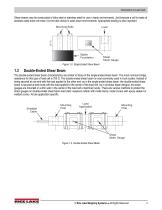
Introduction to Load Cells Shear beams may be constructed of alloy steel or stainless steel for use in harsh environments. Just because a cell is made of stainless steel does not mean it is the best choice in wash down environments. Appropriate sealing is also important. Mounting Bolts Stable Foundation Shear Strain Gauge Figure 1-2. Single-Ended Shear Beam Double-Ended Shear Beam The double-ended shear beam characteristics are similar to those of the single-ended shear beam. The most common bridge resistance for this type of load cell is 700 Ω. The double-ended shear beam is most commonly used...
Open the catalog to page 7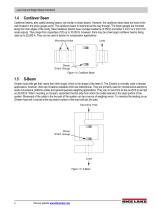
Load Cell and Weigh Module Handbook Cantilever Beam Cantilever beams, also called bending beams, are similar to shear beams. However, the cantilever beam does not have a thin web located in the strain gauge cavity. The cantilever beam is machined all the way through. The strain gauges are mounted along the inner edges of the cavity. Most cantilever beams have a bridge resistance of 350 Ω and either 3 mV/V or 2 mV/V full scale outputs. They range from capacities of 25 up to 10,000 lb. However, there may be a few larger cantilever beams being used up to 20,000 lb. They can be used in tension or...
Open the catalog to page 8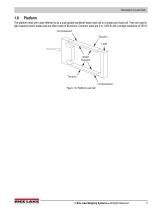
Introduction to Load Cells The platform load cell is also referred to as a dual-guided cantilever beam load cell or a single point load cell. They are used in light capacity bench scales and are often made of aluminum. Common sizes are 2 to 1,000 lb with a bridge resistance of 350 Ω. Compression Tension Load Strain Gauges Tension Compression Figure 1-6. Platform Load Cell © Rice Lake Weighing Systems ● All Rights Reserved
Open the catalog to page 9
Load Cell and Weigh Module Handbook Load Cell Construction Load cells can be constructed from a variety of materials. Aluminum Load Cells Alloy Steel Load Cells Stainless Steel Load Cells Aluminum load cell elements are used primarily in single point, low capacity applications. The alloy of choice is 2023 because of its low creep and hysteresis characteristics. Aluminum load cells have relatively thick web sections compared to alloy steel cells of comparable capacities. This is necessary to provide the proper amount of deflection in the element at capacity. Machining costs are usually lower on...
Open the catalog to page 10
Introduction to Load Cells Selecting Load Cells Using load cells incorrectly can create safety problems and be expensive. Load cells are categorized in three major groups: • Environmentally Protected (EP) • Welded Seal (WS) • Hermetically Sealed (HS) Hermetically sealed cells are also characterized by the Ingress Protection (IP) numbers. This system effectively matches load cell to application for optimal results. To select the proper load cell protection qualities, a fundamental understanding of the differences between environmentally protected and hermetically sealed load cells is necessary....
Open the catalog to page 11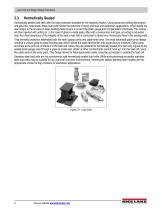
Load Cell and Weigh Module Handbook Hermetically Sealed Hermetically sealed load cells offer the best protection available for the weighing market. Using advanced welding techniques and ultra-thin metal seals, these load cells handle the extremes of harsh chemical and washdown applications. What makes the seal unique is the process of laser-welding metal covers to protect the strain gauge and compensation chambers. The cavities are then injected with potting or, in the case of glass-to-metal seals, filled with a pressurized inert gas, providing a redundant seal. As a final assurance of the integrity...
Open the catalog to page 12All Rice Lake Weighing Systems catalogs and technical brochures
 Overhead Weighing Catalog 2026
196 Pages
 Load cell
388 Pages
 Patient Weighing Solutions
40 Pages
 Précision Solutions
293 Pages
- Flowmeter
- Electrical cable
- Rectangular housing
- Copper cable
- Copper electrical cable
- Rolling bearing
- Tension/compression force transducer
- Steel bearing
- Terminal box
- Multi-strand cable
- Nut
- Stainless steel flow monitor
- Metal box
- Multi-wire electrical cable
- Ball bearing
- Wireless remote control
- Remote control with buttons