
- Catalogs
- Rica - Zoppas Industries Heating Element Technolog
- thik film technology

thik film technology

thik film technology
Thick film technology involves applying a material layer onto a substrate, with thicknesses ranging from 5 to several hundred microns, typically around 25 microns. It is widely used in the electronics industry for hybrid circuits. The process involves mixing layer material with polymer and glass binders to form a thick film ink suitable for screen printing, which is then dried and fired to achieve specific electrical properties.
Applications and Advantages
Thick film heaters are used in various applications such as tea kettles, waffle irons, and more. They offer benefits like rapid response, high power density, and energy efficiency. The technology allows for multiple heating elements on a single substrate, providing tailored temperature distribution.
Technical Specifications
Thick film heaters can withstand up to 2000 V dielectric breakdown, with operational temperatures ranging from 200°C to 600°C depending on the substrate. The technology supports a wide range of resistor paste formulations, enabling diverse circuit designs.
Polymer Thick Film Heaters with PTC Effect
This innovative technology integrates heating elements onto various substrates, offering compact, efficient, and safe heating solutions. The PTF heaters exhibit a PTC behavior, adjusting resistance with temperature changes to optimize power consumption and prevent overheating.
Benefits of PTF PTC Heaters
These heaters are self-regulating, have low thermal mass, and can be directly applied to surfaces, maximizing heat transfer. They are flexible in design and applicable to many substrates, reducing construction costs and enhancing appliance performance.
Typical Properties and Design Hints
PTF heaters have specific resistance and TCR ranges, with switch-off temperatures between 50°C and 150°C. Design recommendations include maximizing heating surfaces and using insulated metal substrates for better heat spreading.
Cost and Value
While PTF film heaters may be more expensive than traditional elements, their benefits in terms of application architecture, performance, and reliability lead to significant overall savings in appliance construction and lifecycle costs.
Catalog excerpts
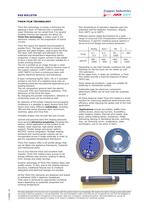
R&D BULLETIN THICK FILM TECHNOLOGY Thick film technology is simply a technique for applying a layer of material onto a substrate. Layer thickness can be varied from 5 to several hundred microns but typically are about 25. Thick film technology is widely used in the electronic industry for the preparation of hybrid circuits. Thick film layers are applied and processed in powder form. The layer material is mixed with polymer and glass binders, used to give the thick film layer both strength and adhesion to the substrate and temperature depending electric properties. A heavy organic solvent is also added to form a thick film ink of a viscosity suitable for a screen printing process. The ink is printed as an image through a mesh screen onto the substrate, dried to remove most of the organic medium (100°C-200°C) and fired (450°-900°C) to form a continuous layer with specific electrical behaviour and tolerances. A layer containing Ag/Pd, Ni/Cr, Mo or C powders printed in the form of a resistive track onto an insulating substrate has potential applications as a heating element. The ink composition governs both the electric (O/sq and TCR) and mechanical (adhesion, TCE) behaviour of the thick film layer. By changing the powder composition, dielectric or conducting areas can be printed as well. By selection of the binder material and processing conditions it is possible to apply several thick film layers onto many different substrates, including 300 and 400 series stainless steel, aluminium, ceramics, glass and mica foils. Printable shapes may be both flat and circular. Cermet and polymer thick film heating elements have several attractive properties including thin section, direct application to the surface to be heated, rapid response, high power density support, flexible design and power pattern, NTC/PTC control integration. Multiple heating elements and varying power outputs can be incorporated across a single substrate in order to get the requested temperature distribution. Max temperature of operation depends upon the substrate and the dielectric thickness, ranging from 200°C up to 600°C. Different resistor paste formulations fix a wide range of O/sq and TCR (Temperature Coefficient of Resistance, in ppm/K) enabling several options in terms of circuit design and product behaviour. Pd/Ag Ni/C r Mo C O/sq 0.1 .. 0.2 0.2 .. 2.0 50 .. 1000 2 .. 200 ppm/K 300 .. 3500 400 .. 600 -400 .. 400 -500 .. –1000 Depending on the heat transfer conditions the watt densities on the hot track can be raised up until 100 watt/sqcm. At the upper limit, in static air conditions, a Thick Film heater provide a thermal response of about 300°C/sec. Silver based terminations / pads are suitable for soldering or mechanical contact. Solderable pads for electronic component attachment (SMD) can be built onto the substrate as well. All these features make Thick Film heaters a smart solution for improving appliance performances and efficiency while reducing the global cost of the host application. Applications include tea kettles, waffle irons, clothes dryers, stove top burners, humidifiers, water heaters, boilers, thermal print heads, glue guns, ceiling heating panes, acquarium, fridge defrosting, deicing or demisting devices, warming tray, car reversing mirror, evaporators, plate exchangers, just to list some of them. Thick Film heaters offer a 2D-profile design that can be fitted into appliance framework, hydraulic and mechanical parts. Due to low thermal mass and excellent heat transfer, Thick Film heaters have proven to be energy-efficient heat sources, leading to space, time, energy and water savings. Another advantage of Thick Film heaters deals with quality issues. In fact, due to the heating element structure, traditional failures due to moisture adsorption and electrical leakage are avoided. 11/2003 - 07 All the Thick Film elements are designed and tested to withstand 2000 V dielectric breakdown. That value is achieved by appropriate insulating layers depending on substrate properties and working temperature. The data presented in this brochure are in accordance with the present state of our knowledge. We reserve the right to change product data within the scope of technical progress or new developments. The recommendations made in this brochure do not absolve the user from the obligation of investigating the possibility of infringement of third parties’ rights and, if necessary, clarifying the position. Recommendations for use do not constitute a warranty, either express or implied, of the fitness or suitability of the product for a particular purpose.
Open the catalog to page 1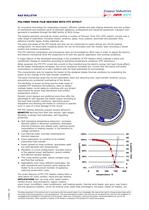
R&D BULLETIN POLYMER THICK FILM HEATERS WITH PTC EFFECT An innovative technology for integrating compact, efficient, reliable and safe heating elements onto the surface of mechanical and hydraulic parts of domestic appliance, professional and industrial equipment, transport and garments is available through the R&D facility of IRCA Group. The heating elements are built by screen printing a number of Polymer Thick Film (PTF) electric circuits onto a wide range of substrates, including metals, ceramics, glass, mica, plastics, polyimide and polyester foils, adhesive transfer tapes, textile materials,...
Open the catalog to page 2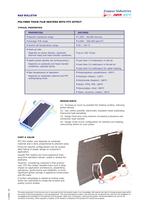
R&D BULLETIN POLYMER THICK FILM HEATERS WITH PTC EFFECT TYPICAL PROPERTIES PROPERTIES RATINGS • Specific resistance range • 1,000 – 90,000 ohm/sq • Average TCR range • 5,000 – 300,000 ppm/°C • Switch-off temperature range • 50 – 150 °C • Heat-up rate Depends on power density, substrate thermal mass and heat transfer conditions • Useful power density (at working temp.) Depends on substrate and heat transfer conditions, typically being: • Max temperature of operation • Up to 100 °C/sec • Less than 1.0 watt/sqcm in still air • Less then 2.0 watt/sqcm in forced air • Less than 4.0 watt/sqcm for water...
Open the catalog to page 3All Rica - Zoppas Industries Heating Element Technolog catalogs and technical brochures
 Catalogue Plastics
13 Pages
 Pellet
8 Pages
 Wind Turbines
2 Pages
 Process Heating
2 Pages
 PLASTICS
13 Pages
 Energy
2 Pages
 Medical
2 Pages
 Wellness and Aesthetics
2 Pages
 Railway
2 Pages
 Defence
2 Pages
 Bakery
2 Pages
 Laundry
2 Pages
 Air Conditioning
2 Pages
 Automotive
2 Pages
 Coffee and Vending
2 Pages
 Domestic Heating
2 Pages
 Machinery
2 Pages
 Food Service
2 Pages
 IMMERSION HEATERS GAS AND BSP
13 Pages
 Plastic
2 Pages
 Backery
2 Pages
 kit plug in catering
32 Pages
 CARAVAN & MOTORCARAVAN
2 Pages
 AVIATION & MILITARY
2 Pages
 AESTHETICS & HEALTHCARE
4 Pages
 General Catalogue
8 Pages
 HEATING ELEMENTS FOR COOKING.
31 Pages
 electronic control
5 Pages
 flexible heating foil
9 Pages
 high density catridge heater
8 Pages
 heating cables
6 Pages
 FUNCTIONAL ASSEMBLIES
2 Pages
 RICA - Medical
2 Pages
 RICA - Kit Plug In
32 Pages
 RICA - Plastics Stock
40 Pages
 RICA - Plastics
36 Pages
 RICA - Wind Turbines Folder
2 Pages
 RICA - Rid Folder
2 Pages
 RICA - Heating System Railway
64 Pages
 RICA - Kit Drop-In
28 Pages


Archived catalogs
 Rica eng
20 Pages
- Cartridge heater
- Tubular electric heater
- Heating cable
- Flexible heating element
- Band heater
- High-temperature cartridge heater
- Silicone heating element
- Finned heating element
- Heating coil
- Armored heating element
- Adhesive heating element
- Resistive heating cable
- Silicone-insulated heating cable
- Polyimide heating element
- Printed electronics heating element