
- Catalogs
- Reynard Corporation
- Thin Film Gauges

Thin Film Gauges

Thin Film Gauges
Introduction
Reynard Corporation introduces thin film-based environmental gauges designed to monitor corrosive environments. These gauges are created by depositing environmentally sensitive coating materials onto an inert substrate in a custom quasi-grid pattern.
Specifications
The gauges feature redundant traces for monitoring environmental changes and damage protection. Unmatched lines allow for monitoring varying corrosion levels and different corrosive elements. The grid configurations are tailored for specific environments, combining matched and unmatched lines to achieve desired electrical characteristics.
Procedures
Environmental degradation is detected by observing changes in electrical characteristics across the gauge. Photolithography techniques ensure high-precision and repeatability in confined areas, meeting system requirements.
Materials and Applications
Common materials include Copper, Silver, Aluminum, Iron, and Zinc, with the possibility of using other materials or dopants for specific applications. Traces can be applied to various substrates, including flexible ones like Melinex®.
Reynard Corporation's Commitment
Reynard Corporation's engineers collaborate with clients to define key product characteristics, ensuring high reliability and timely delivery for custom applications.
Key Characteristics
- Custom grid line configurations
- Photolithography-based precision and repeatability
- Material selection tailored to application needs
Catalog excerpts
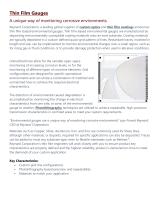
Thin Film Gauges A unique way of monitoring corrosive environments. Reynard Corporation, a leading global supplier of custom optics and thin film coatings announces thin film-based environmental gauges. Thin film-based environmental gauges are manufactured by depositing environmentally susceptible coating materials onto an inert substrate. Coating materials are typically deposited in a custom defined quasi-grid pattern of lines. Redundant traces, matched in length and size, can be implemented to monitor environmental changes over a small region, such as for rising gas or fluid conditions, or to provide damage protection when used in abrasive conditions. Unmatched lines allow for the variable open-space monitoring of increasing corrosion levels, or for the monitoring of different types of corrosive elements. Grid configurations are designed for specific operational environments and can utilize a combination of matched and unmatched lines to achieve the required electrical characteristics. The detection of environmental caused degradation is accomplished by monitoring the change in electrical characteristics from one side, or zone, of the environmental gauge to another. Photolithography techniques are utilized to achieve repeatable, high-precision transmission characteristics in confined areas to meet your system requirements. “Environmental gauges are a unique way of monitoring corrosive environments” says Forrest Reynard, CEO of Reynard Corporation. Materials such as Copper, Silver, Aluminum, Iron, and Zinc are commonly used for these lines, although other materials, or dopants, required for specific applications can also be deposited. Traces can be added to most any substrate type, even to flexible substrates such as Melinex ®. Reynard Corporation’s thin film engineers will work closely with you to ensure product key characteristics are properly defined and the highest reliability product is delivered on-time to meet the demands of your custom application. Key Characteristics: • Custom grid line configurations • Photolithography based precision and repeatability • Materials to match your a
Open the catalog to page 1All Reynard Corporation catalogs and technical brochures
 Gradient Filters
12 Pages
 Metalized Windows
1 Page
 Bullseye Apodizing Filters
2 Pages
 Circular Variable ND Filters
2 Pages
 Linear Apodizing Filters
2 Pages
 Diamond Point Turning
2 Pages
