
- Catalogs
- Rexnord Industries, LLC
- True Torque Fluid Couplings Selection Guide Type HF


True Torque Fluid Couplings Selection Guide Type HF

True Torque Fluid Couplings Selection Guide Type HF
- Soft Start Flexibility: Offers cushioned starts at an economical price, enhancing system component lifespan.
- Mechanical Overload Protection: Protects systems against sudden jams and overloads, preventing equipment damage.
- High Capacity Options: New sizes 2760HF & 2870HF provide higher capacity at higher speeds.
- Adjustable Startup Characteristics: Allows precise adjustment by changing the fluid fill level.
- Extended Delay Fill Chamber: Recommended for conveyors with unloaded starts or low inertia, reducing shock and stretch at startup.
- Gear Coupling Mount (HF20): Economical, allows drop-in/drop-out servicing.
- Disc Coupling Mount (HF25): Non-lubricated, suitable for high power and high rpm.
- Sheave/Hollow Shaft Mount (HF41): Designed for V-belt connections, mounted on motor shaft.
- Increased Starting Torque: Utilizes the breakdown torque of standard motors, avoiding oversized motors.
- Reduced Current Draw: Minimizes electrical consumption and extends motor life by reducing high current draw during startup.
- Load Balancing: Facilitates easy load balancing in multiple drive systems, enhancing operational efficiency.
- Steelflex/Hollow Shaft Mount: Types HF31 and HF32 are designed for limited shaft gaps and high power applications. HF31 uses setscrew retention, while HF32 uses a keeper plate and retention fastener.
- Tschan/Hollow Shaft Mount: Type HF132 is non-lubricated and low maintenance, suitable for minimum shaft gaps.
- Non Delay Fill (HFN) and Inactive Delay Fill (HFR): Provide soft starts with short delays, suitable for overload protection.
- Delay Fill (HFD): Offers a softer start with a longer delay, ideal for belt conveyors.
- Extended Delay Fill (HFDD): Provides the softest start with the longest delay, suitable for high-end belt conveyors.
- For belt conveyors, select HFN or HFD from Page 16, and for extra soft starts, consider HFDD selections on Page 17.
- For general duty applications, select HFD or HFN/HFR from Pages 18-21.
- Choose a mounting arrangement from Page 8 and verify availability and allowable speed using the table on Page 15.
- Check bore capacity using dimension tables on Pages 22-31.
Catalog excerpts

N O I Protecting your system, enhancing component life, from beginning to end. T 521-110 H E F A L K C O R P O R A T True Torque™ Fluid Couplings
Open the catalog to page 1
True Torque Fluid Couplings Economical soft starts, with smooth acceleration. Shock-load protection ™ From underground & overland belt conveyors to crusher and mixing applications, equipment professionals are constantly seeking better technology to protect critical production systems against the effects of damaging shock loads. And when it comes to eliminating sudden/jarring starts, or preventing system failure/deterioration due to overloads, nothing outperforms the system-saving capability of Falk True Torque fluid couplings. • Unmatched, cushioned soft start flexibility, at an economical price...
Open the catalog to page 2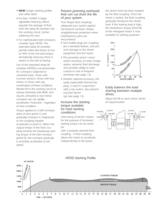
• NEW Longer starting profiles and softer starts • For Sizes 1420HF & larger, adjustable metering orifices regulate the passage of fluid from the delay fill chamber into the working circuit, further softening the start. • For sophisticated belt conveyors, consider Type HFDD. The extended delay fill chamber permits initial start factor as low as 40% of the full load torque, dramatically reducing shock & stretch to the belt at startup. Use of the extended delay fill chamber (HFDD) is recommended for conveyors subjected to unloaded starts, those with concave sections, those with low inertia, or...
Open the catalog to page 3
Basic Types The non-delay fill option (HFN/HFR) provides soft start, including a short delay (example: 5-10 seconds) in the acceleration of the load, and is a good choice when overload protection or increased starting torque is a primary requirement. Complete drive systems from Falk But Falk’s capability isn’t limited to just selling a component, we sell drive systems incorporating the gear drives, couplings, backstops, brakes, guards & motors, all mounted on a bedplate, swing base or alignment free assembly. Plus, our ready availability keeps you producing… even in the most remote places on...
Open the catalog to page 4
Selection Guide 521-110 June 2004 Table of Contents Benefits of a Fluid Coupling . . . . . . . . . . . . . . . . 6-7 Mounting Arrangements . . . . . . . . . . . . . . . . . . . 8 Basic Types . . . . . . . . . . . . . . . . . . . . . . . . . 9 Principles of Operation . . . . . . . . . . . . . . . . . 10-11 Accessories . . . . . . . . . . . . . . . . . . . . . . 12-13 How to Select . . . . . . . . . . . . . . . . . . . . . . . 14 Fluid Coupling Identification . . . . . . . . . . . . . . . . 15 Availability Table . . . . . . . . . . . . . . . . . . . . . . 15 Quick Selection Tables . . . . . . ....
Open the catalog to page 5
F A L K Benefits of using a Falk fluid coupling Soft cushioned starts Without the fluid coupling, the motor instantly transmits its locked rotor torque (starting torque) to the driven machine (point A at right). Then, it quickly reaches and applies the breakdown torque (point B). For common applications, locked rotor and breakdown torque often approximates 200% or more, of the motor nameplate rating. Damage can result if the required break-away starting torque of the driven machine is significantly less, the machine will be abruptly accelerated to rated speed. With a fluid coupling installed,...
Open the catalog to page 6
Reduced current draw when starting The electric current draw at startup is dramatically reduced when a fluid coupling is present. The motor starts without any meaningful load yet applied by the driven machinery (point A, Figure 1). In the absence of load, the motor quickly accelerates to approximately 90% of its full load speed (point B, Figure 1). The result is that low current draw (point C, Figure 1) is achieved within several shaft revolutions. At this point the inertia of the motor has been accelerated, and the application of load from the driven machine will not cause subsequent periods...
Open the catalog to page 7
Mounting Arrangements Gear Coupling Mount Type HF20 (Exposed Bolt) • Most Economical • Drop-in/drop-out servicing (no need to move connected • Readily shipped from stock components Steelflex/Hollow Shaft Mount Type HF31 (Setscrew Retention) Type HF32 (Keeper Plate Retention) • For limited shaft gaps/Steelflex grid coupling at driving end • Hollow shaft bored to the order • Type HF31/available Sizes 320-1 480/secured to driven shaft with (2) setscrews/allow clearance for setscrew wrench driven shaft with keeper plate & retention fastener/drill & tap driven shaft end for retention fastener • Excellent...
Open the catalog to page 8
Basic Types Non Delay Fill (HFN) and Inactive Delay Fill (HFR) l l l l l l Delay Fill (HFD) l Soft, cushioned start with a short delay in the acceleration of the load (Example: 5 seconds) Satisfactory soft start for many common applications Best choice for overload protection (Page 6) Good choice for increased starting torque (Page 6) All fluid remains in the working circuit HFR (plugged delay fill chamber) furnished when HFN not available RUNNER l l l l Softer, more cushioned start with longer delay in the acceleration of the load (Example: 12 seconds) Excellent choice for belt conveyors, and...
Open the catalog to page 9
F A L K } CASING Principles of Operation RUNNER WORKING CIRCUIT IMPELLER Introduction The working circuit is defined by the Casing, Impeller, and Runner. A conical baffle is attached to the Impeller, and a flat baffle is attached to the Runner. The Impeller and Runner each represent half of a hollow torus, each with flat radial vanes. Torque transfer takes place as follow. Driving End (Input) mechanically transfers torque to the Casing. Casing mechanically transfers toque to the Impeller. Impeller transfers torque, via the Fluid, to the Runner. Runner mechanically transfers torque to the Shaft....
Open the catalog to page 10
Overload – stall Should the load torque increase, the slip will increase, which causes the runner to drop in speed. The coil of fluid circulating between the impeller and runner will expand to provide additional torque. The extent to which this coil can expand is limited by the flat baffle on the runner. Consequently fluid couplings provide inherent overload protection. If the increase in torque causes the fluid in the working circuit to expand to the point of contacting the baffle, the coupling will stall and slip will be 100%. This continuous high slip generates heat and the fluid temperature...
Open the catalog to page 11All Rexnord Industries, LLC catalogs and technical brochures
 1000 series
8 Pages
 Thomas XTSR Couplings
4 Pages
 CMR series
2 Pages
 111-210 AirMax-WEB
12 Pages
 Falk? Truehold Backstops Catalog
26 Pages
 Falk? Omnibox® Worm Gear Drives
146 Pages
 Rexrnord® Planetgear? Gear Drives
134 Pages
 Viva? Coupling Catalog
20 Pages
 Thomas® Coupling Catalog
44 Pages


Archived catalogs
 Link-Belt Drive and Roller Chain Catalog
114 Pages
 Rexnord® Mill Duty Bearing Catalog
20 Pages
 Marbett® Conveyor Components Catalog
32 Pages


- Rolling bearing
- Clamping device
- Steel bearing
- Conveying belt
- Flexible coupling
- Ball bearing
- Shaft shaft coupling
- Radial bearing
- Plastic conveyor belt
- Transmission chain
- Metal chain
- Flush grid conveyor belt
- Torque coupling
- Transfer chain
- Modular conveyor belt
- Rigid coupling
- Roller chain
- Bearing unit
- Steel chain
- Friction clutch