
- Catalogs
- Retsch GmbH
- White paper: The Art of Milling


- Company
- Products
- Catalogs
- News & Trends
- Exhibitions
White paper: The Art of Milling
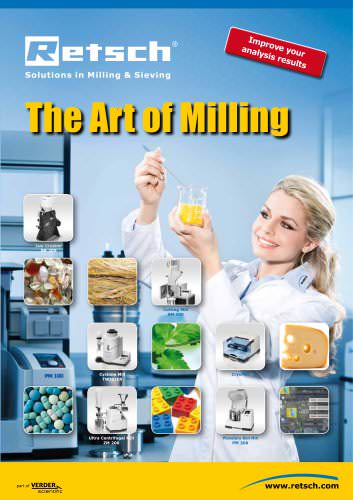
White paper: The Art of Milling
The document emphasizes the critical role of proper sample preparation in obtaining accurate analysis results in production plants. It identifies common issues where analysis results deviate from specifications due to errors in sampling and sample preparation rather than changes in production parameters.
Proper handling is essential, particularly for heterogeneous samples. The document uses a sand heap example to demonstrate how segregation and moisture content can impact sample representativeness, stressing the importance of representative sampling for accurate analysis.
Sampling should encompass all properties of the initial material with statistical reliability. Standards like DIN provide guidelines to minimize random errors and ensure reproducibility in sampling procedures and tools.
Sample preparation involves division and grinding. Methods such as sample splitters and rotating dividers are explained to achieve representative sub-samples. The document stresses that preparation should not alter sample properties, with examples like particle size distribution and moisture content analysis.
Size reduction is crucial for homogenizing samples and achieving analytical fineness. The document discusses grinding to appropriate sizes for various analysis methods, noting that a particle size of 500 microns is generally sufficient, except for XRF methods requiring sizes below 100 microns.
The document outlines principles of size reduction in milling, including pressure, impact, friction, shearing, and cutting. Different principles suit different material types, such as impact and friction for hard-brittle materials, and cutting for soft and elastic materials.
The selection of grinding tools is crucial for accurate sample preparation. The document highlights the importance of choosing tools that do not alter sample properties, recommending materials like PTFE and zirconium oxide for applications requiring sterilization.
Proper sample preparation, including representative sampling and appropriate size reduction, is vital for accurate analysis results. The use of rotating dividers ensures sample representativeness, minimizing errors and preventing production stops. RETSCH offers various tools to ensure reliable and reproducible outcomes.
Catalog excerpts

Imp r anal ove you ysis r resu lts Cyclone Mill TWISTER Ultra Centrifugal Mill ZM 200 Planetary Ball Mill PM 200
Open the catalog to page 1
Representative analysis results require adequate sample preparation The following situation is typical for many production plants: After a routine quality check, the production process is stopped or an already produced batch is suspended, because the analysis results were not within the relevant critical values. But does the tested product really deviate from the specifications? The quality control managers are convinced of this because modern analysis instruments provide results with very low tolerances. The sample in question was tested several times and the result was confirmed. The question...
Open the catalog to page 2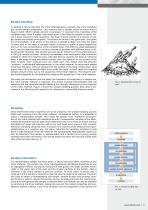
Sample handling In general it can be said that the more heterogeneous a sample, the more important the correct sample preparation. Let’s assume that a sample should be taken from a heap of sand. Which sample amount is necessary to represent the properties of the complete heap? Does it matter from which point of the heap the sample is taken? Figure 2 gives answers to both questions: The heap of sand consists of a mixture of bigger stones and smaller sand grains. The stones are found in the upper part, the grains are at the bottom. If, as shown in the picture, a sample is taken only from the upper...
Open the catalog to page 3
not altered by the preparation process. This can also be explained with our example: if the particle size distribution of the sand sample is to be determined, the sample must not be ground. If the moisture content is analyzed, the sample must not be heated to prevent the contained water from evaporating. In the following the two sample preparation methods are discussed in detail. sample splitter rotating sample divider rotating tube divider Sample division If all properties are distributed evenly in the sample and if there is no segregation, a small part of the sample could be extracted, e.g....
Open the catalog to page 4
vides better results as the division process is realized by a defined tool. However, the fact that the sample is fed in manually is again a potential source of errors. In rotating sample dividers and rotary tube dividers the sample feeding and the division itself are automated. If the division is carried out with fixed parameters (rotation speed, feeding speed), the sample and thus its properties are evenly distributed into the laboratory bottles. The sub-sample represents the initial sample. If the division is repeated with identical parameters, it provides comparable results so that the analysis...
Open the catalog to page 5
SIZE REDUCTION PRINCIPLES Pressure Force is applied between two solid surfaces that either represent the grinding tool surfaces directly or may be the surfaces of adjacent particles. Pressure is exerted by the grinding tools. Example: jaw crushers Impact effects Force at a solid surface. This could either be that of a grinding tool, or be represented by other particles. Strain by impact is II. Analytical fineness The term “analytical fineness” describes the maximum particle size a sample may have where no systematic error occurs in the subsequent analysis. There are different types of analysis:...
Open the catalog to page 6
Grinding tools The selection of suitable grinding tools is an important aspect of neutral-to-analysis sample preparation, as the following examples show: • If a soil sample is to be analyzed for its calcium, silicon oxide or cobalt contents, it must not be processed with grinding tools of stainless steel or hardened steel, as these steels contain the elements to be analyzed. • Cement clinker, in contrast, can be ground with grinding tools of these materials if the calcium and silicon oxide content is to be determined. • PTFE, zirconium oxide and glass are materials which can be sterilized and...
Open the catalog to page 7
RETSCH PRODUCT RANGE Visit us at www.retsch.com and you will find further information such as news, product info, brochures, videos for download, application database and much more. Ultra Centrifugal Mill ZM 200 Rotor Beater Mills SR 200/SR 300 Cross Beater Mill SK 100 Cyclone Mill TWISTER Knife Mills GRINDOMIX GM 200/GM 300 Heavy-Duty Cutting Mills SM 100/SM 200/SM 300 Vibratory Disc Mill RS 200 Planetary Ball Mills PM 100 CM/PM 100/PM 200 Planetary Ball Mill PM 400 Measuring System PM GrindControl Test Sieves Evaluation Software EasySieve® Optical Particle Analyzer CAMSIZER®/CAMSIZER XT Retsch...
Open the catalog to page 8All Retsch GmbH catalogs and technical brochures
 General Product Overview
16 Pages
 New Mixer Mill MM 500 vario
2 Pages
 General Catalogue
132 Pages
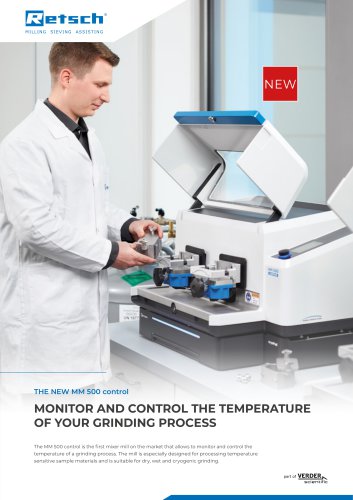 THE NEW MM 500 control
4 Pages
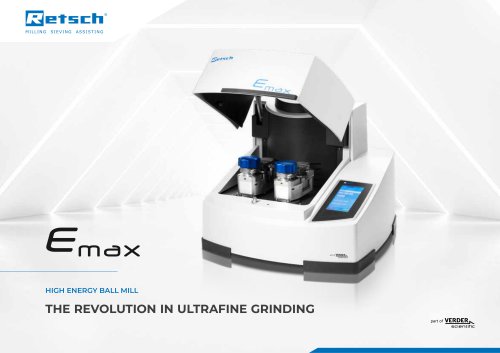 Emax
Emax20 Pages


Archived catalogs
 Ball Mills
4 Pages
 Verder Scientific
20 Pages
 Mixer Mills / CryoMill
12 Pages
 Biotech
4 Pages
 RS 200
4 Pages
 Jaw Crushers
12 Pages
 Rotor Mills
20 Pages
 Cutting Mills
12 Pages
 Knife Mills GRINDOMIX
12 Pages



- Automatic cleaning system
- Drying system
- Feeder
- Retsch stationary crusher
- Retsch horizontal mill
- Vertical pulverizer
- Ultrasonic washing machine
- Retsch food mill
- Primary crushing plant
- Stone crushing plant
- Retsch rotor mill
- Retsch waste mill
- Mineral material crusher
- Compact cleaning system
- Impact pulverizer
- Recycling grinding mill
- Building material crusher