

AX-BO® and RAFINEX®

AX-BO® and RAFINEX®
Catalog excerpts

Depending on design and size,an additional lubricant quantity must be taken into account for curved tooth couplings withspacer. The length L ist the pri-mary determining factor here. The table thus contains the required additional quantities for all sizes of the constructionseries RAZ.One value in each case refers to the whole spacer for the length L = L The maximum permissible static radial misalignment depends on the permissible angular misalignment and onthe distance between the toothcenters of both coupling hal- ves. This distance is variable for couplings with spacer orintermediate shaft....
Open the catalog to page 3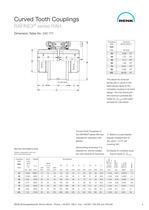
CouplingTorsionaltypespring rates C > T RAH SizeNm/rad > Sizes 32 to 125 available ex stock Subject to alterations which aredue to technical process. CouplingNorm.SpeedDimensionstypecont. > 1) r max. 2) K RAX dutyBore > 2) P > KN n > max. d > 1 : d > 2 BCDEFGHJSizenpremin.max. > max. static radial misalign-ment Total greasequalntityMass momentof inertiaWeight kw minmin > -1 mmmmmmmmmmmmmmmmmmmmmmmmkgkgm > 2 kg 32 0,02210600101232848540550483923,0 0,250,010,00121,5 38 0,03390001012409410550560574828,5 0,300,020,00272,1 48 0,08750020225212212560570735833,5 0,350,040,0084,6 60 0,16630020226514814570580927236,5...
Open the catalog to page 5All RENK GmbH catalogs and technical brochures
 Gear Units for LNG Carriers
7 Pages
 Single Marine Gear Solutions
7 Pages
 Curved Tooth Couplings
52 Pages
 HYGUARD®Safety Couplings
32 Pages
 Bogenzahn-Gelenkspindeln®
12 Pages
 HSWL 295
2 Pages
 RK 304
2 Pages
 Turbo Gear Units
4 Pages
 Codad Predator
2 Pages


- Planetary gearbox
- Coaxial gearhead
- Precision gearhead
- Compact gearhead
- Flexible coupling
- Gear train gear reducer
- Shaft shaft coupling
- Gearbox for industrial applications
- Transmission gearhead
- Multi-stage gearhead
- Single-stage gearhead
- Shaft gearhead
- Helical gear gearhead
- Dual-stage gearbox
- Flange coupling
- High-performance gearhead
- Clamp gearbox
- Torque coupling
- Electric motor gearhead
- Bevel gearhead