


Precision styli brochure
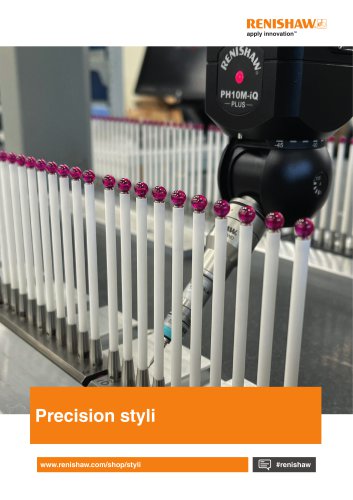
Precision styli brochure
Styli are critical components for coordinate measuring machines (CMMs), akin to turning tools for lathes, essential for precise measurements by generating data points on a workpiece's surface. The accuracy of these measurements is highly dependent on the stylus used.
With rising quality assurance standards, precise measurement tools like styli are crucial for competitive manufacturing. Renishaw offers a wide range of precision-engineered styli to meet these demands.
Choosing the right stylus involves considering the connecting thread (M2, M3, M4, M5) and workpiece geometry. The configuration must allow easy access to all probing points, often requiring multiple components and orientations.
- Straight Styli: For simple features, available in materials like ruby and tungsten carbide.
- Star Styli: Multi-tip configurations for reaching different features with one setup.
- Swivel Styli: Adjustable for angled surfaces and holes.
- Disc Styli: Ideal for probing undercuts and grooves.
- Semi-spherical Disc Styli: Suitable for measuring grooves and stepped bores.
- Cylinder Styli: For thin workpieces where ball styli may not make proper contact.
- Ceramic Hemispherical Styli: Effective for deep features and rough surfaces.
Adaptor plates and extensions enhance the flexibility and reach of styli configurations. Renishaw provides various materials for these components, ensuring compatibility with different measurement tasks.
Renishaw offers materials like titanium, stainless steel, and carbon fibre for stylus components to suit various metrology applications.
Materials for stylus holders and stems emphasize rigidity and weight. Steel and titanium are preferred for holders, with titanium ideal for large M5 styli due to its lightweight properties. Tungsten carbide offers exceptional rigidity for stems, ceramic is used for lightness and thermal stability, steel for superior rigidity, and carbon fibre for low weight and thermal stability.
Similar parameters apply to extensions as to stylus stems. Tungsten carbide is used for deflection resistance, steel for rigidity, aluminium for lightness in stable environments, ceramic for thermal stability, carbon fibre for long extensions, and titanium for lightness and flexural rigidity.
The choice of material for styli components is influenced by ambient conditions, length, flexural rigidity, and permitted masses. Temperature fluctuations can cause measurement errors, so material choice is crucial. Titanium is used for larger accessories, while stainless steel is used for smaller products.
Formulas and data on thermal expansion highlight the importance of material choice in minimizing measurement errors. Carbon fibre is recommended for long extensions due to its minimal mass and temperature stability. Flexural rigidity is crucial to prevent excessive bending during measurements, with tungsten carbide and carbon fibre offering high rigidity.
The choice of ball material depends on the measuring strategy and workpiece material. Ruby is preferred for most applications due to its hardness. Silicon nitride and zirconia are recommended for specific applications like scanning aluminium or cast iron. Ball precision is rated from grade 48 to grade 3, with Renishaw using high precision grades 3 and 5.
Scanning involves continuous contact with the workpiece, which can lead to wear and deposits on the ball stylus. Regular cleaning with a dry, lint-free cloth is recommended. Different materials are suggested for abrasive and adhesive wear scenarios.
Proper calibration of styli is essential for accurate measurements. The document outlines the calibration process, emphasizing the importance of using calibrated balls and storing effective dimensions in the CMM's data processor.
The document concludes with a summary of key criteria for using probe components, including the importance of using short and stable styli, checking for defects, ensuring thermal stability, and adhering to permitted masses.
- Avoid excessive or unnecessary thread connections and aim to use the fewest possible separate components.
- For scanning applications, utilize silicon nitride balls, especially when scanning aluminum, to enhance performance.
- Opt for the largest possible ball size in styli, as large balls act as mechanical filters, minimizing the recording of fine surface structures and reducing random measurement variations.
- Adjust measuring force and dynamics to suit the stylus components. For small ball styli with slim stems, reduce these values as necessary.
- This document is protected by copyright and cannot be reproduced without permission from Renishaw plc.
- RENISHAW® and associated symbols are registered trademarks of Renishaw plc.
- Renishaw reserves the right to make changes to the document, equipment, software, and specifications without prior notice.
- Renishaw plc is registered in England and Wales, with the registered office located at New Mills, Wotton-under-Edge, Glos, GL12 8JR, UK.
- Contact details include UK: [email protected], +44 (0) 1453 524524 and USA: [email protected], +1 847 286 9953.
Catalog excerpts
Precision styli www.renishaw.com/shop/styli
Open the catalog to page 1
Precision styli
Open the catalog to page 2
Contents What is a stylus? . . . . . . . . . . . . . . . . . . . . . . . . . . . . . . . . . . . . . . . . . . . . . . . . . . . . . . . . . . . . . . . . . . . . . 4 The importance of styli for precision measurements . . . . . . . . . . . . . . . . . . . . . . . . . . . . . . . . . . . . . . . 6 Selecting and using styli . . . . . . . . . . . . . . . . . . . . . . . . . . . . . . . . . . . . . . . . . . . . . . . . . . . . . . . . . . . . . . 8 Connecting thread . . . . . . . . . . . . . . . . . . . . . . . . . . . . . . . . . . . . . . . . . . . . . . . . . . . . . . . . . . . . . . . 8 Workpiece...
Open the catalog to page 3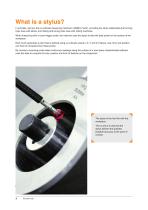
What is a stylus? In principle, styli are the co-ordinate measuring machine’s (CMM’s) “tools”, providing the same relationship that turning tools have with lathes, and milling and boring tools have with milling machines. When measuring with a touch-trigger probe, the machine uses the stylus to take the data points on the surface of the workpiece. Each touch generates a point that is defined using co-ordinate values in X, Y and Z. Feature, size, form and position can then be computed from these points. By contrast a scanning probe takes continuous readings along the surface of a work piece. Sophisticated...
Open the catalog to page 4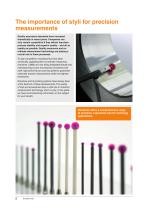
The importance of styli for precision measurements Quality assurance standards have increased dramatically in recent years. Companies can only remain competitive if they deliver top-class process stability and superior quality – and all as rapidly as possible. Quality assurance and coordinate measurement technology are playing a crucial role in these processes. To stay competitive, manufacturers have been continually upgrading their co-ordinate measuring machines. CMMs are now being integrated directly into manufacturing as part of production processes and swift, high-performance scanning systems...
Open the catalog to page 6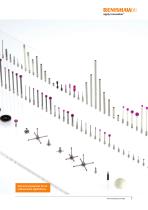
Styli and accessories for all measurement applications.
Open the catalog to page 7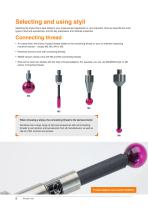
Selecting and using styli Selecting the stylus that is best suited to your measurement application is very important. Here we describe the main types of styli and accessories, and the key parameters and material properties. Connecting thread • At a basic level, the choice of stylus always relates to the connecting thread on your co-ordinate measuring machine’s sensor – usually M2, M3, M4 or M5. • Renishaw sensors work with connecting threads. • ZEISS sensors mainly work with M5 and M3 connecting threads. • Styli can be used very flexibly with the help of thread adaptors. For example, you can...
Open the catalog to page 8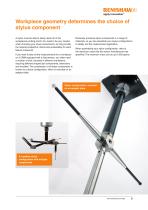
Workpiece geometry determines the choice of stylus component A stylus must be able to easily reach all of the workpiece’s probing points. You need to be very careful when choosing your stylus components, so they provide the required inspection criteria and accessibility for each feature measured. If you want to take all the measurements for a workpiece on a CMM equipped with a fixed sensor, you often need a number of styli, mounted in different orientations, requiring different shaped styli components, extensions and knuckles. The combination of all these components is known as a stylus configuration,...
Open the catalog to page 9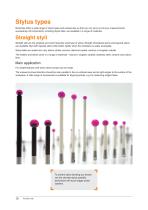
Stylus types Renishaw offers a wide range of stylus types and accessories so that you can carry out all your measurements successfully. All components, including stylus balls, are available in a range of materials. Straight styli Straight styli are the simplest and most frequently used type of stylus. Straight shouldered stems and tapered stems are available. Styli with tapered stems offer better rigidity when the workpiece is easily accessible. Stylus balls are made from ruby, silicon nitride, zirconia, diamond coated, ceramic or tungsten carbide. The holders and stems come in a range of materials...
Open the catalog to page 10
RENISHAW.apply innovation™ Straight stylus, right-angled to the workpiece surface.
Open the catalog to page 11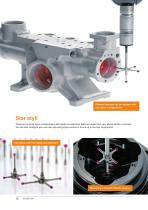
Different features can be reached with one stylus configuration. Star styli These are multi-tip stylus configurations with rigidly mounted styli. Balls are made from ruby, silicon nitride or zirconia. You can also configure your own star styli using stylus centres to mount up to five styli components. Star stylus with five rigidly mounted styli. Measuring a complex interior contour. Precision styli
Open the catalog to page 12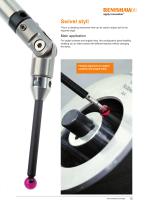
Swivel styli This is a clamping mechanism that can be used to adjust styli to the required angle. Main application For angled surfaces and angled holes, this configuration gives flexibility, enabling you to make contact with different features without changing the stylus. Flexible alignment for angled surfaces and angled holes.
Open the catalog to page 13
Disc styli These styli are ‘sections’ of highly spherical balls and are available in various diameters and thicknesses. Mounted on a threaded spigot, the discs are made from steel, ceramic or ruby. Full rotational adjustment and the ability to add a centre stylus are features of the range. This makes them particularly flexible and easy to use. Main application These styli are used to probe undercuts and grooves within bores, which may be inaccessible to star styli. Probing with the ‘spherical edge’ of a simple disc is effectively the same as probing on or about the equator of a large stylus ball....
Open the catalog to page 14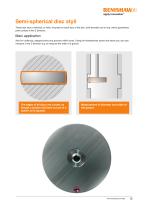
Semi-spherical disc styli These styli have a half-ball, or roller, mounted on each face of the disc, both beneath and on top, which guarantees point contact in the Z direction. Main application Also for undercuts, stepped bores and grooves within bores. Using the hemispheres above and below you can also measure in the Z direction e.g. to measure the width of a groove. The edges of all discs are curved, as though a section had been cut out of a sphere at its equator. Measurement of diameter and width of the groove.
Open the catalog to page 15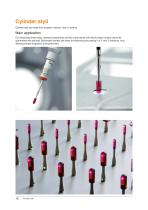
Cylinder styli Cylinder styli are made from tungsten carbide, ruby or ceramic. Main application For measuring sheet metal, pressed components and thin work pieces with which proper contact cannot be guaranteed with ball styli. Ball-ended cylinder styli allow full datuming and probing in X,Y and Z directions, thus allowing surface inspection to be performed. Precision styli
Open the catalog to page 16All RENISHAW catalogs and technical brochures
 TP7M probe and stylus kit
4 Pages
 inVia Raman microscope
28 Pages
 Renishaw fixtures
68 Pages
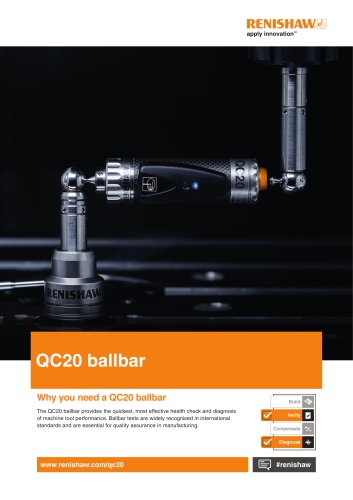 QC20 ballbar
16 Pages
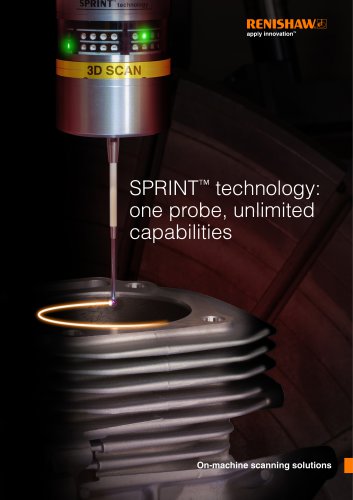 SPRINT technology brochure
11 Pages
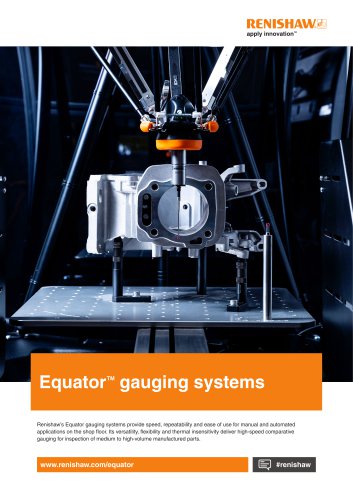 Equator brochure
12 Pages
 Metrology fixture table
4 Pages
 RFP1 fringe probe for REVO-2
2 Pages
 RVP vision probe for REVO-2
2 Pages
 MH20 articulating probe head
2 Pages
 Data sheet: MH20 and MH20i
4 Pages
 RTP20
RTP202 Pages
 PH10M-iQ PLUS
2 Pages
 REVO-2 and RSP2 probes
2 Pages
 SFP2 surface finish probe
2 Pages
 Data sheet: HS20 laser head
2 Pages
 Data sheet: RLU20 laser unit
2 Pages
 Data sheet: RLU10 laser unit
2 Pages
 RLMD01_09
13 Pages
 RLBD01_04
9 Pages
 RLCD03_03
9 Pages
 HiLin™
20 Pages
 PRIMO™ system
8 Pages
 RSP3-6 extended reach probe
4 Pages
 RGH25F UHV, RGH20F UHV
8 Pages
 Renishaw retrofit
12 Pages
 SP80
SP804 Pages
 SP600
SP6004 Pages
 Styli for Zeiss applications
57 Pages
 Precision styli
60 Pages
 CMM technology guide
28 Pages




- VirtualExpo Group
- Our Partners
- Recruitment
- Testimonials