
- Catalogs
- Reliance Precision Limited
- Reliance cool muscle motor with Ethernet-IP Datasheet

- Products
- Catalogs
- News & Trends
- Exhibitions
Reliance cool muscle motor with Ethernet-IP Datasheet

1 / 2 PagesView full catalog
Reliance cool muscle motor with Ethernet-IP Datasheet
Product catalog summary
Product Overview: The Reliance Cool Muscle Motor with EtherNet/IP interface is designed for seamless integration into Ethernet networks, allowing direct connection to EtherNet/IP enabled PCs or PLCs. This interface is factory-fitted for NEMA sizes 17 and 23 motors, with retrofit options available.
Output Assembly Object (OgT): This includes communication to motor controller flags (run/idle), control words (start/stop/home), position profile parameters (destination position, speed, acceleration, torque), input functions, and motor function parameters (K-parameters).
Input Assembly Object (TgO): Provides communication error codes and motor status codes for monitoring and diagnostics.
Technical Specifications: The motor supports a pulse interface with CW/CCW step/direction input signals, a maximum frequency of 500 Kpps, and a minimum pulse width of 0.8µsec. Voltage levels are specified for high and low signals.
Variable Voltage Interface: Integrated into the C-Type motor, this interface allows speed control by varying voltage from 2.6V to 4.8VDC for CW direction and 2.4V to 0VDC for CCW direction. Position control is proportional to voltage input.
Computer Control Interface: Offers TTL motor interface with options for RS232 or RS485. Input signal levels are specified for high (>3V) and low (<0.8V).
RT3 Real Time Interface: Supports coordinated motion for complex tasks, embedded PLC logic banks for motion calculations, and quadrature simulated AB outputs with a maximum frequency of 20kHz.
Programmable I/Os: The RCM features 4 inputs and 2 outputs configurable for digital, analogue, serial, or pulse counter functions. Input functions include origin sensor, manual feed, and motor enable, while output functions include alarms and in-position signals.
Networking Solutions: RCMs can be networked in a daisy chain, allowing inter-motor communication and command reception from computers or controllers. RCMs can operate independently post-programming.
Advanced Motion Features: The motor supports continuous PTP motion with variable speeds and accelerations, and a push mode for emulating pneumatic operations.
Virtual Signal Techniques: RCMs utilize virtual signal techniques to maximize I/O port functionality by creating multiple events from a single input signal.
See more
All Reliance Precision Limited catalogs and technical brochures
 new 2014 Catalogue
448 Pages
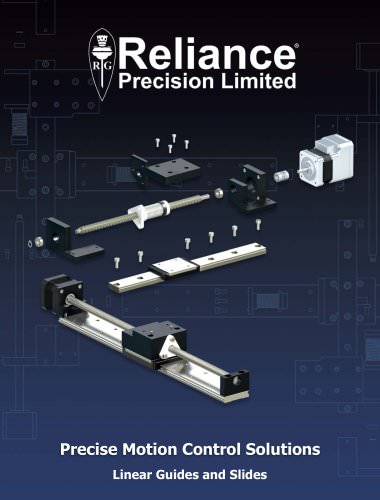 Linear Guides and Slides
21 Pages
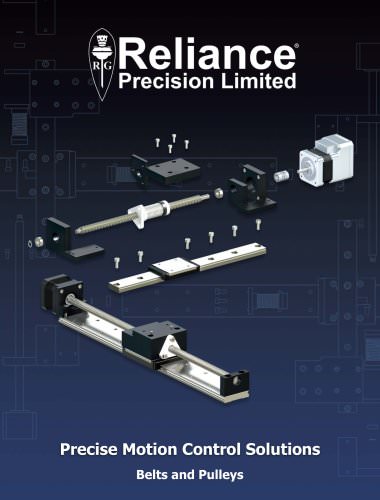 Belts and Pulleys
9 Pages
 Bearings and Spacers
11 Pages








Related Searches
- Electromotor
- DC electromotor
- Actuator
- Linear actuator
- Planetary gearbox
- Electric actuator
- Power transmission belt
- Precision gearhead
- 24 V motor
- Right angle gearhead
- Compact gearhead
- Compact electromotor
- Flexible coupling
- Shaft shaft coupling
- Gearbox for industrial applications
- Industrial strip
- Transmission gearhead
- Compact actuator
- Stepper motor
- Screw actuator
*Prices are pre-tax. They exclude delivery charges and customs duties and do not include additional charges for installation or activation options. Prices are indicative only and may vary by country, with changes to the cost of raw materials and exchange rates.
About DirectIndustry
DirectIndustry is a marketplace that offers B2B players a complete experience, from product sourcing to purchase. DirectIndustry is an entity of VirtualExpo Group.
Are you a buyer?
Are you a supplier?