
- Catalogs
- Regulator Cetrisa
- VERY LIGHT FERROUS METALS SEPARATOR

VERY LIGHT FERROUS METALS SEPARATOR

VERY LIGHT FERROUS METALS SEPARATOR
Introduction
The document discusses the challenges and solutions in separating light iron metals, such as stainless steel, which are difficult to capture due to low magnetic remanence and association with non-iron fragments. REGULATOR-CETRISA has developed equipment for the separation and recycling of these metals.
Physical Principle and Characteristics
The R-INOX separator operates by creating an intense magnetic field at the output drum of a conveyor belt, effectively separating light iron metals. The equipment features a robust metallic structure with a conveyor belt moving over an antimagnetic stainless steel table. The output drum uses Neodymium-Ferrous-Boron magnets, known for their high energy, to separate small iron materials.
Applications
The R-INOX equipment is used in various sectors, including wood, plastic, and aluminum processing, to separate iron contaminants. It is particularly effective in removing embedded iron from wood and aluminum profiles.
Operation
Materials are subjected to a magnetic field at the output roller, resulting in the separation of low iron metals, high iron metals, and non-metals based on their magnetic properties.
Equipment Configurations
REGULATOR-CETRISA offers equipment with working widths up to 2,000 mm, tailored to specific material characteristics. The company provides testing facilities to ensure effective separation and satisfactory results.
Contact Information
For further details, contact REGULACION DE MOTORES, S. A. at their GAVA, Spain location, or visit their website.
Catalog excerpts

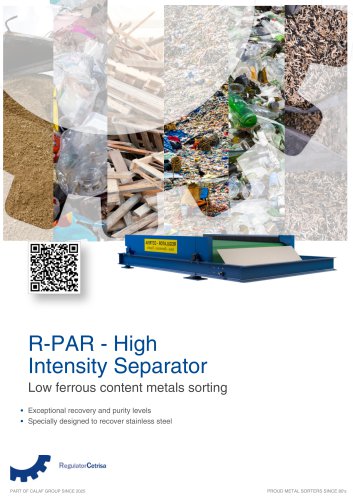
SEPARATION OF LIGHT IRON METALS (R-INOX) INTRODUCTION Within the metals, iron metals should be considered as the highest percentage elements and are the most easily captured by magnetic fields. However, the light iron metals, similar to stainless steel, are sometimes highly difficult to separate, whether it's because of their little magnetic remanence or even for being joined, in proportion, to large non-iron fragments that make their process and separation more difficult. Aware of this problem, REGULATOR-CETRISA has developed a complete line of Equipments for Separating and Recycling LIGHT Iron or VERY LOW Iron Metals (R-INOX), similar to stainless steel, for separating, recycling and recovering them. PHYSICAL PRINCIPLE and CHARACTERISTICS The functioning physical principle of the Separator of Very Low Iron Metals (R-INOX) is the creation, in the output drum at the end of the conveyor belt, of an intense magnetic field that acts on the iron metals and also on the light iron metals, such as stainless steel. The Separator of Very Low Iron Metals (R-INOX) is made up of a robust metallic structure. This structure is the support for two drums and the conveyor belt. The conveyor belt moves over an antimagnetic stainless steel table that guarantees a perfect horizontality. It also has an automatic maintenance system for the centre of the belt to guarantee its correct operation. The output drum is a magnetic roller made up of Neodymium-Ferrous-Boron (NdFeB) magnets, in studied configurations, which are the magnets that provide the most energy on the market. This intense magnetic potential is also capable of separating small iron material that other equipment, such as an overband, has not been able to attract and separate. REGULATOR-CETRISA offers equipment with effective working widths of up to 2,500 mm. and with different drums adapted to the flows and characteristics of the materials that should be processed. For this reason that there is working equipment in many different sectors, such as: RAEE, VFU, wood, plastic, etc. Besides the separation of materials similar to stainless steels, other regular applications of the Separator of Very Low Iron Metals (R-INOX) are, for example: · For the treatment of wood, after the pre-crushing, the R-INOX equipment can separate fragments of wood that have any small remains of embedded iron (nails, studs…). · When profiles of aluminium are processed, they often have embedded nails and studs ofcontaminating iron metal. With the R-INOX equipment, these profiles are separated from the material flow.
Open the catalog to page 1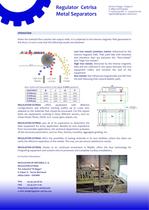
OPERATION When the material flow reaches the output roller, it is subjected to the intense magnetic field generated in the drum, in such a way that the following results are obtained: Low iron metals (stainless steels): Influenced by the intense magnetic field. Their path falls with retention and therefore they are between the “Non-metals” and “High Iron metals”. High iron metals: Attracted by the intense magnetic field and are collected in the space between the two equipment rollers and towards the end of the equipment. Non-metals: Not influenced magnetically and fall from the belt following...
Open the catalog to page 2All Regulator Cetrisa catalogs and technical brochures
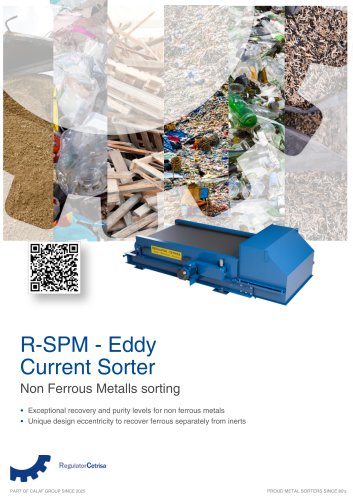 R-SPM _2026_EN
4 Pages
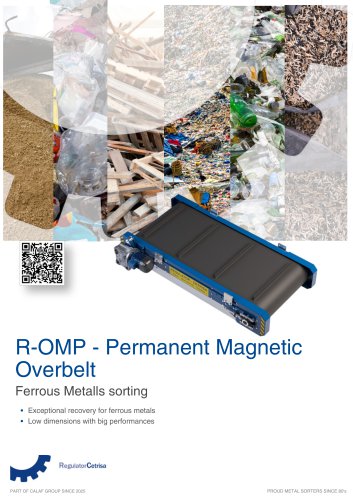 R-OMP_2026_EN
4 Pages
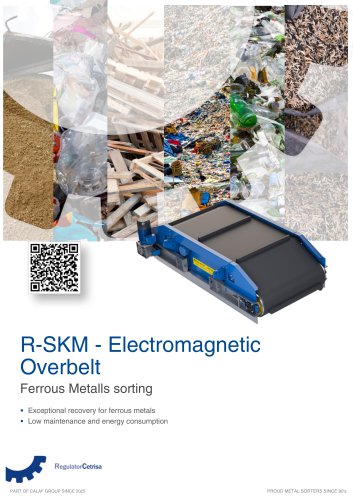 R-SKM_2026_EN
4 Pages
 R-PAR _2026_EN
4 Pages

Archived catalogs
 MAGNETIC ROLLER (R-RM)
2 Pages
 Magnetic Drum Separator
2 Pages


- Regulator Cetrisa solids separator
- Regulator Cetrisa magnetic separator
- Cascade separator
- Regulator Cetrisa separator for the recycling industry
- Regulator Cetrisa metal separator
- Automatic separator
- Compact separator
- High-efficiency separator
- Magnetic drum separator
- High-intensity separator
- Waste recycling separator
- Permanent magnet separator
- Magnetic plate separator
- Magnetic roller separator
- Hanging separator
- Rectangular separator
- Separator with inductive detection