
- Catalogs
- Reach Machinery Co.,Ltd.
- Strain wave gear reducer RHSD series

Strain wave gear reducer RHSD series
Strain wave gear reducer RHSD series
Overview of RHSD Series Harmonic Reducers
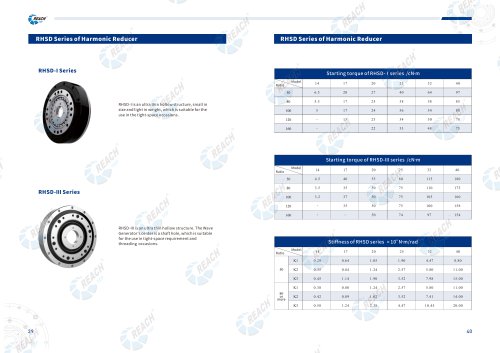
The document provides detailed technical specifications and characteristics of the RHSD series harmonic reducers, including RHSD-I and RHSD-III models. These reducers are designed for applications requiring compact size, light weight, and high precision, suitable for tight-space installations.
1. Product Series Description
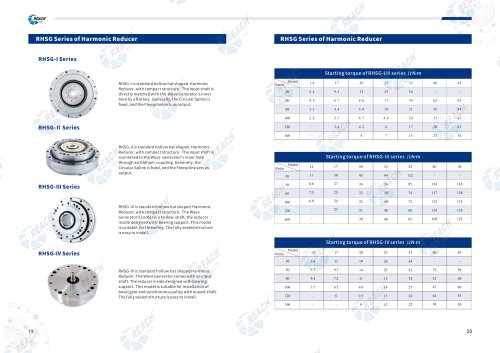
- RHSD-I Series: Ultra-thin hollow structure, small size, and light weight, ideal for tight-space applications.
- RHSD-III Series: Also ultra-thin hollow structure with the wave generator center as a shaft hole, suitable for threading and tight-space requirements.
2. Mechanical Specifications
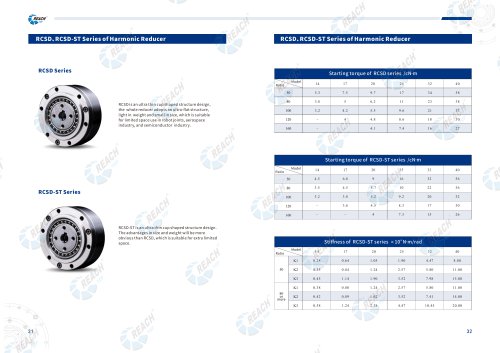
- Starting Torque: Provided for both RHSD-I and RHSD-III series, measured in cN·m, indicating the torque required to initiate movement.
- Stiffness: Specified as ×10 N·m/rad, indicating resistance to angular deformation.
- Rated Torque and Allowable Torque: Rated torque at 2000 rpm and allowable peak torque at start/stop are detailed for various models and gear ratios.
- Backlash and Transmission Accuracy: Backlash values are given in arc seconds, with transmission accuracy also specified in arc seconds, reflecting the precision of motion transmission.
- Noise Levels: Noise emissions are measured in decibels (dB), important for applications sensitive to sound.
- Maximum Input Speed and Allowable Average Input Speed: Limits on rotational speeds to ensure safe and reliable operation.
- Buckling and Ratcheting Torque: Mechanical limits for structural integrity and operational safety.
3. Dimensional Data and Mounting
- Dimension tables for RHSD-I and RHSD-III series include critical parameters such as diameters (φC, φG), lengths (L3, L4), and mounting hole sizes (e.g., M3, M4, M5).
- Outline drawings accompany the dimension tables to assist in installation and integration.
- Wave generator dimensions are specified for certain models (e.g., 14 and 17).
4. Performance Parameters
- Hysteresis Loss: Measured in arc minutes, indicating energy loss due to internal friction during operation.
- Torque Ratios: Various gear ratios are listed (e.g., 14, 17, 20, 25, 32, 40), with corresponding performance metrics.
- Torque Capacity: Data on allowable average torque, peak torque, and momentary torque provide guidance on operational limits.
5. Application Recommendations and Limitations
- RHSD-I and RHSD-III series are recommended for applications requiring compactness and high precision in limited spaces.
- Speed and torque limits must be observed to prevent mechanical failure.
- Backlash and noise levels should be considered in precision and noise-sensitive environments.
6. Summary of Key Parameters
| Model | Ratio | Rated Torque (N·m) | Max Input Speed (rpm) | Backlash (arc sec) | Transmission Accuracy (arc sec) | Noise (dB) |
|---|---|---|---|---|---|---|
| RHSD-I | 14 | 130 | 2000 | 20 | 20 | 60 |
| RHSD-I | 40 | 3600 | 2000 | 20 | 20 | 60 |
| RHSD-III | 14 | 88 | 2000 | 20 | 20 | 60 |
| RHSD-III | 40 | 170 | 2000 | 20 | 20 | 60 |
Note: The above table summarizes typical values; detailed specifications vary by exact model and ratio.
7. Mechanical Limits and Safety
- Buckling torque and ratcheting torque values are provided to ensure mechanical safety under load.
- Starting torque values indicate the minimum torque required to overcome static friction.
8. Additional Notes
- Dimensions φC, φG, L3, and L4 are limited and critical for design integration.
- Mounting hole sizes (M3, M4, M5) vary by model and must be matched correctly.
This summary consolidates the key technical data and recommendations for the RHSD series harmonic reducers, facilitating selection and application in precision mechanical systems.
Catalog excerpts
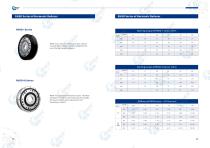
RHSD-I Series RHSD-I is an ultra thin hollow structure, small in size and light in weight, which is suitable for the use in the tight-space occasions. Starting torque of RHSD- RHSD-III Series RHSD-III is an ultra thin hollow structure. The Wave Generator's center is a shaft hole, which is suitable for the use in tight-space requirement and threading occasions. Starting torque of RHSD-II
Open the catalog to page 1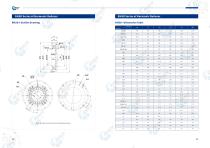
RHSDSeriesofHarmonicReducer RHSD-IOutlineDrawing RHSDSeriesofHarmonicReducer RHSD-IDimensionTable Model Symbol
Open the catalog to page 3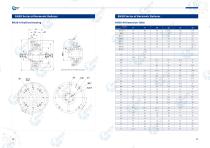
RHSD-III Outline Drawing RHSD-III Dimension Table Wave Generator of model 14and 17
Open the catalog to page 4All Reach Machinery Co.,Ltd. catalogs and technical brochures
 Electromagnetic Brakes
8 Pages
 Electromagnetic Brakes
14 Pages
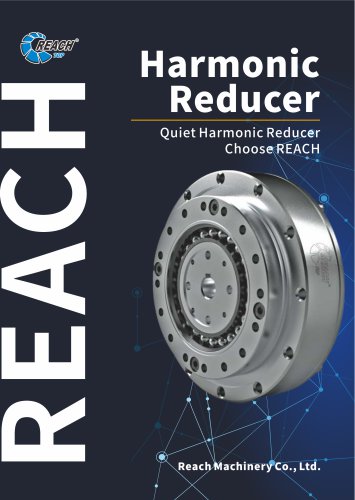 Harmonic reducer_REACH
72 Pages
 Couplings Reach@GS
59 Pages
 Couplings GR
59 Pages
 REACH 22
1 Page
 REACH 21
1 Page
 REACH 20
1 Page
 REACH 19
2 Pages
 REACH 18
1 Page
 REACH 17
1 Page
 REACH 16
1 Page
 REACH 15
1 Page
 REC
REC9 Pages
 RDC
RDC4 Pages
 RGE-GR
3 Pages
 REACH 13
1 Page
 REACH 12
1 Page
 REACH 11
1 Page
 REACH 07
2 Pages
 REACH 06
2 Pages
 REACH 05
2 Pages
 REACH 04
2 Pages
 REACH 03
2 Pages
 REACH 01
2 Pages
 REB18 Square hub
1 Page
 REACH 14
2 Pages
 REACH 02
1 Page


- Reach Machinery coaxial gear reducer
- Precision gearhead
- Compact gearhead
- Solid-shaft gearhead
- Flexible coupling
- Reach Machinery hollow-shaft gear reducer
- Shaft shaft coupling
- Reach Machinery friction brake
- Transmission gearhead
- Shaft gearhead
- Dual-stage gearbox
- High-performance gearhead
- Low-noise gearhead
- Low-backlash gearhead
- Torque coupling
- High-precision gearhead
- High-torque gearhead
- Reach Machinery robot gear reducer
- Rigid coupling
- Zero-backlash shaft coupling