
- Catalogs
- Reach Machinery Co.,Ltd.
- Strain wave gear reducer RCSG series

Strain wave gear reducer RCSG series
Strain wave gear reducer RCSG series
Overview of RCSG Series Harmonic Reducers
The document provides detailed technical specifications, structural descriptions, performance parameters, and dimensional data for the RCSG series of harmonic reducers, including RCSG-I, RCSG-II, and RCSG-III models.
1. Structural Descriptions
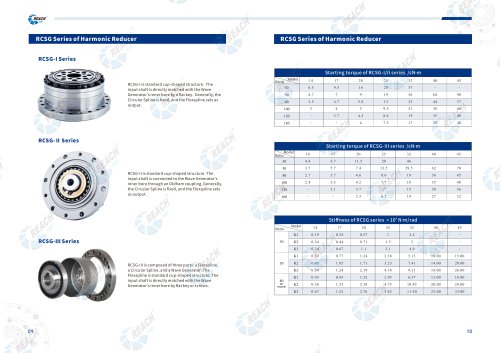
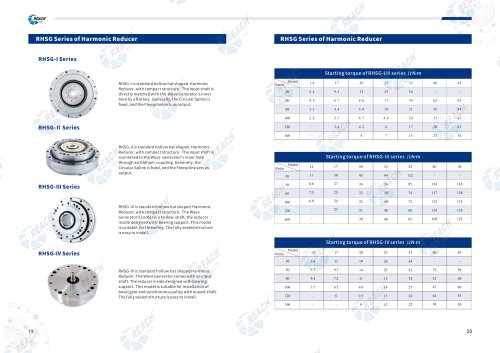
- RCSG-I Series: Standard cup-shaped structure where the input shaft is directly connected to the Wave Generator's inner bore via a flat key. The Circular Spline is typically fixed, and the Flexspline serves as the output.
- RCSG-II Series: Also a cup-shaped structure, but the input shaft connects to the Wave Generator's inner bore through an Oldham coupling. The Circular Spline is fixed, and the Flexspline is the output.
- RCSG-III Series: Composed of three parts: Flexspline (cup-shaped), Circular Spline, and Wave Generator. The input shaft is directly matched with the Wave Generator's inner bore by flat key or screws.
2. Performance Specifications
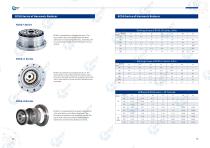
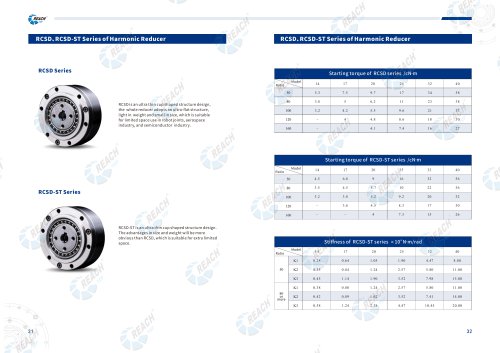
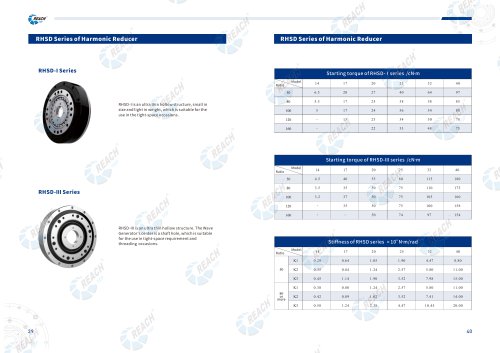
- Starting Torque: Provided for RCSG-I/II and RCSG-III series across various model sizes and gear ratios (e.g., 14, 17, 20, 25, 32, 40, 45).
- Stiffness: Stiffness values of RCSG series are given in N·m/rad multiplied by 10, indicating torsional rigidity.
- Torque Ratings: Rated torque at 2000 r/min, allowable peak torque at start and stop, allowable average torque, and maximum momentary torque are specified for different models and ratios.
- Maximum Input Speed and Allowable Average Input Speed: Defined for each model to ensure operational limits are respected.
- Backlash and Transmission Accuracy: Backlash is measured in arc seconds, with RCSG-II having a maximum backlash 10 arc seconds higher than others. Transmission accuracy is also specified in arc seconds.
- Noise Levels: Noise in decibels (dB) is provided for all ratios.
- Buckling Torque and Hysteresis Loss: Buckling torque values in N·m and hysteresis loss in arc minutes are tabulated for various models and ratios.
- Ratcheting Torque: Provided for certain models and ratios.
3. Dimensional Data and Outline Drawings
- Dimension tables and outline drawings are provided for RCSG-I, RCSG-II, and RCSG-III series, including key dimensions such as diameters, lengths, and mounting hole specifications.
- Limited dimensions (e.g., L10 for RCSG-I, L9 for RCSG-II, and φB, φE, L4, L7 for RCSG-III) are highlighted to indicate critical size constraints.
- Details include bolt sizes (e.g., M4, M5), shaft diameters, and tolerances (e.g., ±0.2 mm, ±0.3 mm, ±0.5 mm).
4. Key Parameters and Recommendations
- Models are categorized by size (14, 17, 20, 25, 32, 40, 45) and gear ratios (1, 2, 3).
- Performance parameters such as starting torque, rated torque, and stiffness increase with model size.
- Backlash and transmission accuracy are critical for precision applications; RCSG-II has slightly higher maximum backlash.
- Noise levels are generally low, supporting use in noise-sensitive environments.
- Maximum input speeds and allowable average speeds must be adhered to for reliable operation.
5. Summary of Critical Data Extracted from Tables
- Starting torque ranges from approximately 0.19 cN·m to 33.00 cN·m depending on model and ratio.
- Rated torque at 2000 r/min ranges from 260 N·m (model 14) up to 8900 N·m (model 45).
- Allowable peak torque at start/stop and allowable average torque values scale with model size.
- Backlash values are typically around 10 to 20 arc seconds, with transmission accuracy around 10 to 20 arc seconds.
- Noise levels range approximately from 60 dB to 90 dB depending on model and operating conditions.
6. Notes and Limitations
- Maximum backlash for RCSG-II series is 10 arc seconds higher than other series.
- Limited dimensions must be respected for proper installation and operation.
- Some data points are missing or marked with dashes, indicating non-applicable or unavailable values.
This structured summary captures the essential technical details and specifications necessary for understanding, selecting, and applying the RCSG series harmonic reducers in mechanical systems.
Catalog excerpts
RCSG-I Series Startingtorqueof RCSG-I/IIseries /cN-m RCSG-II Series RCSG-II isstandard cup-shaped structure. The input shaft is connected to the Wave Generator's inner bore through an Oldham coupling. Generally, the Circular Spline is fixed, and the Flexspline sets as output. Startingtorqueof RCSG-III series /cN-m RCSG-III Series RCSG-I 11 iscomposed ofthree parts: a Flexspline, a Circular Spline, and a Wave Generator. The Flexspline isstandard cup-shaped structure. The input shaft is directly matched with the Wave Generator's inner bore by flat key orscrews. Stiffness of RCSG series x 1041
Open the catalog to page 1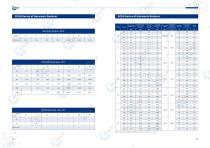
Note: The maximum backlash of RCSG-II is 10 arc sec more.
Open the catalog to page 2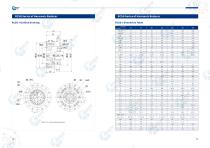
RCSG Series of Harmonic Reducer RCSG Series of Harmonic Reducer RCSG-I Outline Drawing RCSG-I Dimension Table Note: L10 isthe limited dimension
Open the catalog to page 3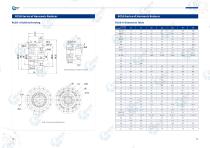
RCSG Series of Harmonic Reducer RCSG-II Outline Drawing L10i0.2 RCSG-II Dimension Table Wave Generator of model 14and 17 Note: L9 isthe limited dimension
Open the catalog to page 4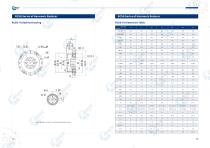
RCSG Series of Harmonic Reducer RCSG-III Dimension Table RCSG-III Outline Drawing K JS9 01 H7 Note: 4>B, (f>E, L4, and L7 are the limited dimensions
Open the catalog to page 5All Reach Machinery Co.,Ltd. catalogs and technical brochures
 Electromagnetic Brakes
8 Pages
 Electromagnetic Brakes
14 Pages
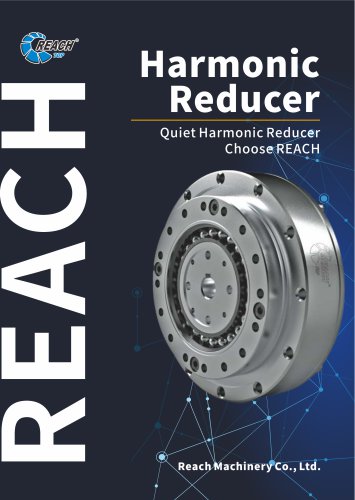 Harmonic reducer_REACH
72 Pages
 Couplings Reach@GS
59 Pages
 Couplings GR
59 Pages
 REACH 22
1 Page
 REACH 21
1 Page
 REACH 20
1 Page
 REACH 19
2 Pages
 REACH 18
1 Page
 REACH 17
1 Page
 REACH 16
1 Page
 REACH 15
1 Page
 REC
REC9 Pages
 RDC
RDC4 Pages
 RGE-GR
3 Pages
 REACH 13
1 Page
 REACH 12
1 Page
 REACH 11
1 Page
 REACH 07
2 Pages
 REACH 06
2 Pages
 REACH 05
2 Pages
 REACH 04
2 Pages
 REACH 03
2 Pages
 REACH 01
2 Pages
 REB18 Square hub
1 Page
 REACH 14
2 Pages
 REACH 02
1 Page


- Reach Machinery coaxial gear reducer
- Precision gearhead
- Compact gearhead
- Solid-shaft gearhead
- Flexible coupling
- Reach Machinery hollow-shaft gear reducer
- Shaft shaft coupling
- Reach Machinery friction brake
- Transmission gearhead
- Shaft gearhead
- Dual-stage gearbox
- High-performance gearhead
- Low-noise gearhead
- Low-backlash gearhead
- Torque coupling
- High-precision gearhead
- High-torque gearhead
- Reach Machinery robot gear reducer
- Rigid coupling
- Zero-backlash shaft coupling