
- Catalogs
- RDP Electronics
- Model RLC Compression Load Cell

Model RLC Compression Load Cell

Model RLC Compression Load Cell
- Excitation/supply: 0 to 15V (acceptable), 10V (calibrated)
- Output: 2mV/V ±10%
- Zero balance: ±2% F.S.
- Bridge resistance: 350/700 Ohms nominal
- Linearity error, Hysteresis, Repeatability: ±0.03% F.S.
- Resolution: Infinite
- Temperature coefficients: ±0.001% F.S./°F
- Operating temperature range: -4°F to 140°F
- Compensated temperature range: 14°F to 104°F
- Ingress protection: IP65
- Over-range capacity: 50%
- Material: Steel
- Electrical termination: 9.8ft integral cable
Catalog excerpts
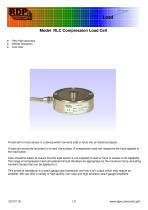
Load Model RLC Compression Load Cell ● ● ● Very high accuracy Infinite resolution Low cost A load cell or force sensor is a device which converts load or force into an electrical signal. A load cell should be mounted on a hard, flat surface. A compression load cell measures the force applied to the load button. Care should be taken to ensure that the load sensor is not exposed to load or force in excess of its capability. The range of compression load cell selected should therefore be appropriate for the maximum force (including transient forces) that can be applied to it. This series of transducer is a strain gauge type transducer and has a mV output which may require an amplifier. We can offer a variety of high quality, low noise and high precision strain gauge amplifiers.
Open the catalog to page 1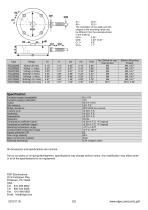
A1= 22.5° A2= 22.5° The orientation of the cable exit with respect to the mounting holes may be different from the example shown in the drawing. CD1= 0.54'' CD2= 0.20'' ±0.01'' CL1= 0.9'' CL2= 1.1'' Specification Excitation/supply (acceptable) Excitation/supply (calibrated) Output Zero balance Bridge resistance Linearity error Hysteresis Repeatability Resolution Temperature coefficient (zero) Temperature coefficient (span) Operating temperature range Compensated temperature range Ingress protection (IP) Over-range capacity Major construction material Electrical termination All dimensions and...
Open the catalog to page 2All RDP Electronics catalogs and technical brochures
 Model RLT Tension Load Cell
2 Pages


Archived catalogs

- Tension/compression force transducer
- Steel load cell
- Strain gauge force sensor
- Stainless steel force transducer
- Signal amplifying integrated circuit
- Displacement transducer
- Linear displacement sensor
- Precision force transducer
- Signal conditioner
- Analog displacement transducer
- Button type resistive load cell
- Voltage amplifier
- Metal displacement sensor
- Sensor signal conditioner
- Electronic amplifier
- Digital amplifier
- LVDT displacement sensor
- DIN rail amplifier