
- Catalogs
- RCD Components
- CM300 SERIES

CM300 SERIES

CM300 SERIES
- 300W power capacity with a compact and low-profile design.
- Non-inductive and lightweight construction.
- High stability and reliability.
- Wide resistance range with up to 5KV insulation voltage.
- Virtually vibration-proof.
- Operating temperature range from -55°C to +175°C.
- RoHS compliance as standard.
- Military burn-in/screening and various design modifications available.
- Customizable features such as flexible leads, custom values, markings, and lead/Pb terminations.
Suitable for use with air- or water-cooled heat sinks. The CM300's proprietary flame retardant epoxy insulation provides optimal environmental protection and dielectric strength. Ideal for applications in inverters, power supplies, laser systems, DC-DC converters, X-ray/radio frequency generators, medical equipment, snubber circuits, bypass and coupling circuits, and other high voltage or high power applications.
- Power Rating: 300W at flange temperature <= +25°C.
- Resistance Range and Tolerance: 0.1Ω to 1MΩ; standard tolerances of 2%, 5%, and 10%.
- Temperature Coefficient: ±100ppm from +25°C to +125°C, except optional L in low values.
- Operating Temperature Range: -55°C to +175°C, measured at flange surface.
- Max Working Voltage: 1000V (up to 2000V available).
- Dielectric Strength: 2KVAC (up to 5KV available) for 60 seconds between terminal and flange.
- Load Life Stability: ±1% over continuous power for 1000 hours.
- Moisture Resistance: ±1% at 60°C, 90-95% RH for 1000 hours.
- Insulation Resistance: >1000 Megohms between terminals and flange.
- Derating: 300W at 25°C to 0W at 175°C, derate linearly.
- Thermal Impedance: 0.23W/°C from resistor to flange.
CM300 L - 104 - J W (Type, Optional Insulation Leads, Resistance Code, Tolerance, Termination)
Catalog excerpts
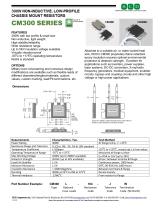
300W NON-INDUCTIVE, LOW-PROFILE CHASSIS MOUNT RESISTORS Terni.W is RoHS compliant CM300 SERIES FEATURES 300W with low profile & small size Non-inductive, light weight High stability/reliability Wide resistance range Up to 5KV insulation voltage available Virtually vibration-proof -550C to +1750C operating temperature RoHS is standard OPTIONS Military burn-in/screening and numerous design modifications are available such as flexible leads of different diameters/lengths/materials, custom values, custom marking, lead/Pb terminations, etc. Attached to a suitable air- or water-cooled heat sink, RCD’s CM300 proprietary flame retardant epoxy insulation ensures optimal environmental protection & dielectric strength. Excellent for applications such as inverters, power supplies, laser systems, DC-DC converters, X-ray/radio frequency generators, medical equipment, snubber circuits, bypass and coupling circuits and other high voltage or high power applications. RCD Components Inc, 520 E. Industrial Park Dr, Manchester, NH, USA03109 rcdcomponents.com Tel: 603-669-0054 Fax: 603-669-5455 Emailsalesmcdcomponents.com FA120 Sale of this product is n accordance with GF-C61. Specifications subject to charge 'without notice, Type Optional Insul. Leads Resistance Tolerance Termination Code Code Code (W=RoHS)
Open the catalog to page 1All RCD Components catalogs and technical brochures
 CUSTOM HYBRID PRODUCTS
1 Page
 CA, CH, CV SERIES
1 Page
 TS-TSE SERIES
1 Page
 CEA SERIES
1 Page
 CE SERIES
1 Page
 RS1014 SERIES
1 Page
 R SERIES
1 Page
 P SERIES
1 Page
 AL
AL1 Page
 HL SERIES
1 Page
 PR SERIES
1 Page
 PRM SERIES
1 Page
 PCN SERIES
1 Page
 CER SERIES
1 Page
 TR SERIES
1 Page
 RC SERIES
1 Page
 RG-RH-RP series
1 Page
 UHV SERIES
1 Page
 SR SERIES
1 Page
 CHIP RESISTOR KITS
1 Page
 ISOLATION TRANSFORMERS
1 Page
 CFZ SERIES
1 Page
 CC SERIES
1 Page
 600 SERIES
1 Page
 RCD's catalog
115 Pages


- Temperature probe
- Transformer
- Dry transformer
- Resistance temperature sensor
- Capacitor
- Encapsulated transformer
- Power transformer
- Ceramic capacitor
- SMD capacitor
- Wire-wound resistor
- Board-mount resistor
- Power resistor
- Choke coil
- Multilayer capacitor
- Chip capacitor
- Housed resistor
- Wire-wound inductor
- Current inductor
- Thin-film resistor
- Magnetic inductor