


- Company
- Products
- Catalogs
- News & Trends
- Exhibitions
2023 FULL CATALOGUE

2023 FULL CATALOGUE
This section provides an overview of RAYPA's product offerings, focusing on vertical and benchtop autoclaves. The catalogue is divided into the Top Line and Classic Line, each with specific series and models for different applications.
The document compares vertical and benchtop autoclaves, detailing differences in load capacity, sterilization chamber specifications, and user interface features. Key parameters such as temperature range, pressure limits, and sterilization technology are highlighted.
The Top Line series includes the TLV-S, TLV-PD, and TLV-FA series, designed for multipurpose use, enhanced drying, or fast cooling. Accessories to enhance functionality are also listed.
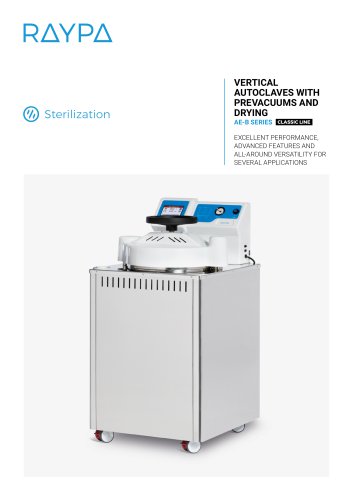
The Classic Line includes the AES, AE-DRY, and AE-B series, catering to general laboratory needs with options for drying and pre-vacuum features. Accessories for these models are detailed.
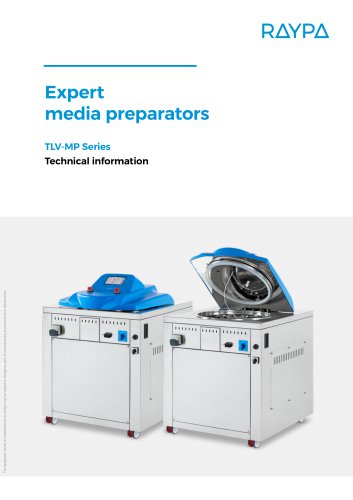
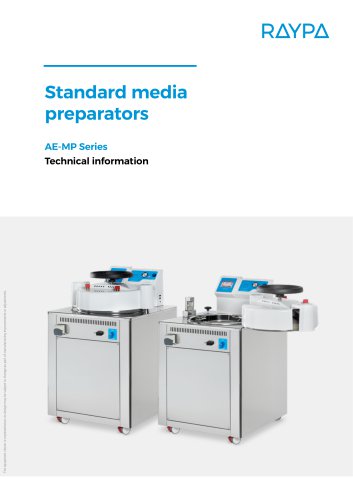
The AE-MP series media preparators automate the preparation of culture media, with listed accessories.
The executive message discusses challenges faced in 2022, such as the COVID-19 pandemic and supply chain disruptions, and highlights RAYPA's success and growth through strategic development and digitalization.
The history section outlines key milestones from the company's founding in 1974 to recent achievements, including ISO certifications and new product launches.
This section emphasizes RAYPA's global reach, customizable product range, effective technical service, commitment to innovation and quality, and comprehensive consultancy services.
The document details RAYPA's certifications, including ISO 9001:2015 and ISO 13485:2016, ensuring compliance with international quality and safety standards.
General Classification: All models are designed for general laboratory use, with top-loading and front-loading options.
Compatible Applications: Suitable for sterilizing culture media, liquids, laboratory waste bags, and glassware.
Sterilization Chamber and Door Specifications: Chamber volumes range from 8L to 79L, with AISI-316L stainless steel construction. Maximum temperature is 134°C, and maximum pressure is 2.1 Barg.
Water Management: Options for multiple-use and single-use tanks, with automatic tap water supply and water pumps.
User Interface and Microprocessor: Displays range from digital LCD to TFT touchscreens, with automatic microprocessor control and timer start features.
Sterilization Technology Features: Steam generation methods include heating elements and steam generators, with gravitational and vacuum purge types.
Data Management: Internal memory cycle limits range from 150 to 200 cycles, with optional printers for data output.
Regulations and Certifications: Models comply with ISO 13485:2016, UL/CSA electric design, CE marking, and Pressure Equipment Directive 2014/68/EU.
These autoclaves feature advanced connectivity, compliance with FDA, GMP, and GLP standards, and fast cooling systems for liquid sterilization. They offer total control, advanced technical assistance, and professional traceability.
Specifications: Chamber volumes range from 56L to 155L, with power requirements of 3600W to 9000W. They feature a 7” capacitive touchscreen, automatic water feed, and instant steam production.
Operation: Phases include prevacuum, heating, sterilization, and cooling, with vacuum drying and programmable auto start-up in advanced models.
These models provide advanced sterilization of solids with a super drying system, featuring a water-ring vacuum pump and heating jacket. They are fully automatic with advanced connectivity and technical support.
The document provides detailed information about the TLV-FA Series vertical autoclaves, designed for advanced sterilization of liquids and other materials. These autoclaves feature a fast cooling system, modern design, and advanced connectivity options.
Key Features
- Advanced sterilization with a fast cooling system using an internal radial fan, water cooling coils, and pressure support.
- Modern, ergonomic design with automatic features such as a push-button-controlled door and automatic water filling.
- Connectivity options include PC, cloud, intranet, and LIMS, compliant with FDA, GMP, and GLP standards.
- Instant steam production and a built-in vacuum pump for the prevacuum phase.
- Culture media and liquids
- Glassware
- Laboratory waste bags
- Biohazardous waste
- Chamber volumes range from 58 to 169 liters with varying dimensions and power requirements.
- Maximum temperature and pressure are 140°C and 2.6 Barg, respectively.
- Equipped with a 7” color capacitive touchscreen and compliance with FDA 21 CFR Part 11 and GMP Annex 11.
- Prevacuum Phase: Air is purged with a vacuum pulse, and steam is injected.
- Sterilization Phase: Temperature is maintained for a predefined duration.
- Cooling Phase: Fast cooling with pressure support and water circulation.
- Various baskets and trays for different load types, made of AISI-304 stainless steel.
- Flexible temperature probes for precise sterilization control.
- Height adjustable tray supports and integrated basket lift systems for ease of use.
- Controller adaptation for FDA compliance with audit trail functions.
- RAYPAcloud licenses for cloud-based connectivity and data management.
- Embedded and external printers for cycle documentation.
The document also describes the Classic Line vertical autoclaves, which are economical and robust, suitable for basic sterilization needs. They feature a top-loading design and are available in various models with chamber sizes ranging from 33 to 175 liters.
This document provides detailed specifications and operational procedures for various models of vertical autoclaves, specifically focusing on the AE-DRY and AE-B series. These autoclaves are designed for efficient sterilization and drying of laboratory materials, offering robust performance and resource efficiency.
Specifications
The autoclaves are controlled by a digital PID microprocessor with four predefined and six editable programs. They allow adjustments in sterilization time, temperature, and mode (agar or flexible probe). The sterilization chamber is made of AISI-316L stainless steel, with external housing of AISI-304 stainless steel. Maximum temperature and pressure are 134°C and 2.1 Barg, respectively.
Operation
The operation involves several phases: heating, sterilization, and cooling. In solids programs, a vacuum drying phase is included. The AE-B series features a built-in steam generator for immediate steam production and multiple prevacuum pulses for effective steam penetration.
Models and Capacities
Models vary in chamber volume, dimensions, and power options. For example, the AE-28-DRY model has a chamber volume of 33/31 liters and operates at 2000 or 3200 watts, while the AE-150-DRY model has a chamber volume of 175/153 liters and operates at 6000 or 9000 watts.
Benefits
The AE-DRY series is noted for its cost-effectiveness and ease of installation, requiring no specific connections. The AE-B series offers advanced features like a 5'' touchscreen display and 50 customizable programs, suitable for complex and bulky loads.
Applications
These autoclaves are suitable for sterilizing culture media, liquids, plastics, metal objects, glassware, laboratory waste bags, porous solids, and wrapped objects.
Accessories
Various accessories are available, including flexible probes, thermal printers, software for cycle recording, and basket lift systems. These enhance the functionality and ease of use of the autoclaves.
Conclusion
The document outlines the technical capabilities and operational procedures of the AE-DRY and AE-B series autoclaves, highlighting their suitability for diverse laboratory applications and their advanced features for efficient sterilization and drying processes.
This document provides detailed specifications and features of various autoclave models and their accessories. It includes information on lift systems, casters, trolleys, water filling systems, and other components designed to enhance the functionality and efficiency of autoclaves.
Lift Systems
The document describes two main lift systems: the Classic-Lift and the Mobile Basket Lift System. The Classic-Lift is available in standard and reinforced models, with dimensions and power specifications provided. The Mobile Basket Lift System is a stainless steel electric lift with casters, designed for easy loading and unloading of items up to 30Kg, featuring a long-life battery for cordless use.
Casters and Trolleys
Premium casters are available for upgrading autoclaves to improve mobility. A transport trolley made of chrome iron and plastic is also described, designed to aid in loading and unloading equipment, featuring textured shelves and rubber casters.
Water Filling Systems
The document outlines automatic water filling systems compatible with certain autoclave series, including a water pump and a purified water tank. It also describes an eco-efficient water purifier and a condensates tank for storing purified water.
Temperature and Validation Accessories
Accessories for temperature monitoring and validation include a cable gland for external temperature probes, an external temperature probe adapter, and a temperature data logger. These are essential for calibration and validation procedures.
Warranty and Qualification
The document mentions a standard 12-month warranty extendable to three years, and offers IQ/OQ/PQ qualification services with model-specific instructions.
Spare Parts and Maintenance
A set of essential spare parts is available to support the recommended maintenance plan, aiming to maximize equipment lifespan and minimize downtime.
Classic Line Autoclaves
The Classic line includes benchtop autoclaves with compact designs and robust performance. They are available in front-loading and top-loading models, with various chamber sizes and features such as fast steam-release valves, flexible probes, and optional control software.
Specifications and Operation
Detailed specifications for different models, including AES and AHS series, are provided. The operation phases of heating, sterilization, and cooling are explained, highlighting the use of Incoloy® 825 heating elements and digital PID microprocessor control.
Front-Loading Autoclaves with Drying
The AHS-DRY series features front-loading autoclaves with drying capabilities, equipped with a heating jacket and vacuum pump for complete drying of solid loads. They offer automatic water supply and optional upgrades for enhanced functionality.
The document provides detailed information on the specifications, features, and applications of the AHS-B Series benchtop autoclaves, designed for sterilization processes in laboratory settings. These autoclaves are equipped with advanced features for efficient sterilization of various materials, including wrapped and porous objects, textiles, and complex geometries.
Specifications
The autoclaves come in different models with varying chamber volumes (22L, 55L, 79L) and dimensions. They feature a built-in steam generator, heating jacket, and vacuum pump for effective sterilization and drying. The maximum temperature and pressure are 134°C and 2.1 Barg, respectively. They are equipped with a 5’’ TFT-LCD touchscreen and offer 50 customizable programs.
Features and Benefits
The AHS-B Series autoclaves provide immediate production of high-quality saturated steam and are suitable for sterilizing a wide range of materials. They include a mechanical purge system for steam penetration, a compact design, and a front-loading format. Additional features include programmable automatic start-up, automatic water supply, and user administration control.
Operation
The sterilization process involves multiple phases: prevacuum, heating, sterilization, vacuum drying, and cooling. The autoclaves ensure complete dryness of solid loads through a vacuum drying phase.
Accessories
A variety of accessories are available, including wire trays, baskets, bag holders, containers with filters, flexible probes, and printers. These accessories enhance the functionality and adaptability of the autoclaves for different sterilization needs.
Software and Additional Equipment
SW7000 and SW8000 software facilitate communication between the autoclaves and PCs for cycle display and recording. Additional equipment includes transport trolleys, autoclave tables, and water purification systems.
Applications
The autoclaves are suitable for sterilizing culture media, liquids, plastics, metal objects, glassware, laboratory waste bags, and porous solids. They are designed to optimize workflow in microbiology and plant tissue culture laboratories.
Conclusion
The AHS-B Series benchtop autoclaves offer a comprehensive solution for efficient and safe sterilization processes, with a range of customizable options and accessories to meet diverse laboratory needs.
The document provides detailed information on media preparators and food analysis equipment, highlighting their applications, specifications, and available accessories. It covers the preparation of culture media, sterilization processes, and food analysis methods.
Applications
Media preparators are used for preparing agar, lysogeny broth, buffer solutions, and in microbiology laboratories, plant tissue culture, and cultivation of plant stem cells for cosmetics. Food analysis equipment is used in the food industry, animal feed, environmental analysis, pharmaceutical, and chemical industries.
Specifications
Media preparators offer 50 adjustable programs, direct water supply, and easy cleaning features. They include a USB port for data download and Ethernet connectivity. The sterilization chamber is made of AISI-316L stainless steel, with fast cooling capabilities and a high-power magnetic stirrer.
Operation
The operation involves heating, sterilization, and cooling phases. The heating phase uses powerful elements to produce steam, followed by a sterilization phase where temperature is maintained. The cooling phase uses water coils for rapid cooling.
Accessories
Various accessories are available, including eco-efficient water purifiers, external dosing stations, additional peristaltic pumps, compressed air systems, and automatic water filling systems. These enhance the functionality and efficiency of the media preparators.
Food Analysis Equipment
The document also details food analysis equipment like the MBC Series compact block digestion system, DNP Series Kjeldahl distillers, SX-6 fat extractor, and F-6P fibre extractor. These devices are equipped with Wi-Fi connectivity and the RAYPAnet platform for data management.
New Technologies
The introduction of a new touchscreen microprocessor offers an intuitive interface, advanced cycle programming, and safety alarms. The RAYPAnet platform allows for real-time data viewing and export.
Conclusion
The document provides comprehensive information on the capabilities and specifications of media preparators and food analysis equipment, emphasizing their applications, operational phases, and available accessories to enhance laboratory efficiency.
The document provides detailed specifications and features of an oenologic distiller designed for the analysis of alcoholic beverages. It highlights the equipment's capabilities, safety features, and compliance with industry standards.
Specifications and Features
- Stainless steel external housing with a 5” color touchscreen and Wi-Fi connectivity for result analysis on RAYPAnet.
- Automatic distillation compatible with drinks of any alcoholic strength, featuring an optimized cooling circuit.
- Includes 10 preset programs for common applications based on alcohol content and sample volume.
- Built-in steam generator with adjustable power and automatic water level control, and a pump for automating dilution water addition.
- Accurate and reproducible results in accordance with standardized analysis procedures.
- Compliance with OIV, EEC 2676/90, and EC 2870/2000 standards.
- Measurement of alcoholic strength by volume.
- Analysis of volatile acidity and sorbic acid.
- External dimensions: 520 x 360 x 910 mm; Weight: 27 Kg; Power: 2000 W; Voltage: 230 V.
- Steam generator water consumption: 1.6 L/h; Cooling water flow rate: 3 L/min.
- Distillation time: 7 min/200 mL.
- Precision glass alcoholometer with various models available for different alcoholic strengths.
- Distillation tube rack and volumetric flasks for sample collection.
- Offers preventive maintenance contracts and custom plans for comprehensive maintenance.
- Provides calibration certificates, technical support, and training sessions.
- On-site start-up and verification of correct installation.
- ISO 9001:2015 certified, CE marking, and compliance with the European Commission’s Pressure Equipment Directive.
- Products are free from environmentally hazardous substances.
- Compliance with FDA 21 CFR Part 11 and GMP Annex 11 for cloud-based connectivity.
- Website: www.raypa.com/en/
- Email: [email protected]
- Phone: +34 937 830 720 (Ext: 2109)
Catalog excerpts

Autoclaves & Food Analysis
Open the catalog to page 1
05 Message from the executive team 06 Our history 07 Why choose RAYPA? 08 Autoclaves 11 Portfolio overview 12 Technical comparison of vertical autoclaves 14 Technical comparison of benchtop autoclaves 16 Load capacity of vertical autoclaves TOP LINE 18 Introduction Top line vertical autoclaves 22 TLV-S Series multipurpose vertical autoclaves 24 TLV-PD Series vertical autoclaves with super drying system 26 TLV-FA Series vertical autoclaves with fast cooling system 28 Accessories CLASSIC LINE 34 Introduction Classic line vertical autoclaves 36 AES Series vertical autoclaves without drying 38 AE-DRY...
Open the catalog to page 2
Dear collaborators, The year 2022 shall forever be remembered as a time of significant challenges and unprecedented events. The COVID-19 pandemic, the energy crisis resulting from the conflict in Ukraine, and disruptions to the global supply chain have necessitated major adjustments to our personal and professional lives. As a company and a global community, we have faced these challenges together. Despite the uncertainty and difficulty of the pasts years, RAYPA has experienced one of its most successful years to date. We take great pride in having been able to collaborate with scientists and...
Open the catalog to page 4
1974 Ramón Espinar establishes a boilermaking company, which serves as the foundation for the present-day organization. 2008 The founder’s daughter and son, Teresa and Ramon, assume leadership of the company, with a focus on specialization in autoclaves and food analysis. 2019 Launch of TLV-S, TLV-PD and TLV-FA Series autoclaves with state-of-the-art technology and the most advanced connectivity on the market. 2015 Launch of the AE-B and AHS-B Series autoclaves for sterilizing wrapped loads and objects of complex geometries. 1987 Launch of the first generation of AES, AHS-N, AE-DRY and AHS-DRY...
Open the catalog to page 5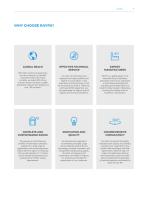
WHY CHOOSE RAYPA? GLOBAL REACH With half a century of experience, we have a long list of satisfied customers around the world. Currently, we export 85% of our annual turnover and have a stable distribution network with presence in over 100 countries. EFFECTIVE TECHNICAL SERVICE Our team of technicians and engineers are highly qualified and experts in our products. If you experience a technical issue, it will be our priority to rectify it. When you purchase RAYPA equipment, you are guaranteed the highest level of support and technical assistance. EXPERT MANUFACTURER RAYPA is a global leader in...
Open the catalog to page 6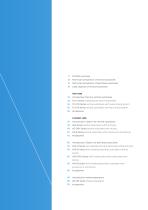
11 Portfolio overview 12 Technical comparison of vertical autoclaves 14 Technical comparison of benchtop autoclaves 16 Load capacity of vertical autoclaves TOP LINE 18 Introduction Top line vertical autoclaves 22 TLV-S Series multipurpose vertical autoclaves 24 TLV-PD Series vertical autoclaves with super drying system 26 TLV-FA Series vertical autoclaves with fast cooling system 28 Accessories CLASSIC LINE 34 Introduction Classic line vertical autoclaves 36 AES Series vertical autoclaves without drying 38 AE-DRY Series vertical autoclaves with drying 40 AE-B Series vertical autoclaves with prevacuums...
Open the catalog to page 8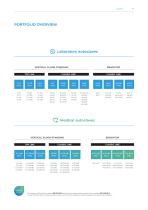
PORTFOLIO OVERVIEW @ Laboratory autoclaves VERTICAL FLOOR-STANDING TLV-S TLV-PD TLV-FA Series Series Series Series Series Series Series AVS-N AHS-N AHS-DRY AHS-B Series Series Series Series Medical autoclaves VERTICAL FLOOR-STANDING TLV-S-MD Series TLV-PD-MD Series TLV-FA-MD Series AES-MD Series AE-DRY-MD Series AHS-N-MD Series AHS-DRY-MD Series AHS-B-MD Series This company is certified with the regulation ISO 9001:2015 and has a line of medical autoclaves certified with the regulation ISO 13485:2016. For more information about our medical autoclaves, please consult the specific catalogue for...
Open the catalog to page 10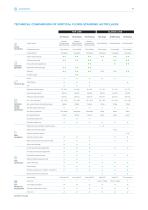
Continued on next page
Open the catalog to page 11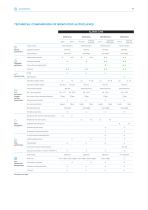
Continued on next page
Open the catalog to page 13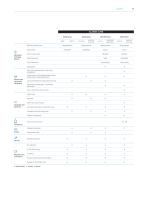
+: Recommended V: Included O: Optional
Open the catalog to page 14
Autoclave model Total baskets Units/ basket Total units Total baskets Units/ basket Total units Total baskets Units/ basket Total units Total baskets Units/ basket Total units A: Number of units using standard baskets. B: Number of units using specially designed baskets for the specific combination of autoclave model and container. The data contained within these tables, regarding load capacities, serves as a non-binding guide to assist you in the selection of the most appropriate autoclave model.
Open the catalog to page 15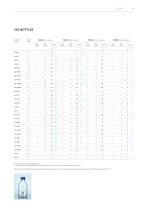
ISO BOTTLES Autoclave model Total baskets Units/ basket Total units Total baskets Units/ basket Total units Total baskets Units/ basket Total units Total baskets Units/ basket Total units A: Number of units using standard baskets. B: Number of units using specially designed baskets for the specific combination of autoclave model and container. The data contained within these tables, regarding load capacities, serves as a non-binding guide to assist you in the selection of the most appropriate autoclave model.
Open the catalog to page 16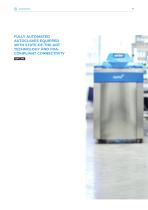
FULLY AUTOMATED AUTOCLAVES EQUIPPED WITH STATE-OF-THE-ART TECHNOLOGY AND FDA-COMPLIANT CONNECTIVITY
Open the catalog to page 17
Top line vertical autoclaves
Open the catalog to page 18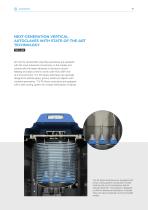
NEXT-GENERATION VERTICAL AUTOCLAVES WITH STATE-OF-THE-ART TECHNOLOGY TOP LINE All Top line vertical floor-standing autoclaves are equipped with the most advanced connectivity on the market and comply with the latest advances in electronic record keeping and data control to work under FDA, GMP and GLP environments. TLV-PD Series autoclaves are specially designed to sterilize glass, porous solids and objects with complex geometries. TLV-FA Series autoclaves are equipped with a fast cooling system for a faster sterilization of liquids. TLV-FA Series autoclaves are equipped with a fast cooling system...
Open the catalog to page 19
Top line vertical autoclaves TOTAL CONTROL, ADVANCED TECHNICAL ASSISTANCE AND PROFESSIONAL TRACEABILITY Custom reports Unlimited data storage Audit trail and SSL encryption User administration control with passwords Integrated device management RAYPASUPPORT TeamViewer® for screen sharing with the technical service Remote monitoring of equipment status Contact the technical service from within the device (email and SMS) Remote maintenance and diagnostics Protocol history Video instructions Advanced cycle programming Real-time program display 7” colour display capacitive touchscreen Ticket and...
Open the catalog to page 20All RAYPA catalogs and technical brochures
 Media preparators
19 Pages
 RANDALL EXTRACTOR - SX-6
9 Pages
 FIBRE EXTRACTOR - F-6P SERIES
10 Pages
 OENOLOGIC DISTILLER - ENODEST
10 Pages
 KJELDAHL DIGESTER - MBC SERIES
12 Pages
 KJELDAHL DISTILLER - DNP SERIES
16 Pages




- Heat sterilizer
- Process sterilizer
- Sterilization autoclave
- Process autoclave
- Automatic autoclave
- Extraction unit
- Steam sterilizer
- Sterilizer for the food industry
- Automatic distillation unit
- Vacuum autoclave
- Automatic sterilizer
- Laboratory distillation unit
- Digestion system
- Top-loading autoclave
- Compact autoclave
- Autoclave for the food industry