

XLTbend

XLTbend
Document Overview
The document appears to be a technical file containing a mixture of encoded or corrupted data, interspersed with some structured technical content. Due to the presence of non-readable characters and fragmented text, the document's full context is unclear. However, identifiable sections suggest it includes specifications, procedural instructions, and possibly standards or recommendations related to a technical or engineering domain.
Main Sections Identified
1. Specifications and Parameters
The document references various parameters and numeric values, possibly related to measurements, tolerances, or configuration settings. These include sequences of numbers and symbols that might correspond to technical specifications or calibration data.
2. Procedures and Instructions
There are indications of procedural steps or operational guidelines, though the exact nature is obscured by corrupted text. Some segments suggest stepwise instructions or workflow sequences, potentially for equipment setup or testing.
3. Standards and Norms
Mentions of standards or normative references appear, possibly indicating compliance requirements or quality benchmarks. Specific codes or abbreviations hint at adherence to industry or regulatory standards.
4. Recommendations and Best Practices
Scattered references imply recommendations or best practices, likely aimed at optimizing performance or ensuring safety. These are not clearly delineated but may be embedded within procedural content.
Data Tables and Graphical Elements
The document contains multiple sequences resembling tables or data arrays, with numeric and symbolic entries. Due to encoding issues, the exact data content and graphical representations cannot be reliably extracted or interpreted.
Critical Information and Limitations
- The document is heavily corrupted or encoded, limiting comprehensive analysis.
- Key technical parameters and procedural elements are present but fragmented.
- Clear identification of standards or normative references is partial.
- Recommendations and best practices are implied but not explicitly detailed.
Summary
This technical document includes specifications, procedural guidelines, and references to standards within a technical domain. However, due to significant encoding or corruption issues, the content is fragmented and partially unreadable. Extraction of precise data, detailed procedures, or explicit normative references is not feasible. The document likely serves as a technical reference or manual but requires a clean, decoded version for full comprehension and application.
Catalog excerpts

RAS REINHARDT MASCHINENBAU GMBH
Open the catalog to page 1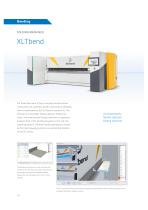
Bending FOLDING MACHINES For those who want to form complex precision sheet metal parts like cassettes, panels, and boxes profitability even in small batches, the XLTbend is a perfect fit. The XLTbend is a incredibly flexible UpDown folding machine. The revolutionary Bendex software for automatic programming of the bending sequence, front and rear operating options, ViN laser loading assistance, as well as the hybrid gauging system are outstanding features of the XLT series. An impressively flexible UpDown folding machine
Open the catalog to page 2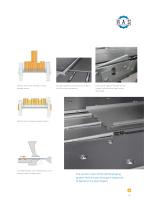
Machine with center extended T shape gauging system. Accurate alignment of long and narrow parts with the active squaring arm. If the outside edges of the blank are not straight, individual stop fingers can be deactivated. Extended flexibility, as the folding beam can be used as a stop for oblique parts. The suction cups of the hybrid gauging system hold the part through a sequence of bends to the stop fingers 35
Open the catalog to page 3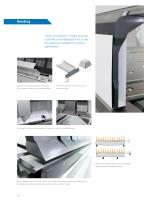
Tools up to 400mm in height and also tools with extremely large front or rear free space are available for special applications. Some materials require the use of radius tools in the upper and lower beams. Combined with folding beam tools with plastic inserts, perfect surfaces will be created.
Open the catalog to page 4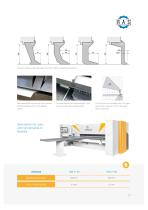
When working from the rear, the ViN also shows the blank loading position on the gauging system. The laser beam of the Virtual Navigator (ViN) shows the exact part loading position. The XLTbend is also available with a 45° upper beam when clearance in front of the upper beam is important. XLTbend RAS 71.30 RAS 71.40 BENDING LENGTH MAX.
Open the catalog to page 5
RAS Reinhardt Maschinenbau GmbH Richard-Wagner-Stralie 4-10 71065 Sindelfingen
Open the catalog to page 6All RAS Reinhardt Maschinenbau GmbH catalogs and technical brochures
 Production Program
76 Pages
 Seam Closing Machine 25.15
4 Pages
 Flanging Machine 21.20
4 Pages
 Swaging Machine EASYformer
4 Pages
 SMARTcut
4 Pages
 PRIMEcut
4 Pages
 POWERcut2
4 Pages
 XXL-Center
4 Pages
 XL-Center
4 Pages
 UpDownCenter 2
4 Pages
 ProfileCenter
4 Pages
 TURBObend
4 Pages
 TURBO2plus
4 Pages
 MEGAbend
4 Pages
 GIGAbend
4 Pages
 FLEXI2bend
4 Pages
 MiniBendCenter-2
6 Pages
 Multibend-Center
10 Pages
 Multibend-Center ECO
6 Pages
 Multibend-Center ECOauto
6 Pages

- Automation software solution
- Management software solution
- Analysis software solution
- Bender
- Control software
- 3D software solution
- Lifting system
- Simulation software solution
- Programming software solution
- Network software
- Profile bender
- Machine software
- Automatic bending cell
- Sheet metal shear
- 2D software
- Plate bending machine
- Rollformer
- Manual bending machine
- Precision bending cell
- Profile roll forming machine