


BASE STATION FACT SHEET

BASE STATION FACT SHEET
The document discusses the challenges and solutions related to synchronization in Macro Base Stations, particularly in the context of mobile networks transitioning to packet-based backhaul mechanisms. It highlights the importance of OCXOs (Oven Controlled Crystal Oscillators) in maintaining synchronization when GNSS signals fail.
OCXO Family Specifications
The document provides specifications for different OCXO models:
- RMO - MercuryTM: Frequency range of 10 to 26 MHz, stability of 10 ppb pk-pk, temperature range of -40 to 85°C, holdover stability of < 100 µs/day, and ageing stability of ±1 ppb/day, supporting Stratum 3.
- ROX - S4/T5: Frequency range of 10 to 65 MHz, stability of ±5 ppb, temperature range of -40 to 85°C, holdover stability of < 50 µs/day, and ageing stability of ±1 ppb/day, supporting Stratum 3E.
- ROX - T3: Frequency range of 5 to 40 MHz, stability of ±1 to 5 ppb, temperature range of -40 to 85°C, holdover stability of < 15 µs/day, and ageing stability of ±0.5 ppb/day, supporting Stratum 3E.
- ROX - T2: Frequency range of 5 to 15 MHz, stability of ±0.2 ppb, temperature range of -40 to 85°C, holdover stability of < 5 µs/day, and ageing stability of ±0.05 ppb/day, supporting Stratum 2.
Synchronization Challenges and Requirements
The document outlines the challenges in synchronizing Macro Base Stations, primarily due to the reliance on GNSS for network timing, which can be disrupted by environmental factors or jamming. It discusses the transition from circuit-switched to packet-switched networks, which necessitates the use of Synchronous Ethernet and packet-based synchronization techniques.
Base Station Solutions
Rakon offers a range of OCXOs designed for Base Station applications, emphasizing the importance of holdover performance and the ability to maintain synchronization in the absence of GNSS signals. The document details the specifications for various radio technologies and base station types, including frequency accuracy and phase error requirements.
Rakon OCXO Key Specifications
The document highlights the key specifications of Rakon's OCXOs, including their holdover performance and suitability for different synchronization designs. It emphasizes the importance of selecting oscillators based on holdover and loop bandwidth requirements, as well as phase noise considerations.
Conclusion
Rakon's expertise in oscillator solutions is highlighted, with a focus on their ability to provide stable synchronization solutions for packet networks. The document concludes with a summary of Rakon's testing and characterization of oscillators under various environmental conditions.
Catalog excerpts
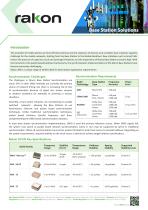
Base Station Solutions Introduction The evolution of mobile phones as Smart Wireless Devices and the explosion of devices such as tablets have created a capacity challenge for the mobile networks, starting from the Base Station to the Mobile Backhaul. New initiatives such as Small Cells reduce the pressure of capacity crunch and coverage limitations, but the importance of Macro Base Stations remains high. With the transition to the packet based backhaul mechanisms, the synchronisation implementations of the Macro Base Stations have become extremely challenging. Rakon offers a unique range of OCXOs ideal for Base Station application requirements. Synchronisation Requirements Synchronisation Challenges The challenges in Macro Base Station Synchronisation are many. GPS or other GNSS methods are currently the primary source of network timing, but there is increasing risk of loss of synchronisation because of signal loss (urban canyons or weather conditions for example) or jamming in various situations. Secondly, circuit switch networks are transitioning to packet switched networks allowing the Base Stations to use Synchronous Ethernet and packet based synchronisation techniques. Unlike traditional synchronisation techniques, packet based solutions transfer frequency and time, complementing the GNSS based synchronisation solutions. Radio Technology Base Station Type Frequency Accuracy Macro Pico / Femto Wide Area Local Area Home Wide Area Local Area Home Phase Error In most base station synchronisation implementations, GNSS is used the primary reference source. When GNSS signals fail, the system may switch to packet based network synchronisation, which in turn may be supported by SyncE or traditional synchronisation. When all synchronisation sources fail, systems fall back to local clock source to provide holdover. Depending on the system requirements, required stability on the clock source is desired to achieve target holdover specifications. Rakon OCXO Key Specifications Frequency Range Stability (FvsT) Temperature Range Holdover Stability Ageing Stability Supported Stability Level OCXO Family New Zealand (HQ) Auckland | China Beijing, Shanghai & Shenzhen | France Argenteuil, Mougins & Pont Sainte Marie | Germany Bad Rappenau | Singapore Singapore City | South Korea Seongnam City | Taiwan Taipei City | United Kingdom Harlow | United States Chicago & Silicon Valley
Open the catalog to page 1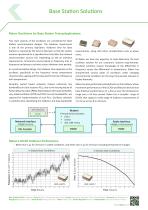
Base Station Solutions Rakon Oscillators for Base Station Timing Applications Two main aspects of the oscillators are considered for Base Station synchronisation designs. The holdover requirement is one of the primary objectives. Holdover time for Base Stations is required by the Service Operator so that the system remains operational for a specified time limit after the network synchronisation sources fail. Depending on the air interface requirements, constraints may be placed on frequency only or frequency and phase to achieve certain holdover time periods. requirements, along with other considerations...
Open the catalog to page 2All Rakon catalogs and technical brochures
 RTF 1610 RevB
1 Page
 RSX-10v1
1 Page
 RSX-8 v1
1 Page
 LNO100 A4
9 Pages
 RXO7050R
7 Pages
 CIE03
CIE0311 Pages
 CIF0405
8 Pages
 CIF06
CIF069 Pages
 MO G01
3 Pages
 RFPO65
2 Pages
 RFPO60
2 Pages
 RFPO55
2 Pages
 RFPO50
2 Pages
 RFPO45
2 Pages
 RFPO40
2 Pages
 ROX2522S4
2 Pages
 ROX2525S4
2 Pages
 ROX2525T5
2 Pages
 ROX3627T3
2 Pages
 ROX3827T3
2 Pages
 ROX5242T2
2 Pages
 ROX5252T2
2 Pages
 ROX5252T1
2 Pages
 IT3200C
7 Pages
 IT2200J
7 Pages
 IT2200K
7 Pages
 IT2100F
2 Pages
 CFPT9050
9 Pages
 CFPT9000
12 Pages
 CFPT9300
9 Pages
 RFPT500
5 Pages
 RFPT400
5 Pages
 RPT5032N
2 Pages
 RPT7050N
2 Pages
 RPT5032P
2 Pages
 RPT7050P
2 Pages
 RPT5032J
2 Pages
 RPT7050J
2 Pages
 RPT5032A
2 Pages
 RPT7050A
2 Pages
 RHF7050A
2 Pages
 RHT1490J
2 Pages
 RHT1490A
2 Pages
 RFPT100
2 Pages
 RPT7050G
3 Pages
 RFPT200
7 Pages
 RFPT700
6 Pages
 RPT7050D
2 Pages
 RVX1490M
7 Pages
 RVX7050R
8 Pages
 RVX7050P
8 Pages
 RVX7050M
9 Pages
 RVX5032R
8 Pages
 RVX5032P
8 Pages
 RVX5032M
7 Pages
 RVX2520P
1 Page
 RVX2520R
1 Page
 RVG1490L
2 Pages
 RCV2520Q
1 Page
 RXO7050P
7 Pages
 RXO7050M
9 Pages
 RXO5032R
7 Pages
 RXO5032P
7 Pages
 RXO5032M
10 Pages
 RXO2520P
1 Page
 RXO2520R
1 Page
 RXG1490L
2 Pages
 RCX2520Q
1 Page
 QEN49
QEN494 Pages
 QEN55
QEN554 Pages
 RK115
RK1152 Pages
 CFPX3750
7 Pages
 CFPX3758
7 Pages
 CFPX3000
7 Pages
 RHC-49US
5 Pages
 RSX-5
RSX-55 Pages
 Synchronous Ethernet
2 Pages
 Base Station Solutions
2 Pages
 GNSS Based Synchronisation
2 Pages
 Small Cell Solutions
2 Pages
 The Internet of Things
2 Pages
 GNSS Positioning Solutions
2 Pages
 RGX-3
RGX-37 Pages
 RSX-8
RSX-810 Pages
 RSX10
RSX105 Pages
 RSX-11
5 Pages
 RSX1612
7 Pages
 RXT2520AT
6 Pages
 RXT2016AT
6 Pages
 RTF3215
1 Page
 RK 409
7 Pages
 RK 407
2 Pages
 CIF07
CIF076 Pages
 DEFENSE FACT SHEET
2 Pages
 SMALL CELLS FACT SHEET
2 Pages
 Space OCXO series RK 408
9 Pages
 Crystal filters FTF 1
2 Pages
 Rakon XO QEN79
4 Pages
 ULN USO Module Assembly
5 Pages


- Electronic oscillator
- Surface-mount oscillator
- Frequency oscillator
- OCXO oscillator
- Crystal resonator
- SMD oscillator
- Oscillator for telecom applications
- XO oscillator
- Voltage oscillator
- Phase oscillator
- Power oscillator
- Low-noise oscillator
- Clock oscillator
- Oscillator with connector
- Automated oscillator
- Plug-in oscillator
- High-stability oscillator
- VCO oscillator
- SAW oscillator