
- Catalogs
- RAE Systems
- Benzene - The Next Asbestos?


Benzene - The Next Asbestos?

Benzene - The Next Asbestos?
Benzene is a prevalent aromatic hydrocarbon found in gasoline, industrial solvents, and cigarette smoke. Its toxic properties have led to increased regulation and monitoring to protect those at risk of exposure.
History and Uses
Initially isolated from coal tar, benzene was widely used as an industrial solvent until its toxicity was recognized. Today, it is primarily derived from petroleum and used to produce chemicals like styrene, phenol, and cyclohexane. Approximately 238,000 workers in the U.S. are potentially exposed to benzene.
Characteristics and Health Effects
Benzene is a colorless liquid with a sweet odor, highly flammable, and slightly soluble in water. It is a known carcinogen affecting blood cell production and the immune system. Long-term exposure can lead to leukemia and other health issues.
Regulation and Monitoring
Regulatory bodies classify benzene as a known human carcinogen. OSHA's Permissible Exposure Limit (PEL) is 1 ppm over an 8-hour period, with stricter limits from other agencies. Monitoring methods include portable instruments and real-time systems, with accuracy requirements set by OSHA.
Monitoring Technologies
Various technologies are available for benzene detection:
- Single-use Gas Detection Tubes: Inexpensive but slow and prone to errors.
- Semiconductor or Metal Oxide Sensors (MOS): Inexpensive but not benzene-specific and less sensitive.
- GC/MS Lab Analysis: Highly sensitive but time-consuming and costly.
- Portable GC Systems: Selective but bulky and complex.
- Flame Ionization Detectors (FIDs): Sensitive but non-selective and complex.
- Photoionization Detectors (PIDs) with Filter Tubes: Optimal for real-time monitoring, providing rapid and accurate benzene-specific measurements.
Conclusion
Effective benzene monitoring is crucial for worker safety. PIDs with filter tubes offer a practical solution for real-time, accurate detection, enabling timely protective measures.
Catalog excerpts

Benzene--The Next Asbestos? Monitor in g technologies to mitigate r isk and cr ea t e a safer and mor e compliant plant envir on m en t By Meg Godfrey, RAE Systems A graduate in mechanical engineering from the University of Texas at Austin, Meg Godfrey is the Product Marketing Manager for Portable Products for RAE Systems, Inc., (www.raesystems.com) of San Jose, California. She can be reached at [email protected]. The thr ea t of benzene The aromatic hydrocarbon benzene is almost everywhere. It is a component of gasoline, and it is an important industrial solvent and precursor in the production of drugs, plastics, synthetic rubber, and dyes. It is a natural constituent of crude oil, but it is usually synthesized from other compounds present in petroleum. It is found in high concentrations in cigarette smoke. Like asbestos, the use and handling of benzene has changed over the past several decades as its toxic properties have become better understood. As the understanding of the threat has developed, various sensing technologies and regulations have been used to provide better protection of people at higher risk of exposure. Histor y and uses Benzene was first discovered and isolated from coal tar in the 19th century. Prior to the 1920's, benzene was frequently used as an industrial solvent, especially for degreasing metal. As its toxicity became obvious, other solvents replaced benzene in applications that directly exposed the user to benzene. Today, benzene is made mostly from petroleum sources and ranks in the top 20 in production volume for chemicals produced in the United States. By far the largest use of benzene is an intermediate to make other chemicals. The most widely produced derivatives of benzene are styrene, which is used to make polymers and plastics, phenol for resins and adhesives (via cumene), and cyclohexane, which is used to manufacture Nylon. Smaller amounts of benzene are used to make some types of rubbers, lubricants, dyes, detergents, drugs, explosives and pesticides. As many as 238,000 people may be occupationally exposed to benzene in the United States. These industries include benzene production (petrochemicals, petroleum refining, and coke and coal chemical manufacturing), rubber tire manufacturing, and storage or transport of benzene and petroleum products containing benzene. Other workers who may be exposed to benzene due to their occupations include steel workers, printers, rubber workers, shoe makers, laboratory technicians, and gas station employees. Char a ct er ist ics and health effects Benzene is a colorless liquid with a sweet odor. Benzene evaporates into air very quickly, dissolves slightly in water, and is highly flammable. Most people can begin to smell benzene in air at 1.5 - 4.7 parts of benzene per million parts of air (ppm) and can begin to taste benzene in water at 0.5 - 4.5 ppm. Benzene's health hazards are well documented. It is a recognized carcinogen, developmental and reproductive toxicant. It is also suspected as a toxicant in cardiovascular, endocrine, gastrointestinal, immunological, neurological, and respiratory systems.
Open the catalog to page 1
Short-term exposure to high doses (700 - 3,000 ppm) of benzene may cause drowsiness, dizziness, headaches, tremors, confusion, and/or unconsciousness. Death may occur after oral ingestion or inhalation of very high concentrations (approximately 10,000 - 20,000 ppm) of benzene. People who breathe benzene for long periods may experience harmful effects in the tissues that form blood cells, especially the bone marrow. These effects can disrupt normal blood production and cause a decrease in important blood components. A decrease in red blood cells can lead to anemia. Reduction in other components...
Open the catalog to page 2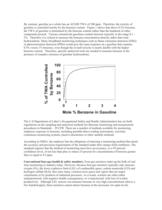
By contrast, gasoline as a whole has an ACGIH TWA of 300 ppm. Therefore, the toxicity of gasoline is controlled mostly by the benzene content. Figure 1 shows that above 0.2% benzene, the TWA of gasoline is dominated by the benzene content rather than the hundreds of other compounds present. Various commercial gasolines contain benzene typically in the range 0.1 2%. Therefore it is critical to measure the benzene concentration directly rather than total hydrocarbons. Many broadband monitoring techniques such as flame ionization detectors (FIDs) or photoionization detectors (PIDs) would give the...
Open the catalog to page 3
Moreover, LEL sensors are broadband monitors and cannot measure benzene specifically in gasoline mixtures. Types of technologies available for benzene and other har m fu l VOC monitor in g Given that there are multiple technologies available for benzene detection, what is the most appropriate method for protecting the long-term health and safety of workers? Each type of sensing technology has its particular uses, strengths and weaknesses, but PID, or photoionization detection, is frequently the optimal choice for real-time monitoring where benzene is present. There are a number of other technologies...
Open the catalog to page 4
requiring hours to several days before results are available. During a plant turnaround, every minute of shut-down time is critical and much more rapid feedback is needed to make personal protective equipment decisions for workers. Por t a b le GC Systems. Portable gas chromatographs, usually with PID or FID detectors, provide selective benzene measurements down to 0.1 ppm, but have several drawbacks. They tend to be heavy and bulky, making them difficult to use in tight spaces and on ladders and catwalks. They tend to be relatively expensive and complex; therefore usually only the company industrial...
Open the catalog to page 5All RAE Systems catalogs and technical brochures
 HAND & ARM PROTECTION
12 Pages
 Miller TechLine™ Kits
2 Pages
 Miller DuraHoistTM
8 Pages
 Miller ®
4 Pages
 FALL PROTECTION
22 Pages
 Miller H500 Series
8 Pages
 HONEYWELL RIG DOG™ GLOVES
12 Pages
 AreaRAE Pro
8 Pages
 RAELink3 Mesh
2 Pages
 RAEShare
1 Page
 RDK Rugged- Host
2 Pages
 SensorRAE 4R+
2 Pages
 Smoke Generation Tubes
1 Page
 SolarRAE
2 Pages
 ToxiRAE Pro CO2
2 Pages
 ToxiRAE Pro
2 Pages
 ToxiRAE Pro LEL
2 Pages
 ToxiRAE Pro PID
2 Pages
 UltraRAE 3000
2 Pages
 VOC Zeroing Tube
2 Pages
 WeatherPak
2 Pages
 Humidity Filtering II Tube
2 Pages
 MBeacon
2 Pages
 Wireless Alarm Bar
2 Pages
 MicroRAE
5 Pages
 MultiRAE Benzene
2 Pages
 MeshGuard
2 Pages
 AreaRAE Steel Z1
2 Pages
 AreaRAE Gamma Steel
2 Pages
 EchoView Host
2 Pages
 FMC-2 and FMC-4
2 Pages
 FMC-16
2 Pages
 FMC 2000
2 Pages
 EntryRAE
2 Pages
 miniDOSE
2 Pages
 DoseRAE Pro
2 Pages
 QRAE 3
2 Pages
 RAEGuard LEL
2 Pages
 RAEGuard PID
2 Pages
 RAE Systems
35 Pages
 BioHarness
2 Pages
 AutoRAE Lite for ToxiRAE 3
2 Pages
 AutoRAE Lite for QRAE II
2 Pages
 AreaRAE Steel Z2
2 Pages
 MiniRAE Lite Datasheet
2 Pages
 GammaRAE II R
2 Pages
 FMC-60
2 Pages
 FMC-40
2 Pages
 FMC-10
2 Pages
 ChemRAE
2 Pages
 AutoRAE 2
2 Pages
 AreaRAE Inert
2 Pages
 QRAE Plus
2 Pages
 QRAE II Pump
2 Pages
 QRAE II Diffusion
2 Pages
 ProRAE Guardian
2 Pages
 PlumeRAE
2 Pages
 NeutronRAE II
2 Pages
 MultiRAE Pro
2 Pages
 MultiRAE Lite
2 Pages
 MultiRAE
2 Pages
 MiniRAE Lite
2 Pages
 MiniRAE 3000
2 Pages
 DoseRAE
2 Pages


Archived catalogs
 AreaRAE Gamma Steel
2 Pages
 EchoView Host
2 Pages
 ppbRAE 3000
2 Pages
 2010 RAE Systems Mini Catalogue
23 Pages
 HazRAE
2 Pages
 ToxiRAE 3 Datasheet
2 Pages


- Shoes
- Fabric clothing
- Mechanical protection protection gloves
- Anti-slip safety shoes
- Electrical protection safety shoes
- Work safety gloves
- Gas detector
- Industrial safety gloves
- Anti-static safety shoes
- 10 protection gloves
- 9 protection gloves
- EN 388 safety gloves
- 8 protection gloves
- Chemical protection safety gloves
- Handling protection gloves
- Work coveralls
- Plastic glove
- Industrial detector
- Thermal protection clothing
- Anti-cut safety gloves