


Series AM Worm Gear

Series AM Worm Gear
- Rubber Materials: Use rubber gloves when handling rubber materials.
- Guards: Rotating shafts and couplings must be guarded to prevent physical contact or clothing entanglement.
- Noise: High-speed gearboxes may produce harmful noise levels. Ear defenders should be provided.
- Lifting: Use only designated lifting points or eyebolts for lifting operations.
- Lubricants and Lubrication: Follow manufacturer instructions for handling lubricants. Check lubrication status before commissioning.
- Electrical Equipment: Observe hazard warnings and isolate power before working on gearboxes.
- Consult application engineering for special preservation requirements if equipment is stored for over six months.
- Rotate gears and shafts monthly to prevent bearing brinelling.
- Use gloves when removing preservative materials from external gearbox components.
- Installation should follow manufacturer instructions and be performed by qualified personnel.
- Use correct tools and approved spare parts for maintenance.
- Ensure backup systems are in place if backstop device failure could endanger personnel or cause damage.
- Correctly select driving and driven equipment to avoid critical speeds and torsional vibration.
- Do not operate equipment beyond its designed environment, speed, power, torque, or load limits.
- Design improvements are ongoing; specifications may change without notice.
Catalog excerpts

Series A Mid Range Worm Gear Technical Up to - 100kW / 8500 Nm Worm Gears CAM-2.00GB1211
Open the catalog to page 1
PRODUCTS IN THE RANGE Serving an entire spectrum of mechanical drive applications from food, energy, mining and metal; to automotive, aerospace and marine propulsion, we are here to make a positive difference to the supply of drive solutions. Series A Worm Gear units and geared motors in single & double reduction types Series BD Screwjack worm gear unit Series BS Worm gear unit Series C Right angle drive helical worm geared motors & reducers Series F Parallel angle helical bevel helical geared motors & reducers Series G Helical parallel shaft & bevel helical right angle drive gear units Series...
Open the catalog to page 2
ATEX Compliance Assured Total compliance with the ATEX Directive safeguarding the use of industrial equipment in potentially explosive atmospheres is assured for users of our geared products. Certification is available for standard gearboxes and geared motors with badging displaying the CE Mark and the Ex mark, name and location of the manufacturer, designation of series or type, serial number, year of manufacture, Ex symbol and equipment group/category. ATEX directive 94/9/EC (also known as ATEX 95 or ATEX 100A) and the CE Marking Directive are enforced in all EC member states. Compliance is...
Open the catalog to page 3
SERIES AM CONTENTS General Description __________________________________________________________________ 3 Unit Designations ____________________________________________________________________ 4 Explanation and use of Ratings and Service Factors _________________________________________ 5 Load Classification by Applications ______________________________________________________ 6 Moments of Inertia ___________________________________________________________________ 7 Lubrication _________________________________________________________________________ 8 Selection Procedure __________________________________________________________________...
Open the catalog to page 5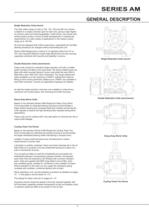
SERIES AM GENERAL DESCRIPTION Single Reduction Units (worm) This fully metric range of units of 100, 125, 160 and 200 mm centres is based on a single universal case for each size, giving a high degree of common parts and interchangeability. Under-driven, over-driven and vertical types provide a choice of shaft arrangements in meeting the requirements of a wide variety of applications in the medium power range up to 140 kW. All units are designed with hollow output bore, outputshaft can be fitted allowing handing to be changed without dismantling the unit. Series A Mid Range gives a choice of...
Open the catalog to page 6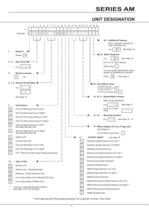
SERIES AM UNIT DESIGNATION 1 2 3 4 5 6 7 8 9 10 11 12 13 14 15 16 17 18 19 20 * Example A 1 2 5 2 7 . 5 W R C - 1 - - - - - - 20 - Additional Features Paint, Lubricant, Double Oil Seal, Hold Back etc e.g. - 1 - Series A Range F See Page 16 19 - Motor Required A e.g. - A See Page 18 2 - 4 - Size of Unit For R or G Types Without Motor Enter - e.g. 1 2 5 5 - Revision Version For slow speed applications where greater oil quantites are required 2 Enter etc 6, 7, 8 - Nominal Overall Ratio e.g. 7 . D See page 9 18 - No of Motor Poles 5 2 4 6 or 8 For R or G Type Enter 5 0 . - 15, 16, 17 - Geared Motor...
Open the catalog to page 7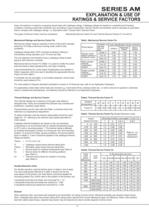
SERIES AM EXPLANATION & USE OF RATINGS & SERVICE FACTORS Gear unit selection is made by comparing actual loads with catalogue ratings. Catalogue ratings are based on a standard set of loading conditions, whereas actual load conditions vary according to type of application. Service Factors are therefore used to calculate an equivalent load to compare with catalogue ratings. i.e. Equivalent Load = Actual Load x Service Factor Two types of Service Factor must be considered:- Mechanical Service Factor Fm and Thermal Service Factors Ft, Fp and Fd Table1. Mechanical Service Factor Fm Mechanical Ratings...
Open the catalog to page 8
SERIES AM LOAD CLASSIFICATION BY APPLICATIONS Driven Machine Table 5 U = Uniform load M = Moderate shock load H = Heavy shock load = Refer to Application Engineering Cranes main hoists bridge travel trolley travel type of load Driven Machine log haul-incline log haul-well type log turning device main log conveyor off bearing rolls planer feed chains planer floor chains planer tilting hoist re-saw merry-go-round conveyor roll cases slab conveyor small waste conveyor-belt small waste conveyor-chain sorting table tipple hoist conveyor tipple hoist drive transfer conveyors transfer rolls tray drive...
Open the catalog to page 9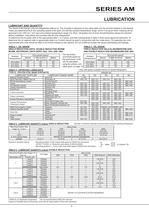
SERIES AM LUBRICATION LUBRICANT AND QUANTITY The Series A Mid Range units are despatched without oil. The oil grade is stamped on the name plate and the oil level marked on the dipstick. These are determined from the operating speed of the gear unit and the ambient temperature range, which if not given when ordering will be assumed to be 1450 rev / min input and ambient temperature range 0 to 35oC. Oil grades and oil level should therefore always be checked before installation, instructions are provided with all units despatched. To determine the oil grade refer to the appropriate table 1 or...
Open the catalog to page 11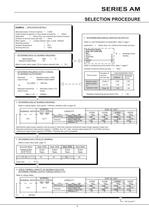
SERIES AM SELECTION PROCEDURE EXAMPLE APPLICATION DETAILS Absorbed power of driven machine = 3.9kW Output speed of gearbox or Input speed of machine = 20rpm Application = Heavy duty, non uniformly fed bucket conveyor Duration of service (hours per day) = 10hrs Motor speed = 3 phase electric motor, 4 pole, 1450rpm Mounting position = 2 Ambient temperature = 20oC Running time (%) = 100% 2 DETERMINE MECHANICAL SERVICE FACTOR (Fm) Refer to Load Classification by Application, table 5, page 7 Application = Conveyors-heavy duty not uniformly fed apron M assembly M belt M bucket M chain M 1 DETERMINE...
Open the catalog to page 12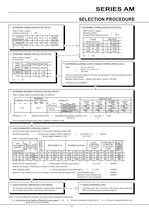
SERIES AM SELECTION PROCEDURE 7 DETERMINE THERMAL SERVICE FACTOR (Ft) 8 DETERMINE THERMAL SERVICE FACTOR (Fp) Refer to table 2, page 6 Ambient temperature = Refer to table 3, page 6 Mounting position Nominal Output Speed (rev/min) Ambient -30 temperature °C Factor Ft Ft = 20°C -20 -10 0 10 20 0 >100 >200 1.0 9 DETERMINE THERMAL SERVICE FACTOR (Fd) Refer to table 4, page 6 & running time = Input shaft speed (Rev/min) 1450 Fd = to to to 2 20.71 Mounting 1 2 1.0 0.91 1.0 0.89 1.0 0.85 Output Speed (rev/min) 1.65 1.52 1.39 1.26 1.14 1.0 = = 100 200 300 0.91 100 % Running time per hour 10 ETERMINE...
Open the catalog to page 13All Radicon catalogs and technical brochures
 Series M Helical In-Line
116 Pages
 BR-Series-AM.
72 Pages
 adicon-SeriesX
32 Pages
 BR Series F
117 Pages
 Radicon Series X Couplings
32 Pages
 BR Series X Couplings
36 Pages
 BR Cone Ring Couplings
16 Pages
 Series J
73 Pages
 Motor
Motor4 Pages
 Series E Flyer
4 Pages
 G series
4 Pages
 BD
BD4 Pages
 Product Brochure radicon
8 Pages
 Benzlers Screw Jacks
69 Pages
 Series J - Shaft Mounted Gearbox
15 Pages
 Radicon Series ET
42 Pages
 BR Series G
71 Pages
 Metric
8 Pages
 Geared Pump
15 Pages
 Series P Planetary
4 Pages
 M series
120 Pages
 Sala Gears
74 Pages
 Screw Jacks
58 Pages
 Roloid Pump
17 Pages
 Heavy Duty Worm Gear Series ER
15 Pages
 SERIE G
71 Pages
 C series
120 Pages
 F series
119 Pages
 Worm Gear Series AJ
89 Pages
 Series BS Worm Gear
60 Pages
 Elflex Flexible Couplings
8 Pages
 Series H industrial gearboxes
123 Pages
 Geared Motor Series K
90 Pages
 Elign Gear Couplings
17 Pages


Archived catalogs
 Worm Gears Series AH
13 Pages


- Industrial pump
- Pump with electric motor
- Stationary pump
- Seawater pump
- Electric gearmotor
- Planetary gearbox
- Coaxial gearhead
- Food product pump
- Right angle gearhead
- Direct current gear-motor
- Compact gearhead
- Solid-shaft gearhead
- Hollow-shaft gearhead
- Flexible coupling
- Gearbox for industrial applications
- Transmission gearhead
- Industrial electric gearmotor
- Coaxial gearmotor
- Shaft gearhead