
- Catalogs
- Radiant Vision Systems
- AR/VR Lens


- Company
- Products
- Catalogs
- News & Trends
- Exhibitions
AR/VR Lens

AR/VR Lens
- Aperture: 3.6 mm, located at the front of the lens to match the human eye's entrance pupil.
- Field of View (FOV): Up to 120° horizontal, covering the approximate human binocular FOV.
- Focus Distance: 0.25 m to infinity.
- Luminance Range: 0.05 cd/m² to 10,000 cd/m² (Y-Series) or 1,000,000 cd/m² (I-Series).
- High-resolution, wide-FOV measurements.
- Image distortion correction for normalized testing.
- Easy-to-use measurement control and analysis software.
Catalog excerpts

AR/VR Lens For Near-Eye Display Testing within Headsets Applications • Measurement of near-eye displays (NEDs); ideal for augmented (AR), mixed (MR), and virtual reality (VR) headsets • Test and measurement of luminance, chromaticity, contrast, modulation transfer function (MTF), image distortion, image sticking, and x,y image position • Characterization and quality control for devices in R&D and production Benefits • High-resolution, wide-FOV measurements up to 120° • Image distortion correction to normalize wide-FOV images before testing • Spatial x,y positions reported in degrees (°) via software • Pairs with high-resolution ProMetric® Imaging Colorimeters and Photometers • Easy-to-use measurement control and analysis software Specially-designed lens option for near-eye display testing within augmented and virtual reality headsets The Radiant Vision Systems AR/VR lens has a unique optical design specially engineered for measuring near-eye displays (NEDs), such as those integrated into virtual (VR), mixed (MR), and augmented reality (AR) headsets. The lens design simulates the size, position, and field of view of the human eye. Unlike alternative lens options, where the aperture is located inside the lens, the aperture of the AR/VR lens is located at the front of the lens, enabling positioning of the imaging system’s entrance pupil within NED headsets to view head-mounted displays (HMDs) at the same location as the human eye. With the aperture at the front of the lens, the connected imaging system can capture the full field of view (FOV) of the display (up to 120° horizontal, covering approximate human binocular FOV) without occlusion by the lens hardware. The aperture size of 3.6 mm also matches the size of a human entrance pupil, allowing displays to be measured under the same conditions as they are viewed by a human observer. The AR/VR lens mounts directly to a Radiant highresolution ProMetric® Y-series Imaging Photometer or I-series Colorimeter. Radiant TrueTest™ Software provides the leading display test algorithms and a specialized test suite for XR display analysis within the TT-ARVR™ Software module, including: modulation transfer function (MTF) based on Line Pairs, Slant Edge Contrast (ISO 12233), or Line Spread Function (LSF); Distortion; Focus Uniformity; reporting the device FOV; and giving spatial x,y positions in degrees (°). Extensive data analysis functions are supported, including isometric plots, cross-section graphs, radar plots, bitmaps and CIE color plots. Aperture location inside of standard lens results in image occlusion. Aperture location in AR/VR lens enables imaging the full display field of view. Radiant Vision Systems 18640 NE 67th Ct. Redmond, WA 98052 USA General Inquiries: [email protected] Technical Support: [email protected] Website: www.RadiantVisionSystems.com Copyright © 2022 Radiant Vision Systems LLC All R
Open the catalog to page 1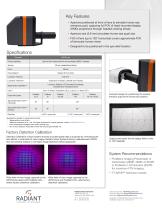
Key Features • Aperture positioned at front of lens to simulate human eye entrance pupil, capturing full FOV of head-mounted display (HMD) projections through headset viewing lenses • Aperture size (3.6 mm) simulates human eye pupil size • FOV of lens (up to 120° horizontal) covers approximate FOV of binocular human vision • Designed to be positioned in the eye relief location Specifications Parameter AR/VR Lens Primary Application Light and color measurement for near-eye displays (NED) in headsets 3.6 mm; Located at front of lens Focus Distance* Luminance - Minimum Luminance - Maximum** 10,000...
Open the catalog to page 2All Radiant Vision Systems catalogs and technical brochures
 NIR Intensity Lens
1 Page
 FPD Conoscope Lens
1 Page
 Microscope Lens
1 Page
 Lens Comparison Guide
1 Page
 Principles of Light & Color
2 Pages


- Measuring device
- Automation software solution
- Management software solution
- Process software
- Real-time software
- Windows software
- Computer-aided design software
- Cloud-based software
- Control software
- Design software solution
- 3D software solution
- Industrial software
- Inspection system
- Measurement software
- Interface software
- Visualization software solution
- Quality software
- Programming software
- Automated software