
- Catalogs
- QuantumX Mixers
- Manufacturing Collagen

Manufacturing Collagen
Manufacturing Collagen
Catalog excerpts

COLLAGEN: SCIENCE, STRUCTURE,
Open the catalog to page 1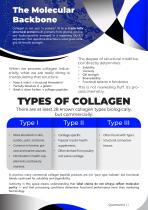
The Molecular Backbone Collagen is not just “a protein.” It is a triple-helix structural protein built primarily from glycine, proline, and hydroxyproline arranged in a repeating Gly-X-Y sequence. That repetitive structure is what gives collagen its tensile strength. The degree of structural modification directly determines: When we process collagen industrially, what we are really doing is manipulating that structure: • • • Keep it intact → structural biomaterial Partially denature it → gelatin Break it down further → collagen peptides Solubility Viscosity Gel strength Bioavailability Functional...
Open the catalog to page 2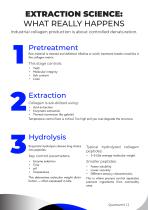
Industrial collagen production is about controlled denaturation. Raw material is cleaned and defatted. Alkaline or acidic treatment breaks crosslinks in the collagen matrix. • Molecular integrity ExtractionCollagen is solubilized using: • Acid extraction • Enzymatic extraction • Thermal conversion (for gelatin) Temperature control here is critical. Too high and you over-degrade the structure. Enzymatic hydrolysis cleaves long chains into peptides. • Enzyme selection This determines molecular weight distribution — often expressed in kDa. • 2-5 kDa average molecular weight • Faster solubility •...
Open the catalog to page 3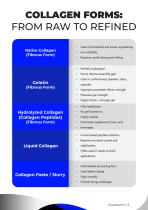
COLLAGEN FORMS:
Open the catalog to page 4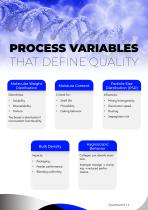
PROCESSAT Molecular Weight Distribution Moisture Content Particle Size Distribution (PSD) • Shelf life • Caking behavior Too broad a distribution? Inconsistent functionality. • Mixing homogeneity • Dissolution speed • Segregation risk Bulk Density • Feeder performance • Blending uniformity Collagen can absorb moisture. Improper storage ^ clumping ^ reduced performance.
Open the catalog to page 5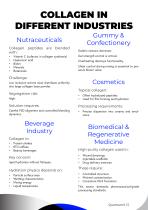
• Vitamin C (cofactor in collagen synthesis) • Hyaluronic acid Low inclusion actives must distribute uniformly into large collagen base powder. Careful PSD alignment and controlled blending dynamics. • Protein shakes • Beauty beverages rapid hydration without fisheyes. • Particle surface area • Wetting characteristics • Mixing energy • Liquid temperature Gelatin remains dominant. Gel strength control is critical. Overheating destroys functionality. Shear control during mixing is essential to preserve bloom value. • Often hydrolyzed peptides • Used for film-forming and hydration • Precise dispersion...
Open the catalog to page 6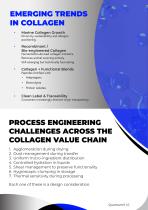
EMERGING TRENDS IN COLLAGENMarine Collagen Growth Driven by sustainability and allergen positioning. Bio-engineered Collagen Fermentation-derived collagen mimetics. Removes animal sourcing entirely. Still emerging but technically fascinating. Peptides fortified with: • Protein isolates Consumers increasingly demand origin transparency. 1. Agglomeration during drying 2. Dust management during transfer 3. Uniform micro-ingredient distribution 4. Controlled hydration in liquids 5. Shear management to preserve functionality 6. Hygroscopic clumping in storage 7. Thermal sensitivity during processing...
Open the catalog to page 7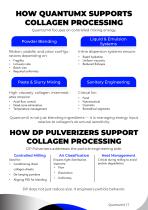
QuantumX focuses on controlled mixing energy.Powder BlendingLiquid & Emulsion SystemsRibbon, paddle, and plow configurations depending on: • Fragility • Inclusion rate • Batch size • Required uniformity Inline dispersion systems ensure: • Rapid hydration • Uniform viscosity • Reduced fisheyes • Biomedical segments High viscosity collagen intermediates require: • Axial flow control • Dead-zone elimination • Temperature management QuantumX is not just blending ingredients — it is managing energy inputrelative to collagen's structural sensitivity.HOW DP PULVERIZERS SUPPORT COLLAGEN PROCESSINGDP...
Open the catalog to page 8All QuantumX Mixers catalogs and technical brochures
 Vacuum Conical Mixers & Dryers
11 Pages
 Vacuum Plow Mixers & Dryers
14 Pages
 Vacuum Paddle Mixers & Dryers
15 Pages
 Vacuum Ribbon Mixers & Dryers
19 Pages


- Dynamic agitator
- Batch agitator
- Drying system
- Liquid homogenizer
- Agitator for the food industry
- Homogenizer for the chemical industry
- Solid mixer
- Solid/liquid agitator
- Powder kneader
- Blender for the pharmaceutical industry
- Horizontal kneader
- Construction blender
- Dewatering system for the food industry
- Paddle agitator
- Solid kneader
- High-speed blender
- Vacuum blender
- Batch drying system
- Explosion-proof agitator
- Granules kneader