


Q-SUN®
Q-SUN®
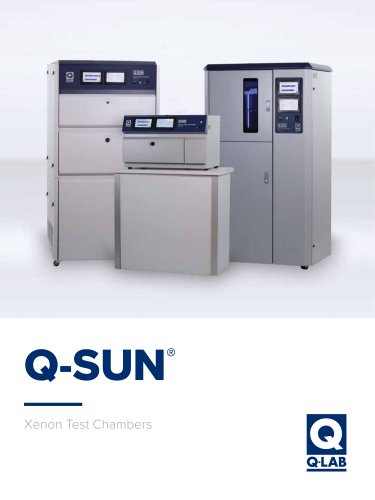
Q-SUN Xenon Test Chambers are designed to simulate the effects of sunlight, heat, and moisture on materials, enabling accelerated testing of material durability. These chambers can replicate years of outdoor exposure in a short period, aiding in predicting product longevity and performance.
- Realistic: Provides realistic testing for materials exposed to sunlight and indoor lighting, customizable to meet major industry standards.
- Affordable: Designed for low total cost of ownership, making them accessible for small labs.
- Easy to Operate: Features automated operation, self-diagnostic warnings, and easy specimen mounting.
- Reliable and Easy to Maintain: Modular subsystems simplify maintenance and repair.
- Q-SUN Xe-1: Compact, economical tabletop model for limited budgets.
- Q-SUN Xe-2: Features a rotating rack for large-capacity testing, ideal for textiles.
- Q-SUN Xe-3: Full-sized model with three lamps for larger specimens.
Xenon arc testing simulates sunlight, heat, and water exposure. Q-SUN chambers offer a range of conditions for testing various materials, including plastics and textiles. Key considerations include calibration, maintenance, and the use of high-purity water.
Q-SUN testers comply with numerous international standards, including ASTM, ISO, and IEC, covering industries such as automotive, paints, textiles, and plastics.
Q-SUN chambers use xenon arc lamps to replicate full-spectrum sunlight. Optical filters ensure the correct spectrum for different applications, with options for daylight, window glass, and extended UV filters.
Features include water spray for moisture simulation, relative humidity control, and precise temperature management using black panel thermometers, crucial for realistic testing of material degradation.
The Q-SUN xenon test chambers, including models Xe-1, Xe-2, and Xe-3, offer features for controlling specimen temperature and humidity. The Xe-2 and Xe-3 models allow simultaneous control of chamber air temperature and black panel temperature, while the Xe-1 requires a choice between the two. An optional chiller is available for low-temperature testing, suitable for sensitive materials like pharmaceuticals and cosmetics.
Q-SUN chambers are designed for ease of use with intuitive programming and dual touch-screen displays available in 17 languages. They can store up to 10 tests in memory and operate continuously. Specimen mounting is flexible, accommodating various sizes and shapes, with specific holders for different specimen types.
Regular calibration of sensors is necessary to ensure accurate results. The SOLAR EYE irradiance sensor and black panel temperature sensors require periodic calibration using the Universal Calibrator system. Maintenance includes routine checks and replacements of lamps, sensors, and air filters. The system includes self-diagnostic error checking and maintenance reminders.
Additional options include a chiller for temperature-sensitive testing, dual spray systems for the Xe-3, and various specimen holders. The water purification system conserves and repurifies water, and the Xe-1-WE model offers water immersion testing. Back spray configurations are available for specific test methods.
The document provides a comparative summary of features across the Xe-1, Xe-2, and Xe-3 models, highlighting capabilities such as specimen capacity, orientation, and additional functionalities like dual touch-screen displays, full spectrum xenon arc lamps, and SOLAR EYE irradiance control.
Q-Lab operates in 120 countries, offering technical, sales, and repair support. Contact information for various global locations is provided, including headquarters in the USA and offices in China, Europe, and Germany.
Catalog excerpts
Xenon Test Chambers
Open the catalog to page 1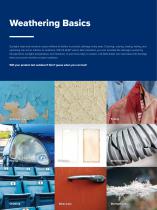
Weathering Basics Sunlight, heat and moisture cause millions of dollars in product damage every year. Cracking, crazing, hazing, fading, and yellowing can occur indoors or outdoors. With Q-SUN® xenon test chambers, you can simulate the damage caused by full-spectrum sunlight, temperature, and moisture. In just a few days or weeks, a Q-SUN tester can reproduce the damage that occurs over months or years outdoors. Will your product last outdoors? Don’t guess when you can test! Adhesion loss Gloss Loss Strength Loss
Open the catalog to page 2
Why Q-SUN? Realistic Q-SUN xenon test chambers are the ultimate research & development and quality control tool for testing materials that are exposed to direct sunlight, sunlight through window glass, or indoor lighting. With a variety of models and options, you can customize your Q-SUN chamber to fit your testing needs. Three basic models suit the xenon testing needs of any lab: the tabletop Q-SUN Xe-1, the rotating rack Q-SUN Xe-2, and the large flat-array Q-SUN Xe-3. All models are full-featured weathering, lightfastness, and photostability chambers, and meet all major industry standards....
Open the catalog to page 3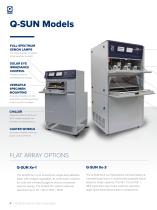
Q-SUN Models FULL-SPECTRUM XENON LAMPS The most realistic simulation of full-spectrum sunlight. SOLAR EYE IRRADIANCE CONTROL Precise control for repeatable test results. VERSATILE SPECIMEN MOUNTING A variety of options for flat specimens and 3D specimens in Xe-1 and Xe-3 models. Optional chiller for Xe-1 and Xe-3 models enables low chamber air temperatures. CASTER WHEELS Increases mobility when lab space is at a premium. FLAT ARRAY OPTIONS Q-SUN Xe-1 The Q-SUN Xe-1 is an economical, single-lamp tabletop tester with multiple capabilities. Its small scale is perfect for a lab with a limited budget...
Open the catalog to page 4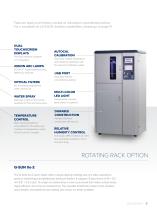
Features apply to all testers, except as indicated in parentheses below. For a complete list of Q-SUN chamber capabilities, please go to page 15. DUAL TOUCHSCREEN DISPLAYS Full-color interface available in 17 languages. Q-SUN “E” model testers provide 3000 hour lamp life. OPTICAL FILTERS Do not require replacement under normal use. WATER SPRAY Operates in light or dark cycles; available for front and back spray. TEMPERATURE CONTROL Black panel (insulated or uninsulated) for all models, plus chamber air temperature control for Xe-2 and Xe-3 models. AUTOCAL CALIBRATION Fast, easy, reliable temperature...
Open the catalog to page 5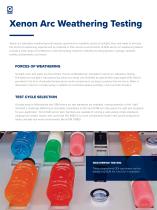
Xenon Arc Weathering Testing Xenon arc laboratory weathering tests expose specimens to repetitive cycles of sunlight, heat, and water to simulate the forces of weathering experienced by materials in their service environments. Q-SUN xenon arc weathering testers provide a wide range of conditions to meet the testing needs for materials including plastics, coatings, sealants, textiles, photovoltaics, and more. FORCES OF WEATHERING Sunlight, heat, and water are the primary “Forces of Weathering” simulated in xenon arc laboratory testing. Full-spectrum sunlight is reproduced by xenon-arc lamps and...
Open the catalog to page 6
PRACTICAL CONSIDERATIONS FOR XENON ARC TESTING Xenon arc laboratory testing can generate valuable data about the relative performance of materials and products when performed correctly. To get the most out of testing, calibration and maintenance of onboard sensors is critical. This includes irradiance, temperature, and relative humidity sensors. Although Q-Lab’s optical filters do not age, all xenon arc lamps do experience aging. Lamps will deliver less UV light over time if not replaced, even if proper calibration is performed. High-purity water is required to avoid specimen spotting and chamber...
Open the catalog to page 7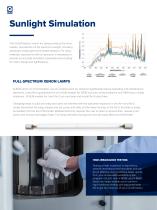
Sunlight Simulation The Q-SUN testers’ xenon arc lamps produce the most realistic reproduction of full spectrum sunlight, including ultraviolet, visible light and infrared radiation. For many materials, exposure to the full spectrum is necessary to provide an accurate simulation, especially when testing for color change and lightfastness. FULL-SPECTRUM XENON LAMPS Q-SUN xenon arc test chambers use air-cooled xenon arc lamps to significantly reduce operating and maintenance expenses. Lamp life is guaranteed for all Q-SUN models for 3000 hours at normal irradiance and 1000 hours at high irradiance....
Open the catalog to page 8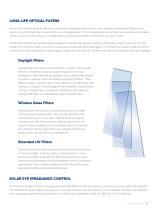
LONG-LIFE OPTICAL FILTERS Xenon light must be properly filtered to achieve the appropriate spectrum for each particular application. Differences in spectra may affect both the speed and the type of degradation. Three categories of optical filters are available to simulate a variety of service environments. The application or test method dictates which filters should be used. Q-SUN optical filters are exceptionally durable and maintain the required spectrum indefinitely under normal use. For the Q-SUN Xe-1 and Xe-3, filters consist of a single pane of specially formulated glass. The Q-SUN Xe-2...
Open the catalog to page 9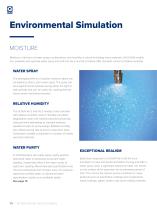
Environmental Simulation MOISTURE Moisture in the form of water spray, condensation, and humidity is critical for testing many materials. All Q-SUN models are available with optional water spray and both the Xe-2 and Xe-3 models offer standard control of relative humidity. WATER SPRAY The damaging effects of outdoor moisture attack are simulated by direct, pure water spray. The spray can be programmed to operate during either the light or dark periods and can be useful for creating thermal shock and/or mechanical erosion. RELATIVE HUMIDITY The Q-SUN Xe-2 and Xe-3 models come standard with relative...
Open the catalog to page 10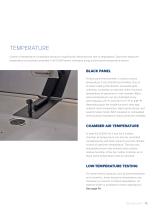
TEMPERATURE Control of temperature is important because it significantly influences the rate of degradation. Specimen exposure temperature is precisely controlled in all Q-SUN xenon chambers using a black panel temperature sensor. BLACK PANEL A black panel thermometer is used to control temperature in the Q-SUN test chamber. Due to its black coating that absorbs all wavelengths uniformly, it provides an estimate of the maximum temperature of specimens in the chamber. Black panel temperatures can be controlled at any point between 25 ºC and 120 ºC (77 ºF to 248 ºF) depending upon the irradiance...
Open the catalog to page 11All Q-LAB catalogs and technical brochures
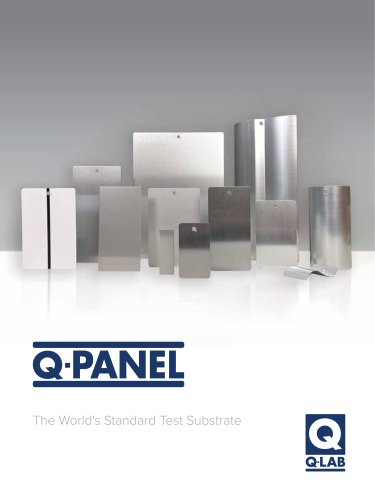 Q-PANEL 2025
9 Pages
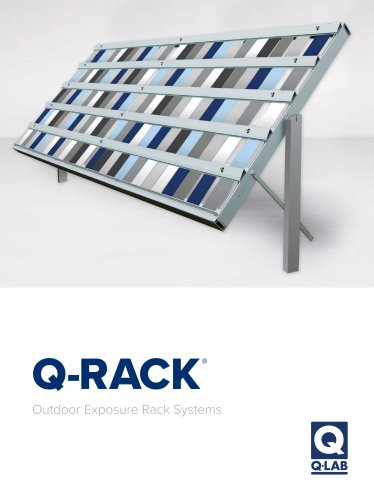 Q-RACK®
8 Pages
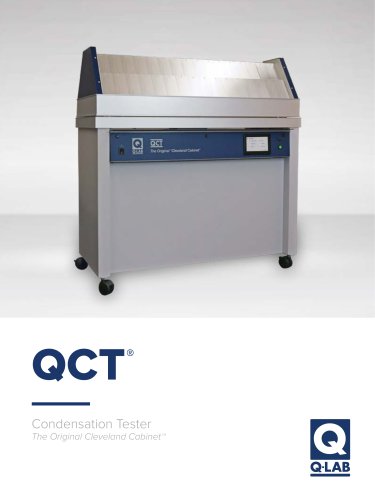 QCT® Condensation Tester
5 Pages
 QUV®
QUV®9 Pages
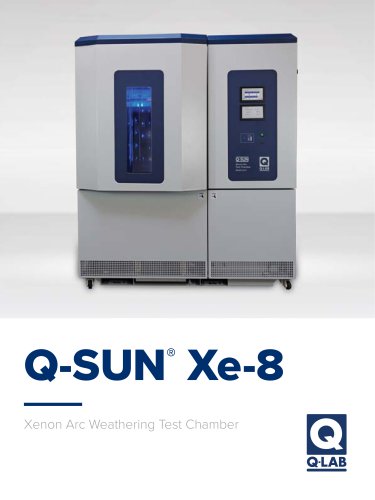 Q-SUN® Xe-8
9 Pages
 Q-FOG
Q-FOG9 Pages
 Q-PANEL
4 Pages
 Q-RACK
4 Pages
 Q-SUN ICH Guidelines
2 Pages
 Q-SUN Xe-1, Xe-2 & Xe-3
16 Pages
 QUV Summary
2 Pages
 Q-Lab products summary
2 Pages

Archived catalogs
 QCT Condensation Tester
1 Page

- Temperature test chamber
- Climatic test cabinet
- Humidity test cabinet
- Environmental test chamber
- Vehicle test chamber
- Temperature calibration system
- Low-temperature test chamber
- Test cabinet on casters
- Stainless steel test chamber
- Automobile test chamber
- Laboratory test cabinet
- Aging test chamber
- Automatic test chamber
- Stability test chamber
- High-capacity test chamber
- 1-door test chamber
- Laboratory calibration equipment
- Simulation test chamber