


Q-SUN ICH Guidelines

Q-SUN ICH Guidelines
The Q-SUN® xenon test chamber by Q-Lab is designed for photostability testing in cosmetics and pharmaceuticals, adhering to ICH Guidelines. It simulates sunlight exposure, ensuring accurate and reproducible results through precise control of light intensity and temperature.
Key Features
- Simple operation and easy lamp replacement.
- Full spectrum xenon arc lamp with D65 and ID65 sunlight simulations.
- SOLAR EYE® Irradiance Control for consistent test results.
- Temperature control for assessing photodegradation under various conditions.
- Optional chiller for tests at room temperature or as low as 15°C.
Product Variants
The Q-SUN tester is available in two sizes: the tabletop Xe-1 with an optional chiller, and the larger Xe-3 for high throughput, offering precise relative humidity control.
ICH Guidelines Compliance
Photostability testing can follow ICH Guidelines using either Option 1 or 2, with specified minimum exposure values for visible and ultraviolet light. The Q-SUN chamber is suitable for Option 1, simulating sunlight with flexibility in test settings to meet exposure requirements.
Testing Parameters
- Visible Light: 1.2 million lux-hours.
- Ultraviolet Light: 200 w-hr/m2 (300-400 nm).
Temperature and Humidity Control
While ICH Guidelines do not specify temperature or humidity, the Q-SUN Xe-3 offers precise RH control, beneficial for certain tests. The optional chiller helps maintain room temperature conditions.
Sample Testing
The Q-SUN chamber accommodates various sample shapes with its flat specimen tray and mounting options.
Catalog excerpts

Photostability Testing for Cosmetics & Pharmaceuticals (ICH Guidelines & Forced Degradation) The Q-SUN® xenon test chamber from Q-Lab offers state of the art, full-spectrum photostability test exposures for pharmaceutical and cosmetics applications. Q-SUN testers are available in two sizes with options that meet ICH Guidelines for Photostability Testing of New Drug Substances and Products, including simulation of direct sunlight or sunlight through window glass. Accurate control of light intensity and temperature ensures repeatable and reproducible results. These features enable the Q-SUN chamber to perform photostability tests according to in-vitro test procedures for sunscreens. Key Features: Simplicity & Accuracy • • • • • Simple operation and lamp replacement so you can concentrate on what’s most important: your tests! Full spectrum xenon arc lamp and optical filter system creates D65 and ID65 sunlight simulations that enable you to test your products against outdoor or indoor daylight. SOLAR EYE® Irradiance Control monitors and controls the light intensity to ensure your tests are repeatable and reproducible. Precise control of chamber air or black panel temperature gives you flexibility to determine the effects of different temperature environments on photodegradation. Optional chiller unit enables tests to be run at room temperature or as low as 15°C so you can determine the synergistic effects of light and heat on your materials and products. Two Sizes All the Critical Features This chart shows the Q-SUN chamber's Daylight-Q filter compared to D65 outdoor sunlight. This chart shows the Q-SUN chamber's Window-Q filter compared to ID65 indoor daylight. The Q-SUN tester comes in two sizes with all the critical features for pharmaceutical and cosmetics applications. The Xe-1 is available in a convenient tabletop size and offers an optional chiller. For labs that need high throughput, the Xe-3 is a freestanding unit with triple the capacity. The Xe-3 also provides precise control of relative humidity.
Open the catalog to page 1
ICH Guidelines Photostability testing of drug substances and products can be done several ways according to the ICH Guidelines. Regardless of whether Option 1 or Option 2 is chosen or which light source within each option is used, the exposure requirements are defined as minimum values within the visible and ultraviolet ranges: • • Visible Light: 1.2 million lux-hours. Ultraviolet Light: 200 w-hr/m2 of integrated UV energy (spectral range of 300-400 nm) Bottles and other oddly-shaped samUnder the ICH Guidelines, it is perfectly acceptable to expose speciples can be easily tested in a Q-SUN mens...
Open the catalog to page 2All Q-LAB catalogs and technical brochures
 Q-PANEL 2025
9 Pages
 Q-RACK®
8 Pages
 QCT® Condensation Tester
5 Pages
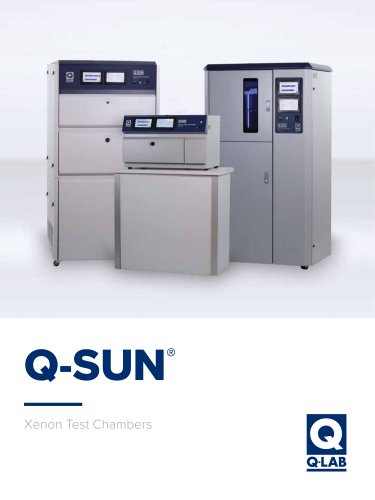 Q-SUN®
16 Pages
 QUV®
QUV®9 Pages
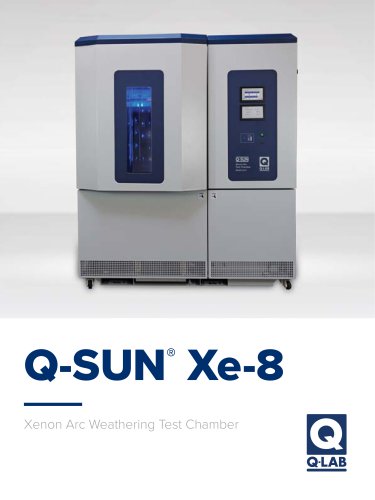 Q-SUN® Xe-8
9 Pages
 Q-FOG
Q-FOG9 Pages
 Q-PANEL
4 Pages
 Q-RACK
4 Pages
 Q-SUN Xe-1, Xe-2 & Xe-3
16 Pages
 QUV Summary
2 Pages
 Q-Lab products summary
2 Pages

Archived catalogs
 QCT Condensation Tester
1 Page

- Calibration system
- Temperature test chamber
- Climatic test cabinet
- Humidity test cabinet
- Environmental test chamber
- Vehicle test chamber
- Temperature calibration system
- Low-temperature test chamber
- Test cabinet on casters
- Stainless steel test chamber
- Automobile test chamber
- Laboratory test cabinet
- Aging test chamber
- Automatic test chamber
- Stability test chamber
- High-capacity test chamber
- 1-door test chamber
- Laboratory calibration equipment
- Simulation test chamber