


Q-FOG Cyclic Corrosion Testers

Q-FOG Cyclic Corrosion Testers
Q-FOG Cyclic Corrosion Testers are designed to simulate natural corrosion processes by exposing specimens to a series of different environments in a repetitive cycle. This approach improves the correlation of test results with outdoor conditions compared to traditional salt spray methods.
Types of Q-FOG Chambers
There are two main models of Q-FOG chambers: Model SSP and Model CCT. Model SSP is suitable for traditional salt spray and Prohesion tests, while Model CCT can perform more complex cyclic automotive tests, including 100% humidity conditions.
Specifications and Features
- Chamber volumes range from 640 to 1103 liters.
- Sample capacities vary, accommodating panels of different sizes.
- Temperature control ranges from ambient to 70°C for various functions like salt fog, dry-off, and humidity.
- Features include easy sample mounting, self-diagnostics, and automatic data logging.
Testing Capabilities
Q-FOG testers can perform a variety of tests conforming to ISO, ASTM, BS, DIN, automotive, and industrial specifications. They are particularly useful for Prohesion tests, which involve rapid temperature changes and low humidity cycles, and conventional salt spray tests for assessing corrosion resistance.
Design and Maintenance
- Constructed from reinforced plastic to prevent corrosion and contamination.
- Equipped with a removable side panel for easy maintenance access.
- Internal solution reservoir with a capacity for extended testing periods.
Advanced Features
- Precise control of fog dispersion using a variable speed peristaltic pump.
- Fast temperature cycling enabled by unique internal chamber heaters.
- Safety features include circuit breakers and over-temperature protection.
Integration with UV Testing
Combining Q-FOG testers with QUV Accelerated Weathering Testers can enhance the simulation of natural environments, as specified in ASTM D5894. This combination provides a more realistic assessment of corrosion resistance.
Conclusion
Q-FOG Cyclic Corrosion Testers offer a comprehensive solution for simulating natural corrosion processes in a laboratory setting, providing reliable and realistic results that conform to various industry standards.
Catalog excerpts

Q-FOG Cyclic Corrosion Testers www.q-lab.com A More Realistic Salt Spray
Open the catalog to page 1
the natural wet/dry cycles of the outdoors, test results frequently provided poor correlation to outdoors. Cyclic Corrosion Testers • Improve correlation with outdoor results Perform sophisticated cyclic corrosion tests Perform Prohesion® or traditional salt spray exposures Conform to ISO, ASTM, BS, DIN, automotive and industrial specifications Cyclic Corrosion Tests Cyclic corrosion testing provides the best possible laboratory simulation of natural corrosion. Current research indicates that test results are similar to outdoors in resulting structure, morphology, and relative corrosion rates....
Open the catalog to page 2
Q-FOG chambers are available in two sizes to fulfill a wide range of testing requirements. Model SSP for Prohesion or Conventional Salt Spray Model CCT for Corrosion Research and Cyclic Automotive Tests Numerous accelerated corrosion tests may be performed in Q-FOG model SSP, including Prohesion, ASTM B117, ASTM G85, BS 3900 F4 & F9, DIN 50.021 and ISO 9227. The Q-FOG model CCT has all the advantages of the model SSP, but adds the exibility of including 100% humidity, another critical exposure Prohesion. This test uses fast cycling, rapid temperature changes, a low humidity dry-off cycle and...
Open the catalog to page 3
Easy Maintenance. Direct access to control components is possible with a removable side panel. All components in a Q-FOG tester are positioned to allow easy access for inspection and maintenance. Simple, straight forward operation; test status and diagnostics continuously displayed. Q-FOG Chamber Design Benefits Easy Programming. The Q-FOG model CCT is designed to cycle between four conditions: Fog, Dry-Off, 100% Humidity, and Dwell. The conditions, time and temperature are controlled by a user-friendly, built-in microprocessor. Interactive software allows easy user programming and operation....
Open the catalog to page 4
Precise Control of Fog Dispersion. The Q-FOG tester has superior fog dispersion compared to conventional systems which cannot vary volume and distance independently. A variable speed peristaltic pump controls the amount of corrosive solution delivered to the spray atomizer, while the air pressure regulator controls the distance of the “throw.” Reinforced Plastic Construction. In a Q-FOG test chamber, there is nothing to corrode and nothing to contaminate your test specimen. Q-FOG testers are made of solid, ber-reinforced plastic. The robust, heavy wall chamber and lid have low thermal conductivity...
Open the catalog to page 5
Cyclic Corrosion Testers: How They Work Cyclic corrosion tests expose specimens to a series of different environments in a repetitive cycle. Simple tests may consist of cycling between two conditions: fog and dry. More sophisticated procedures, such as automotive, call for multi-step cycles incorporating humidity or condensation, along with salt fog and dry-off. With the Q-FOG Cyclic Corrosion Tester, you can cycle through all these environments in one chamber. And, with the custom controller, you can easily program complex test cycles or run any of the pre-programmed procedures. Fog Function...
Open the catalog to page 6
Cyclic Corrosion Testers UV Exposure Improves Laboratory Corrosion Correlation The QUV/se tester features SOLAR EYE® irradiance control for precise maintenance of UV light. While both the QUV and the Q-FOG testers have outstanding advantages on their own, when used together they are revolutionizing corrosion testing. Ultraviolet light stability of a coating can be a major factor in its corrosion resistance. Degradation and corrosion that occurs in natural environments can be better simulated by incorporating UV/weathering factors into a wet/dry cyclic corrosion test. Research indicates that a...
Open the catalog to page 7
Q-Lab Corporation Q-Lab Headquarters Westlake, OH USA Tel: +1-440-835-8700 [email protected] Q-Lab Europe, Ltd. Bolton, England Tel: +44-1204-861616 [email protected] Q-Lab Deutschland, GmbH Saarbrücken, Germany Tel: +49-681-857470 [email protected] Q-Lab Florida Homestead, FL USA Tel: +1-305-245-5600 [email protected] Q-Lab Arizona Buckeye, AZ USA Tel: +1-623-386-5140 [email protected] Q-Lab China 中国代表处 Shanghai, China 中国上海 电话: +86-21-5879-7970 [email protected] LF-8101.4 © 2011 Q-Lab Corporation. All Rights Reserved. Q-Lab, the Q-Lab logo, Q-FOG, and SOLAR EYE are registered trademarks of Q-Lab Corporation....
Open the catalog to page 8All Q-LAB catalogs and technical brochures
 Q-PANEL 2025
9 Pages
 Q-RACK®
8 Pages
 QCT® Condensation Tester
5 Pages
 Q-SUN®
16 Pages
 QUV®
QUV®9 Pages
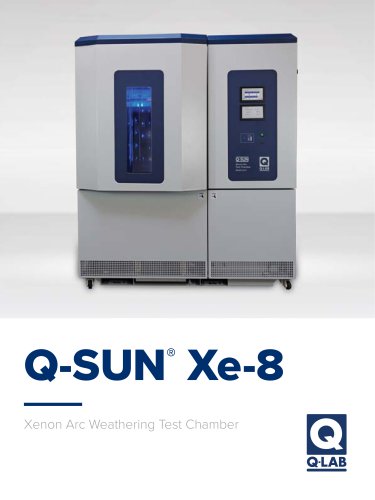 Q-SUN® Xe-8
9 Pages
 Q-FOG
Q-FOG9 Pages
 Q-PANEL
4 Pages
 Q-RACK
4 Pages
 Q-SUN ICH Guidelines
2 Pages
 Q-SUN Xe-1, Xe-2 & Xe-3
16 Pages
 QUV Summary
2 Pages
 Q-Lab products summary
2 Pages
Archived catalogs
 QCT Condensation Tester
1 Page

- Temperature test chamber
- Calibration system
- Climatic test cabinet
- Humidity test cabinet
- Environmental test chamber
- Vehicle test chamber
- Temperature calibration system
- Low-temperature test chamber
- Test cabinet on casters
- Stainless steel test chamber
- Automobile test chamber
- Aging test chamber
- Automatic test chamber
- Laboratory test cabinet
- Stability test chamber
- 1-door test chamber
- High-capacity test chamber
- Accelerated test chamber
- Laboratory calibration equipment