


procella

procella
The manual serves as a quick guide to the features of qs-STAT® and provides information on training programs and self-education resources.
All rights to the procella® software and documentation belong to Q-DAS GmbH. The document's content is subject to change without notice, and no warranty is provided for its correctness.
This manual is intended for administrators setting up procella® workplaces, outlining setup options and program functionalities.
Key setup questions include data storage method, data location, number of users, and start screen configuration. The software manages test plans, measurement data recording, data visualization, and process control with Quality Control Charts.
Test plans involve creating requirements for part characteristics measurements. The document provides detailed instructions on administering test plans and measured values using procella® software, emphasizing the advantages of using a database for comprehensive evaluations and analyses.
Focuses on using Microsoft Access Database for test plan management, allowing users to filter and sort data, restrict measurement values, and customize additional data fields.
Supports data recording via keyboard or measurement systems, with options for process visualization and control using Quality Control Charts.
Defines measurements, part and group measurements, subgroups, inspections, and cycle and subgroup incidence.
Includes defining parts, characteristics, subgroup sizes, specification limits, and process capability requirements.
Flowchart outlines steps from loading the test plan to saving data, including limit control and additional data recording.
Initiate through the File menu, define characteristics, and set characteristic types.
Involves a circular tolerance for the true position of a bore hole's center, with additional tolerances for x and y directional positions.
Records the number of defective units, evaluated as either "characteristics o.k." or "characteristics n.o.k."
Documents various error types per unit, with subordinate characteristics created for each error type.
For min/max evaluations according to AFNOR E60-18, use the characteristics in this group instead of continuous characteristics.
Nominal characteristics create non-hierarchical categories, while ordinal characteristics have a hierarchy for evaluations involving different categories.
Can be adjusted based on characteristic types, affecting all created characteristics of that type.
Consecutive characteristic numbers can be automatically added, and default settings for characteristics class, measured quantity, and events catalog can be defined.
These settings are applied to all characteristics immediately.
Settings for measuring devices can be predefined, especially when recording data via the RS232 interface.
Settings are crucial for recording data manually with procella.
System settings can be applied as default for datasets, with options for manual or part inspection input sequences.
Characteristics of one group switch after every value, with groups changing after each subgroup.
Users can choose between standard view or a specific summary/input mask, with options to save window layouts.
After setting defaults and selecting characteristics, enter necessary information in the Parts and Characteristics masks.
Access different graphic configurations via the Special icon.
Activate input help for plausibility limits to calculate and display limits based on tolerance percentages.
Data can be entered manually or recorded via interface using procella®My.SPC online.
Enter ISO tolerances and select drawing files for characteristics, ensuring graphics are appropriately sized and stored.
Select catalogs for event messages and process parameters, ensuring standardized descriptions for filtering data.
Logical operation formulas can be used to calculate characteristics based on others, with examples provided.
Test plans can be saved as templates without measurement data, allowing users to load templates and enter data as needed.
Data is recorded using Summary/input windows, with visual displays like quality control charts for immediate corrective actions.
Input masks can be customized to meet operator or task requirements, with options to allocate characteristics or values to graphics.
Outlines various configuration options available for graphics such as "Value Chart Individuals," "Histogram," and "Quality Control Chart."
Users can define whether graphics should be displayed for specific characteristic types, such as variable or attribute characteristics.
Explains how to customize the icon bar by assigning new functions to buttons and setting shortcuts.
Describes the process of calibrating measuring devices using a gage block or calibration master.
Instructions for connecting measuring devices to a computer via an RS 232 interface.
Users can view and print standard reports, or create custom reports using the Q-DAS® Form and Mask Designer.
The software offers various configuration options to facilitate data recording and automate actions.
Explains how to use the parts/characteristics list to manage test plans, including creating or deleting parts and characteristics.
A repeat measurement is initiated when an individual value deviates by a specified percentage from a bilateral tolerance.
Various scenarios are outlined for handling bad values, including repeating only the affected measurement or the entire part measurement.
Options include appending repeat measurements as new entries, limiting the number of repeats, and using a phase diagram to manage alarms and repeat frequencies.
Procedures for closing test plans involve handling incomplete subgroups and setting automatic closure conditions.
Data security is emphasized through frequent saving options to prevent data loss in case of system failures.
Configurations for handling limit infringements include mandatory user inputs for alarms.
Settings for interfacing with measurement devices include keyboard lock during data recording.
Defines behavior for updating graphics and handling input errors.
Configurations for displaying alarms include options for separate alarm windows and compulsory event inputs upon alarm confirmation.
Outlines configuration options for testing frequency in a measurement system.
Discusses the calibration of measuring devices, which can be initiated by keystroke or after a set time.
Operating instructions can be added to characteristics before recording.
The Takeover option allows additional data from previous measurements to be carried over until changed.
Recording data settings facilitate manual data recording and enhance data security.
Catalogs can be managed as files or within a database.
The evaluation strategy section allows users to select or configure evaluation strategies for data analysis.
Alarm conditions for continuous and discrete characteristics can be defined.
Outlines a flow chart for using Quality Control Charts (QCC) in procella® without qs-STAT®.
Users can configure their preferred method for working with Control Charts through the evaluation strategy.
Differentiates between preliminary QCC calculation for new processes and QCC calculation when data is available.
Users can manually input control limits for QCCs.
Describes using qs-STAT® for QCC calculation.
Provides an overview of logical operations available in procella®.
Catalog excerpts
procella® User Guide Version: 1 / March 2009 Doku-Nr.: PD-0019 © Copyright 2009 Q-DAS GmbH & Co. KG Eisleber Str. 2 D - 69469 Weinheim Tel.: ++49/6201/3941-0 Fax: ++49/6201/3941-24 E-Mail: [email protected] Internet: http://www.q-das.de Hotline: Tel.: ++49/6201/3941-14 Fax: ++49/6201/3941-714 E-Mail: [email protected]
Open the catalog to page 1
Preface 3 Preface Q-DAS would like to thank all of our customers for their continued trust and support in our products and services. The aim of this manual is to serve as a quick guide to the features of qs-STAT®. We wish you success working with Q-DAS® QM-Tools. Note: Q-DAS would be pleased to send you a copy of our training syllabus. Upto-date information and the upcoming training-schedule are available on our homepage www.q-das.de. Furthermore, Q-DAS can custom design on-site training programs. For self-education, our statistical reference books are recommended. Legal Rights and Warranty All...
Open the catalog to page 3
Introduction 11 1 Introduction 1.1 Structure of the Manual This manual is addressed to administrators who set up procella®workplaces. The aim of this manual is to show the options for setting up a procella®-workplace in a transparent way. You will find an overview over the available program functionalities in our Features manual that lists the functions and meaning of each icon. Please note that this handbook does not contain any statistical background information as this would be beyond the scope of this user’s manual. For acquiring the required statistical background knowledge, especially concerning...
Open the catalog to page 11
procella® 12 Setting-up procella®My.SPC 2 At the beginning, four basic questions for the setup of a procella®working place need to be answered: 1. How shall the data be saved – file or database? 2. Where shall the data be saved – local or centralized? 3. How many users will work on one work place – one or several users? 4. Set-up of the start screen – Which windows shall be displayed to the user after launching the program? 2.1 Administration of Test plans The Software takes care of four assignments under one user-surface: • • • • Creating Test plans Recording measurement data Visualization of...
Open the catalog to page 12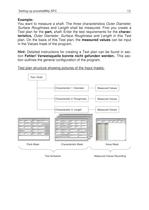
Setting-up [email protected] You want to measure a shaft. The three characteristics Outer Diameter, Surface Roughness and Length shall be measured. First you create a Test plan for the part, shaft. Enter the test requirements for the charac- teristics, Outer Diameter, Surface Roughness and Length in this Test plan. On the basis of this Test plan, the measured values can be input in the Values mask of the program. Hint: Detailed instructions for creating a Test plan can be found in sec- tion Fehler! Verweisquelle konnte nicht gefunden werden.. This sec- tion outlines the general configuration of...
Open the catalog to page 13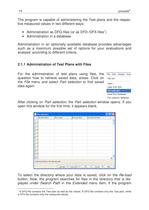
The program is capable of administering the Test plans and the respec- tive measured values in two different ways: Administration in an optionally available database provides advantages such as a maximum possible set of options for your evaluations and analysis' according to different criteria. 2.1.1 Administration of Test Plans with Files For the administration of test plans using files, the File Edit Module Indiv question how to retrieve saved data, arises. Click on HI? N™ the File menu and select Part selection to find saved data again. Part selection Read from database Part selection database...
Open the catalog to page 14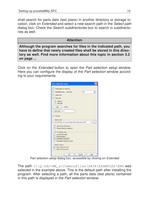
Setting-up procella®My.SPC shall search for parts data (test plans) in another directory or storage lo- cation, click on Extended and select a new search path in the Select path dialog box. Check the Search subdirectories box to search in subdirecto- Although the program searches for files in the indicated path, you have to define that newly created files shall be stored in this direc- tory as well. Find more information about this topic in section 3.2 Click on the Extended button to open the Part selection setup window. Here you can configure the display of the Part selection window accord-...
Open the catalog to page 15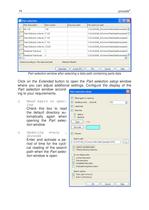
Part selection window after selecting a data path containing parts data Click on the Extended button to open the Part selection setup window where you can adjust additional settings. Configure the display of the Part selection window accord o Read again on open- Check this box to read tomatically again when opening the Part selec- tion window. riod of time for the cycli- path when the Part selec- tion window is open. Part selection setup 0 Read again on opening 0 Updating every ... seconds Search path I I Reload directory selection I I Locked test plans I I Free test plans 0 Completed test plans...
Open the catalog to page 16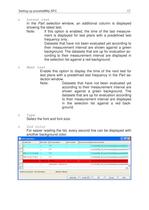
Setting-up procella®My.SPC In the Part selection window, an additional column is displayed showing the latest test. Note: If this option is enabled, the time of the last measure- ment is displayed for test plans with a predefined test frequency only. Datasets that have not been evaluated yet according to their measurement interval are shown against a green background. The datasets that are up for evaluation ac- cording to their measurement interval are displayed in the selection list against a red background. Enable this option to display the time of the next test for test plans with a predefined...
Open the catalog to page 17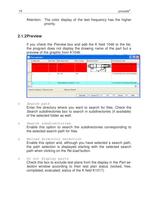
Attention: The color display of the test frequency has the higher If you check the Preview box and add the K field 1046 to the list, the program does not display the drawing name of the part but a preview of the graphic from K1046._ Latest test Next test Part description Part number Drawing name File name and path Test Defective Units No: F 123 Sorted according to: Drawing name Selection filtered! Extended j [ re-load {F2> ] [ OK ] [ Cancel ] [ Help Enter the directory where you want to search for files. Check the Search subdirectories box to search in subdirectories (if available) of the selected...
Open the catalog to page 18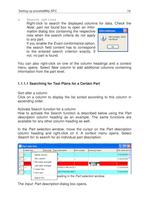
Setting-up procella®My.SPC Right-click to search the displayed columns for data. Check the Note: part not found box to open an Infor- mation dialog box containing the respective note when the search criteria do not apply If you enable the Exact conformance option, the search field content has to correspond to the entered search criterion exactly. If You can also right-click on one of the column headings and a context menu opens. Select New column to add additional columns containing information from the part level. 1.1.1.1 Searching for Test Plans for a Certain Part Sort after a column Click...
Open the catalog to page 19All Q-DAS Inc catalogs and technical brochures
 Q-DAS CAMERA Concept
4 Pages
 O-QIS
O-QIS4 Pages
 Q-PRM
Q-PRM4 Pages
 20M-QI
4 Pages
 CAMERA_eb
4 Pages
 QIS_ea
4 Pages
 Manager_ea
4 Pages
 destra_eb
4 Pages
 STAT
STAT4 Pages
 solara
4 Pages

Archived catalogs
 AQDEF Companion
2 Pages
 Next Generation SPC
2 Pages
 destra for Six Sigma
8 Pages
 General Product Catalog
14 Pages


- Management software solution
- Automation software solution
- Analysis software solution
- Process software
- Real-time software
- Cloud-based software
- Control software
- Monitoring software solution
- Measurement software
- Visualization software solution
- Quality software
- Reporting software
- Machine software
- Optimization software
- Test software
- Planning software solution
- Web-based software solution
- Inspection software
- Production software
- Alarm software