


- Company
- Products
- Catalogs
- News & Trends
- Exhibitions
Nuclear catalogue
Nuclear catalogue
The Main Live Steam (VVP) circuit consists of four lines transporting steam from the steam generator to the turbine. Each line is protected by seven safety valves. The system includes a guard plate welded on the main pipe for protection.
Operations involve cutting and beveling on the steam generator dome and ARE nozzles. The material used is steel TU48C with wall thicknesses from 35 mm to 100 mm. Specific machinery is required due to space constraints and contamination risks.
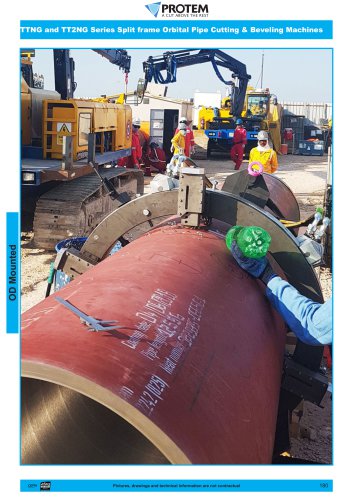
TTNG machines are used for cutting and beveling tubes, designed for heavy wall thicknesses and various positions. Features include a centering system and protective gear housing.
Equipment is packed in locked crates with nuclear certified foam. Tailor-made lifting beams and slings are used for handling with cranes.
PROTEM has developed over 3,500 machines for nuclear power plant construction, maintenance, and dismantling, focusing on reliability, quality, and safety.
Nuclear power provides about 10% of the world's electricity and is a significant source of low-carbon energy. It also aids in medical and space exploration fields.
The containment building provides confinement, protection, and radiation shielding. The primary circuit heats water to 320°C, transferring heat to a secondary circuit to produce steam for electricity generation.
RPVs are critical components designed to withstand high temperatures, pressures, and neutron irradiation, containing the core, cooling water, and generated steam.
This equipment is used for machining weld beads to remove temporarily welded accessories, focusing on minimizing vessel damage and heating.
The reactor vessel head is removable for maintenance, with welded access nozzles. The Omega Seal is a specific joint type used in these operations.
Machines are described for cutting weld joints and MCG tank cover sheaths, emphasizing remote operation and compact design.
The document discusses managing aging in nuclear power plant components to ensure safety and longevity, highlighting the need for regular maintenance and inspection.
Procedures for unscrewing and removing studs, maintaining tappings, and repairing threads are outlined, emphasizing avoiding irreversible damage and minimizing personnel exposure.
The document provides a historical overview of equipment used in nuclear power plants, noting modernization efforts to improve reliability and performance.
Design goals for maintenance machines include compactness, modularity, and optimized maintainability, with a focus on user-friendly interfaces and efficient operation.
Details on various machines used in maintenance and repair, including cycle times, power output, and specific features for different operations.
Operations are conducted on sensitive equipment, requiring remote control and specific safety measures.
Significant reduction in required spare parts and improved cycle times, with enhanced user interface and control mechanisms.
Designed for maintenance of nuclear reactor vessel threaded holes, performing automatic cleaning on a vessel flange.
Allows for local welded joint repairs of feedwater pipes in cramped environments, fully automated and remotely controlled.
Facilitates the introduction and setup of machines into neutron beam tubes, featuring adjustable height and remote control capabilities.
Used for re-machining seal surfaces in neutron beam tubes, ensuring tightness between tubes and the pool.
An electric-stepping, motor-actuated linear drive used to control the rate of fission in nuclear reactors.
Designed to dismantle radiological inspection plugs from steam pipes by machining the weld.
Used for machining screw heads that hold guide tubes, particularly when seized.
Re-machines threads on difficult screw removals and performs thread finishing.
M3 performs screw body machining and drilling; M4 performs thread roughing.
Used in PWR nuclear power stations for machining stainless steel tubes.
Include the reactor chemical and volumetric control circuit (RCV) and the shutdown reactor cooling circuit (RRA).
Injects borated water to stop nuclear reactions and maintain water volume in emergencies.
Outlines the use of internal gripping machines for machining tubes of various grades, including chamfering, stripping, and straightening.
Machining is performed on pipes with specific diameters and materials, such as stainless steel and Inconel.
Serve as sealing and terminating devices, providing environmental protection by sealing on the outer cable sheath.
Convert feedwater into steam using heat from the nuclear reactor core, essential in most nuclear power plants.
Involves cutting and welding primary pipes, using machines like the TTNG 1400 for cutting and beveling.
Various machines are used for cutting, beveling, and re-machining steam generator components.
Regular maintenance and monitoring of steam generators are necessary to prevent microcracks and ensure safety.
Provides detailed technical descriptions of machines used for maintenance and repair, including specifications like weight, cycle time, and power requirements.
A pressurizer maintains pressure in the primary circuit by heating water to its saturation temperature using submerged electrical heaters.
Involves using a pneumatic milling spindle on an electrically driven feed carriage, remote-controlled.
Include expansion, fretting, and bolting techniques, primarily used in the primary circuit.
Involves reinforcing parts by surrounding them with a hoop, often requiring thermal expansion techniques.
Machines like the US3000 R and US400 are used for machining and cladding reactor covers and vessels.
On-site machining of flanges and valves is essential due to the high pressures and temperatures they endure.
Repairs are often unplanned and must be executed quickly once the network is stopped.
Designed for replacing swing check valve seats, suitable for DN 150 to DN 300 valves.
Used for re-machining ST regenerative converters and CO2 turboblower shafts in irradiated areas.
Operations include reactor vessel internals sampling, core drilling, and dismantling of nuclear reactor components.
Include machines for internal cutting of heavy wall pipes and square tubes, utilizing cold and lubrication-free processes.
PROTEM developed machines for dismantling reactor internals, performing operations underwater.
Performs internal cutting of square tubes underwater, featuring stainless steel construction, hydraulic clamping, and remote control capabilities.
Involves cleaning up radioactivity and dismantling the plant, with strategies like Immediate Dismantling, Safe Enclosure, and Entombment.
Designed to handle specific materials and conditions, such as contaminated tubes and exchangers.
Specialized equipment is used to dismantle exchangers, optimizing weight for handling and facilitating decontamination.
Involved dismantling internal components and was part of a broader European decommissioning initiative.
Used for cutting various materials in extreme environments, including underwater.
Used for decommissioning in nuclear power plant pools, specifically for internal cutting of pipes.
Tooling for remote cutting of stainless steel hydraulic guards in contaminated chutes.
Used for dismantling power plants and cutting contaminated pipes.
Designed for cutting large steel components with precision.
Size reduction of stainless steel radioactive containers.
Maintenance of nuclear reactors by dismantling neutron beam tubes.
Remote cutting of contaminated piping.
Used in gas-cooled graphite nuclear power stations for dismantling blocked rod shock absorbers.
Cutting electrical cables with precision.
Cutting non-oxidizing sheet metal under water in the nuclear industry.
Used in irradiated areas for removing graphite cores and making precise holes.
Involves handling various types of radioactive waste generated from nuclear power production and reactor decommissioning.
Includes Low-Level Waste (LLW), Intermediate-Level Waste (ILW), and High-Level Waste (HLW), each requiring specific management strategies.
Treatment processes aim to alter waste characteristics for safety and economic benefits, including volume reduction and radionuclide removal.
Waste storage ensures isolation from the environment and retrievability, often at the production site.
Several countries operate disposal facilities for LLW and ILW, ensuring regulated and controlled waste management.
Includes punching tools, drilling and injection machines, and filter cutting machines for handling radioactive waste.
Automated cutting machines allow remote operation for cutting operations, featuring a video feedback system for monitoring.
Automates lid crimping on stainless steel jars, achieving crimping in less than a minute.
Provides high-quality pulse TIG welding without filler materials, capable of remote maintenance and repair.
Includes vinyl removal machines and solvent drums drilling machines for handling radioactive waste.
Discusses the two main types of submarine hulls: the outer hull and the pressure hull, crucial for maintaining pressure differences.
The sail, or fin, is a tower-like structure on the dorsal surface of submarines, housing the conning tower, periscopes, radar, and communication masts.
Nuclear-powered submarines have thicker hulls than diesel-powered ones due to increased internal pressure from the nuclear reactor.
Submarine reactors provide heat to power steam turbines, using uranium and moderators like water to manage nuclear fission.
Describes various machines used in submarine construction and maintenance, including beveling, orbital cutting, and welding machines.
Used for operations on nuclear steam generators in submarines, featuring an elevating table for precise movements.
HTGRs are cooled using gases like helium or carbon dioxide, operating at temperatures exceeding 800°C.
Fusion involves fusing hydrogen into helium, releasing significant heat and light, with commercial viability not expected before the 2050s.
About 60 reactors are under construction worldwide, with 110 more planned, primarily in Asia.
Lists reactors under construction with details such as country, reactor model, and capacity.
Key components include main pipelines, auxiliary circuits, and primary coolant systems.
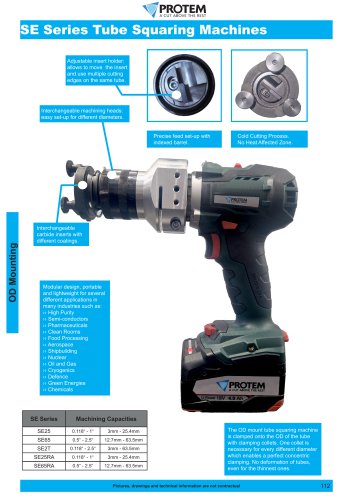
Details various tube squaring machines, highlighting their capacities, technical features, and applications.
Lists several stainless steel clamping collets for different models, used for micro fittings.
Various tool bits are described, made from materials such as HSS and carbide, with coatings like TiN, TiALN, and TiSiN.
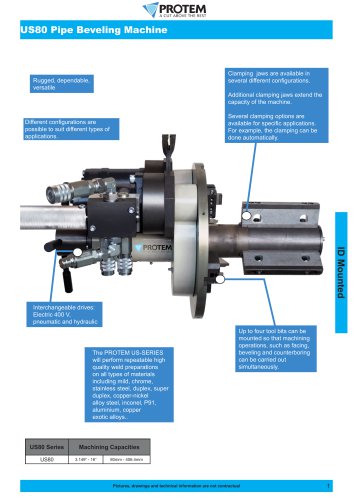
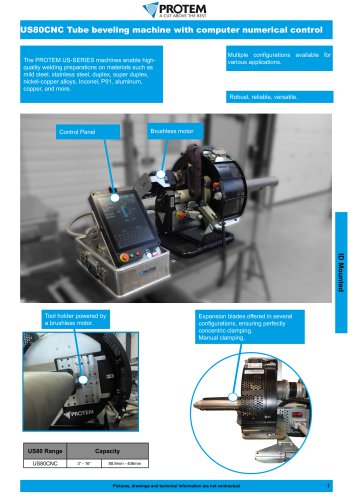
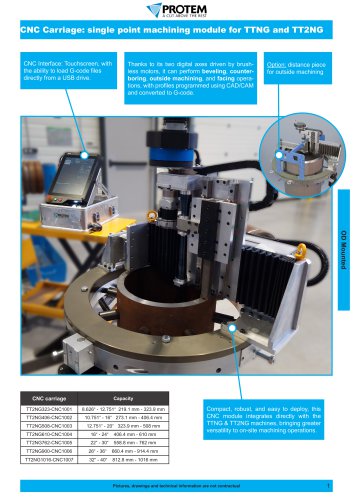
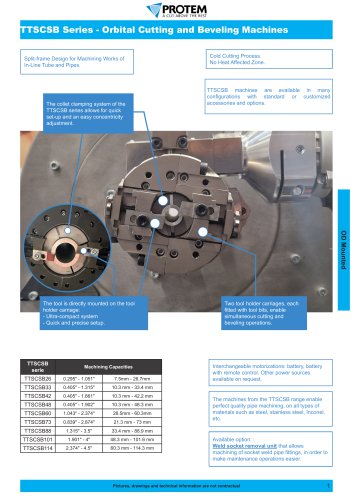
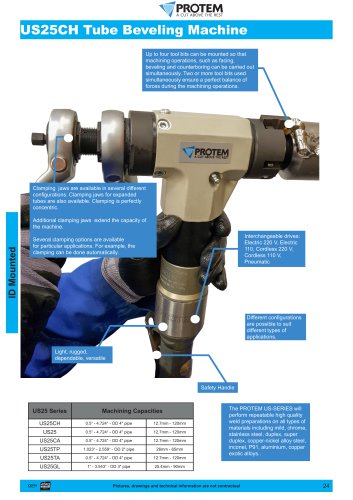
Versatile, portable tube and pipe beveling and facing machines, capable of performing high-quality weld preparations.
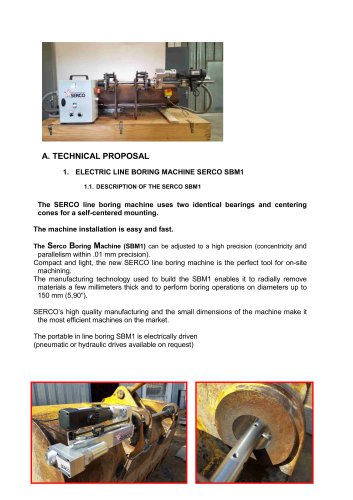
Designed for maintenance and repair of boiler and heat exchanger tubes, offering high accuracy without heat-affected zones.
Machines have specific technical features such as manual or automatic clamping, feed stroke, and expansion capabilities.
Suitable for various applications, including beveling, squaring, counter-boring, weld joint removal, and coating removal.
Includes elbow mandrels, pipe beveling machines, and saddle beveling machines for precise alignment and high-quality weld preparations.
Durable and versatile, capable of performing multiple machining operations simultaneously.
Designed for high-quality weld preparations on various materials, offering interchangeable drives and multiple clamping options.
Capable of handling pipes with diameters ranging from 18" to 56", offering both pneumatic and hydraulic drive options.
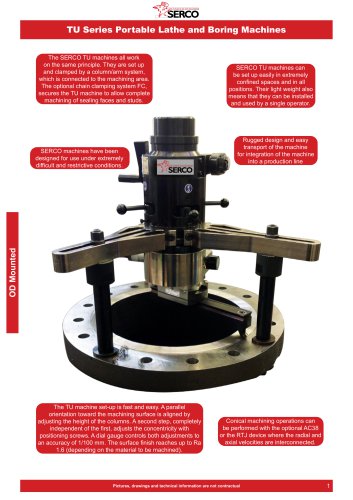
Designed for pipes with diameters from 2.374" to 168", available in multiple configurations.
Specifically engineered for the Oil & Gas Industry, allowing for cutting and beveling of pipe sections with defects.
A variation of the copying carriage designed for heavy wall boring operations.
Provides benefits such as reduced weight, compact size, higher electrical efficiency, and lower thermal heating.
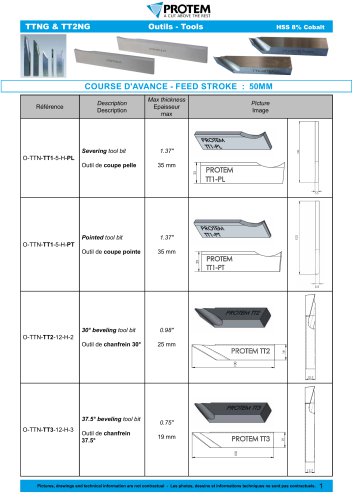
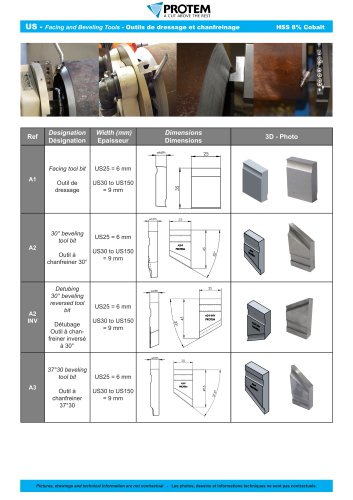
A variety of tool bits are available for different beveling and severing operations.
Highlights the challenges posed by the reactor environment and the importance of regular maintenance and component replacement.
Involves converting UF6 into uranium oxide, a more stable form for long-term storage.
Neutrons released by fission products seconds after fission, crucial for controlling nuclear reactors.
Uranium with less than 0.7% U-235, used in reactor fuel when blended with highly-enriched uranium.
Known as heavy hydrogen, occurring naturally in a ratio of 1:6500 with normal hydrogen.
The natural decay of a radioactive isotope's nucleus, emitting particles and gamma rays.
The energy absorbed by tissue from ionizing radiation, measured in sieverts.
A unit of energy representing the kinetic energy gained by an electron through a one-volt potential difference.
Uranium with increased U-235 content above the natural 0.7%, typically enriched to 3.5% for reactors.
The process of increasing the U-235 to U-238 ratio, measured in Separative Work Units (SWU).
A reactor that produces more fissile material than it consumes, using fertile materials like depleted uranium.
The splitting of a heavy nucleus into two, releasing energy and neutrons.
A structured collection of fuel rods used as a unit of fuel in a reactor.
High-energy electromagnetic radiation from atomic nuclei.
The time required for half of a radioactive isotope's atoms to decay into another element.
A reactor using heavy water as a moderator, such as the Canadian CANDU reactor.
Extremely radioactive materials from used nuclear fuel, requiring shielding and cooling.
Radiation capable of breaking chemical bonds, causing ionization and tissue damage.
A common reactor type using ordinary water as a coolant and moderator.
Reactor fuel consisting of uranium and plutonium oxides.
An uncharged particle in atomic nuclei, crucial for sustaining fission reactions in reactors.
A transuranic element formed in reactors, used in nuclear energy and weapons.
The chemical treatment of used reactor fuel to separate uranium, plutonium, and transuranic elements from fission products.
A unit measuring the biological damage caused by radiation.
Used fuel assemblies from reactors, often treated as waste.
Heavy elements formed by neutron capture, with atomic numbers higher than uranium.
A mildly radioactive element with fissile and fertile isotopes, serving as the basic fuel for nuclear energy.
Refers to fuel assemblies that have been removed from a reactor after several years of use.
Involves incorporating high-level wastes into borosilicate glass to immobilize radionuclides.
Describes the change in reactivity due to the boiling of coolant or moderator in the reactor core.
Includes High-Level Waste (HLW), Intermediate-Level Waste (ILW), and Low-Level Waste (LLW), each requiring specific management strategies.
Ammonium diuranate, a uranium compound in U3O8 production.
A zirconium alloy used to contain uranium oxide fuel pellets in a fuel rod.
Catalog excerpts
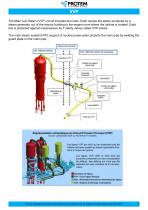
VVPThe Main Live Steam (VVP) circuit includes four lines. Each carries the steam produced by a steam generator out of the reactor building to the engine room where the turbine is located. Each line is protected against overpressure by 7 safety valves called VVP valves.The main steam system(VVP) support of nuclear power plant protects the main pipe by welding the guard plate on the main pipe. Representation schematic!du Circuit Primaire Principal fCSPi l. es 'ignes VvP fen vertj qui ne tespecleni pas les rs iterFfB de r an ltd qua lire duj: In rven t perm e Hre ilex :: lire- ltd risquH da rupture....
Open the catalog to page 2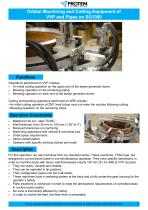
Functions Operations performed on VVP nozzles: • An initial cutting operation on the upper part of the steam generator dome. • Beveling operation on the remaining piping. • Beveling operation on each end of the steam generator dome. Cutting and beveling operations performed on ARE nozzles: • An initial cutting operation at ZM1 level (chips must not enter the nozzles following cutting. • Beveling operation on the remaining tubes. Operation-Constraints • Material to be cut : steel TU48C • Wall thickness: from 35 mm to 100 mm (1.38” to 4”) • Reduced tolerances on machining • Machining operations...
Open the catalog to page 3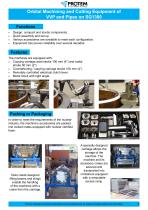
Orbital Machining and Cutting Equipment of VVP and Pipes on SG1300Functions • Design: compact and sturdy components. • Various accessories are available to meet each configuration. • Equipment has proven reliability over several decades. The machines are equipped with: • Copying carriage axial stroke 100 mm (4”) and radial stroke 50 mm (2”). • Counterboring / copying carriage stroke 100 mm (4”). • Remotely controlled electrical clutch lever. • Motor block with right angle. Packing or Packaging In order to meet the requirements of the nuclear industry, the machine’s accessories are packed into...
Open the catalog to page 4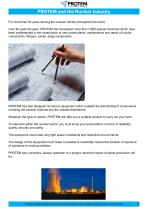
PROTEM and the Nuclear Industry For more than 50 years serving the nuclear industry throughout the world Over the past 50 years, PROTEM has developed more than 3,500 special machines which have been implemented in the construction of new power plants, maintenance and repair of tubular components, flanges, valves, large components. PROTEM has also designed numerous equipment which enabled the dismantling of components including the vessels internals and the vessels themselves. Whatever the type of reactor, PROTEM will offer you a suitable solution to carry out your work To intervene within the...
Open the catalog to page 5
Pictures, drawings and technical information are not contractual and are subject to changes without prior information 6
Open the catalog to page 6
Pictures, drawings and technical information are not contractual and are subject to changes without prior information
Open the catalog to page 7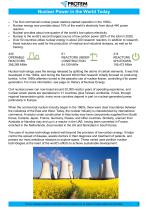
Nuclear Power in the World Today • • • • • The first commercial nuclear power stations started operation in the 1950s. Nuclear energy now provides about 10% of the world‘s electricity from about 440 power reactors. Nuclear provides about one-quarter of the world’s low-carbon electricity. Nuclear is the world‘s second largest source of low-carbon power (26% of the total in 2020). Over 50 countries utilize nuclear energy in about 220 research reactors. In addition to research, these reactors are used for the production of medical and industrial isotopes, as well as for training. 61 REACTORS UNDER...
Open the catalog to page 8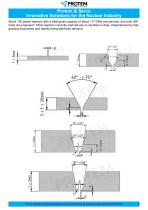
Protem & Serco Innovative Solutions for the Nuclear Industry About 120 power reactors with a total gross capacity of about 117 GWe are planned, and over 300 more are proposed*. Most reactors currently planned are in countries in Asia, characterized by fastgrowing economies and rapidly-rising electricity demand. Pictures, drawings and technical information are not contractual and are subject to changes without prior information
Open the catalog to page 9
Nuclear Technology Nuclear technology uses the energy released by the splitting of atoms of certain elements. This process was first developed in the 1940s, and during World War II the goal of research was to be able to produce bombs. It was from 1950 that nuclear fission was considered more for peaceful purposes in order to produce electricity. Today, thanks to regional transport networks, many countries partly depend on nuclear energy, particularly in Europe. Thus, as early as the 1960s, certain countries decided to launch their nuclear programs. Let us remember that at the time, “political”...
Open the catalog to page 10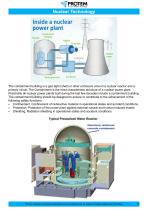
Nuclear Technology The containment building is a gas-tight (shell) or other enclosure around a nuclear reactor and a primary circuit. The Containment is the most characteristic structure of a nuclear power plant. Practically all nuclear power plants built during the last few decades include a containment building. The containment building should be designed to ensure or contribute to the achievement of the following safety functions: • Confinement. Confinement of radioactive material in operational states and accident conditions. • Protection. Protection of the power plant against external natural...
Open the catalog to page 11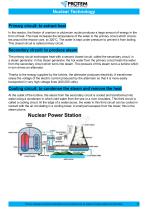
Nuclear Technology Primary circuit: to extract heat In the reactor, the fission of uranium or plutonium nuclei produces a large amount of energy in the form of heat. This heat increases the temperature of the water in the primary circuit which circulates around the reactor core, to 320°C. The water is kept under pressure to prevent it from boiling. This closed circuit is called primary circuit. Secondary circuit: to produce steam The primary circuit exchanges heat with a second closed circuit, called the secondary circuit, in a steam generator. In this steam generator, the hot water from the...
Open the catalog to page 12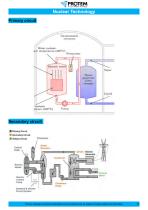
Nuclear TechnologyPrimary circuit Etoictor Secondary circuit| Primary firruil 9 S^cnfutjfy CJrcull "I farl-ary circull CwMJQl «(Ni? * rurtarw Elactnc __ Generator CTtr de" ser RfljLtdr CrmriJCJl fi Volhinr Cruilfol 5ystrfn 13 Pictures, drawings and technical information are not contractual and are subject to changes without prior information
Open the catalog to page 13All PROTEM catalogs and technical brochures
 Pipe Beveling Machine US80
6 Pages
 Tools - TTNG and TT2NG range
11 Pages
 Tube and Pipe Beveling Machines
324 Pages
 Orbital Cutting Saws
12 Pages
 WATER SOLUBLE PAPER AND TAPE
8 Pages
 Boring Bar
1 Page
 Serco SBM1
4 Pages
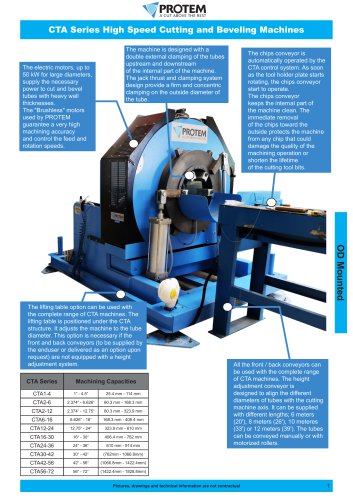
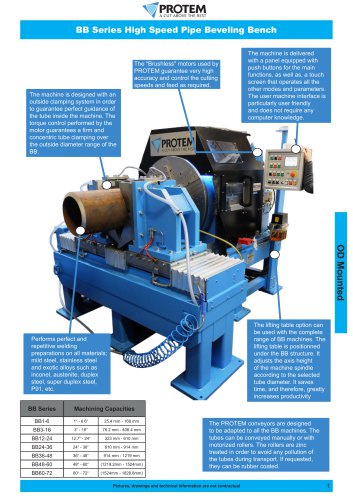
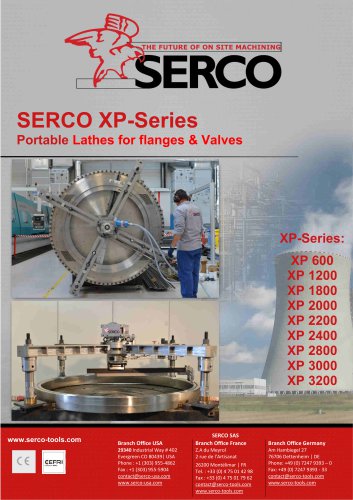
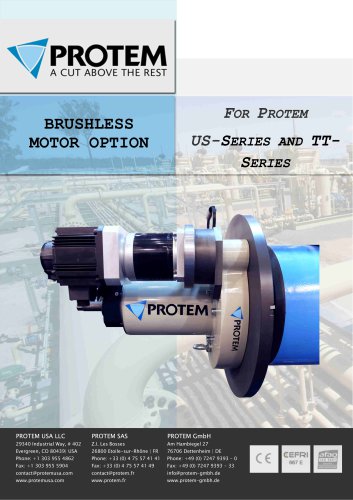






- PROTEM metal cutting machine
- PROTEM CNC cutting machine
- Turning center
- Automatic cut-off machine
- Metal sawing line
- PROTEM cutting machine for industrial applications
- PROTEM knife cutting machine
- High-precision cutting center
- Automatic sawing line
- High-speed cut-off machine
- Band sawing line
- PROTEM tube cutting machine
- 2-axis turning machine
- PROTEM precision cutting machine
- Aluminum cutting center
- PROTEM stainless steel cutting machine
- Horizontal saw
- PROTEM chamfering machine
- Metal fabrication cutting machine