
- Catalogs
- ProMinent Group
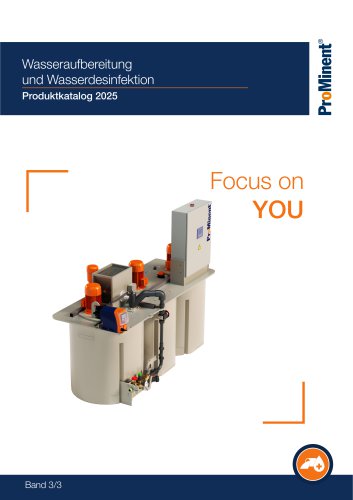
- Water-Treatment-Water-Disinfection-ProMinent-Product-Catalogue-2023-Volume-3


Water-Treatment-Water-Disinfection-ProMinent-Product-Catalogue-2023-Volume-3

Water-Treatment-Water-Disinfection-ProMinent-Product-Catalogue-2023-Volume-3
- UV Systems: DULCODES UV systems provide chemical-free water treatment, ideal for municipal drinking water and swimming pools.
- Ozone Systems: OZONFILT and DULCOZON systems effectively remove organic and inorganic substances without by-products.
- Chlorine Dioxide Systems: Bello Zon systems offer long-lasting microbial protection, suitable for potable water and food industry applications.
- Electrolysis Systems: CHLORINSITU and DULCOLYSE systems generate chlorine on-site, reducing the need for hazardous chemical transport and storage.
- ULTROMAT and DULCODOS: These systems are praised for their ease of assembly and operation, meeting stringent requirements for separating colloidal solids from liquids.
- Storage Tanks: Essential for both indoor and outdoor installations, complying with international manufacturing approvals.
- Diaphragm Systems: Essential for removing particles or dissolved substances, such as salts, from water.
- Ultrafiltration, Nanofiltration, and Reverse Osmosis Systems: These systems provide comprehensive solutions for various filtration needs.
- DULCOLYSE System: Offers low chlorate and chloride disinfection, suitable for sensitive applications like baby food production.
- DULCODOS SAFE-IBC: Designed for earthquake zones, ensuring uninterrupted chemical supply.
- DULCONNEX IIoT Solution: Provides real-time monitoring and management of water treatment systems, enhancing process safety and efficiency.
We offer a wide range of solutions for water treatment and disinfection, supporting both standard and additional components through flexible modules. This includes older devices and components from other manufacturers.
- Water treatment and disinfection systems
- UV systems (DULCODES MP, LP/LP certified/LP F&B/LP-PE)
- Chlorine dioxide systems (Bello Zon CDLb, CDVd, CDKd)
- Electrolysis system (CHLORINSITU IIa 60–2500 g/h)
- Pumps (gamma/ X, gamma/ XL, DULCOFLEX DFXa, DFYa, sigma/ X, DF4a)
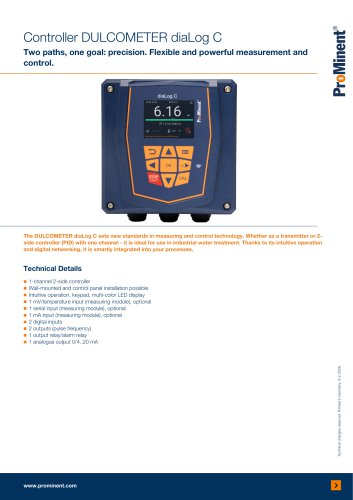
- Controllers (DULCOMETER diaLog DACb, AEGIS II, SlimFLEX 5a)
- Industrial standard signals via I/O modules
The DULCONNEX Gateway connects smart products to our web-based fluid management platform, requiring a WiFi access point for internet communication. It supports various system types, including UVCb and CDLb.
UV disinfection is a chemical-free, reliable process that uses UV-C radiation to destroy germs by attacking their DNA. It is effective against resistant parasites and reduces undesirable substances in water without affecting taste or odor. Applications include drinking water, food and beverage production, pharmaceutical industry, and more.
These systems feature high-quality components, such as stainless steel radiation chambers, high-output lamps, and advanced controllers. They offer benefits like homogeneous UV dose distribution, low life cycle costs, and efficient cleaning systems. The systems are validated for disinfection efficiency and can be integrated into higher-level control systems.
ProMinent offers a variety of UV systems for different applications, including drinking water, process water, and swimming pool water. The systems are designed for maximum water flow and minimum UV transmission, with specific installation requirements for optimal performance.
When designing a UV system, consider the highest water flow, lowest UV transmission, and provide necessary valves for maintenance and safety. A typical installation includes shut-off valves, sample valves, and a controller/ballast system.
To design an appropriate UV system, provide details such as the application, maximum water flow, minimum UV transmission, and water data like turbidity and suspended particles.
- Designed for food and beverage production, offering a broad dimming range and high-grade stainless steel construction.
- Features include electronic ballasts, a UVC sensor, and remote monitoring capabilities.
- Technical data includes flow rates, lamp power, and dimensions, with a focus on low-pressure VARIO Flux lamps.
- Targets saline and seawater disinfection with a corrosion-resistant HD-PE reactor.
- Benefits include high UVC efficiency, low maintenance costs, and flexible installation options.
- Technical details cover flow rates, lamp power, and permissible operating conditions.
- Specialized for sugar syrup disinfection, eliminating heat-resistant spores without affecting product quality.
- Offers energy savings and low investment costs, with a hygienic system design.
- Technical specifications include flow rates, lamp power, and system dimensions.
- Designed for swimming pool water treatment, focusing on the breakdown of combined chlorine.
- Features include medium-pressure lamps, flexible installation, and real-time monitoring.
- Technical data includes flow rates, lamp power, and maintenance requirements.
- Use of VARIO Flux lamps with dynamic heating for high efficiency and long service life.
- Integration capabilities with higher-level control systems and remote monitoring via web interfaces.
- Data logging and analysis for operational transparency and reliability.
- Specifications: The DULCODES UV systems are designed for high flow water treatment, capable of handling up to 809 m3/h. They use medium-pressure lamps to disinfect water and eliminate contaminants like chlorine and ozone.
- Features: The systems include electronic ballasts for lamp output adjustment, UVC sensors for monitoring, and motor-driven wipers for maintenance. They are certified to international standards such as NSF, UL, CSA, and USEPA.
- Benefits: Easy installation, flexible fitting positions, energy-efficient operation, and simple maintenance. The systems are equipped with a large graphic display for monitoring and control.
- Technical Details: Made from stainless steel, the systems have a lamp service life of 8000 hours and are equipped with temperature sensors and various interfaces for control and monitoring.
- Applications: Suitable for potable water, process water, and swimming pool water.
- Applications: Ozone is used for disinfection and oxidation in various sectors, including drinking water supply, food and beverage industry, swimming pools, and industrial processes.
- Benefits: Ozone provides effective disinfection with fewer by-products compared to other oxidants. It is generated on-site and decomposes back into oxygen, making it environmentally friendly.
- Technical Details: The systems use silent electrical discharge to produce ozone from oxygen, ensuring efficient and reliable operation.
- Includes various components such as wiper elements, UVC sensors, replacement filter mats, and remote monitoring modules.
- Additional accessories like protective glasses, gloves, and cleaning systems are available for maintenance and safety.
- Provides real-time, location-independent monitoring of system data and status through smart devices, enhancing operational efficiency and safety.
- Discharge System: Utilizes feed pumps or discharge pumps to deliver ozonized water on-demand once the desired ozone concentration is achieved.
- Residual Ozone Gas Destruction: A catalytic unit safely removes undissolved ozone gas from exhaust air.
- Gas Detector: Monitors room air for ozone leaks, stopping ozone generation and triggering alarms if thresholds are exceeded.
- OZONFILT OZMa: Capable of generating 70-420 g/h of ozone, these systems are maintenance-free and energy-efficient, using compressed air as feed gas. They feature automatic control and process visualization via a touch panel.
- Legal Compliance: Systems must comply with the Biocidal Products Regulation (EU) No. 528/2012 or REACH Regulation (EC) No. 1907/2006 for operation in Europe.
- Ozone Capacity: Ranges from 70 to 420 g/h depending on the model.
- Air and Cooling Requirements: Systems require oil and dust-free air, with specific cooling water quality and consumption rates.
- Electrical and Mechanical Design: Systems are available in various configurations, including standard and stainless steel cabinets, with options for integrated air conditioning and gas treatment.
- Potable Water Supply: Used for oxidation and disinfection, enhancing taste and removing contaminants like iron and manganese.
- Wastewater Treatment: Reduces COD and microcontaminants, and decreases sewage sludge.
- Food and Beverage Industry: Ensures disinfection of potable and rinser water.
- Swimming Pools: Provides a microbiological barrier and improves water clarity.
- Industrial Use: Prevents Legionella and disinfects cooling water.
- Systems require minimal pipe length and joints for ozone transport, with gas detectors installed for safety.
- Mixing equipment must be ordered separately, designed to optimize water flow for efficient ozone mixing.
- Non-return valves are necessary to prevent backflow of ozonized water.
The DULCOZON OZLa is a high-output ozone generator designed for efficiency and compactness, offering ozone capacities ranging from 380 to 6,080 g/h. It features low life cycle costs, high ozone concentration, and modular design for flexible adaptation to process requirements. The system ensures energy efficiency, space savings, and high operating safety with redundant module activation.
Technical Specifications
- Available in 8 sizes with modular design, supporting up to 16 generator blocks.
- Specific energy consumption is less than 8.0 Wh/g of ozone at 10% weight concentration.
- Innovative water cooling system with automatic shut-off and monitoring.
- PLC control with data recording and wide communication interfaces (PROFIBUS, PROFINET, Modbus).
- Optional features include mass flow meter, air conditioning, and sensors for oxygen and ozone monitoring.
Applications
- Drinking water supply: Oxidation and disinfection.
- Wastewater treatment: Reduction of contaminants and disinfection.
- Aquaculture, textile, and food industries: Various oxidation and disinfection processes.
Accessories and Spare Parts
- Compressors: Atlas Copco LFX and Dürr piston compressors for different OZVb types.
- Ozone gas distributor module: Regulates ozone distribution to multiple injection points.
- Static helical mixers: Ensure optimal mixing of ozone with liquid flows.
- Various connecting parts and valves for system integration and maintenance.
Additional Components
- Residual Ozone Gas Destructor: Removes traces of ozone gas from exhaust air.
The document describes two types of residual ozone destructors: PVC and stainless steel versions. The PVC version uses active carbon granulate and is suitable for swimming pool applications with air as the operating gas. The stainless steel version uses a maintenance-free MnO catalyst and is designed for chlorine-free gas flows. It includes integrated heating and various connection sizes.
Ozone Systems OZONFILT and DULCOZON
The document details the GMA 22 ozone gas detector, which monitors ozone gas leakages. It provides specifications such as warning and alarm levels, permissible ambient temperature, and power supply details. The document also includes information on a gas detector for oxygen, a flash light-horn, a gas tracing pump, and potassium iodide starch paper for leak detection.
Cooling Water Chiller
The cooling water chiller is an alternative to using freshwater for cooling. It features a single circuit system, air-cooled refrigeration unit, and integrated circulation pump. It operates within a temperature range of 10 to 55°C and uses CFC-free refrigerant R134a.
Personal Protection Accessories
Includes an ozone-resistant gas mask, warning labels, an emergency stop switch, and overvoltage protection for OZONFILT systems.
Chlorine Dioxide in Water Treatment
Chlorine dioxide is highlighted for its advantages over chlorine, such as its effectiveness regardless of pH and its stability in pipework systems. It does not react with ammonia or form harmful by-products like trihalomethanes.
Bello Zon Chlorine Dioxide Systems
The Bello Zon systems use the chlorite/acid process to generate chlorine dioxide. They offer precise production, easy operation, and high safety standards. Various models are available, each with different capacities and applications, such as combating legionella and treating municipal water.
Performance Overview
The document provides a performance overview of different Bello Zon systems, detailing their output capacities and suitable applications.
Questionnaire for Chlorine Dioxide System Design
A questionnaire is included to assist in designing a chlorine dioxide system, covering aspects like water flow rate, pH value, and desired metering concentration.
Overview:
The Bello Zon CDLb is a chlorine dioxide system designed for cost-effective disinfection across multiple injection points. It operates with a capacity of 0-120 g/h and can store up to 60 g of chlorine dioxide for peak metering. The system is suitable for various applications, including food and beverage disinfection, Legionella control, and water treatment.
Specifications:
- Capacity: 0-120 g/h
- Max flow rate: 600 m3/h at 0.2 ppm ClO2
- Power supply: 100-230 V, 50/60 Hz
- Protection class: IP 65
- Operating fluids: Sodium chlorite 7.5%, Hydrochloric acid 9%, potable water
Benefits:
- Reduced chemical usage and costs
- Quick ramp-up time after downtime
- Safe and reliable operation with closed gas transport system
- Real-time monitoring via DULCONNEX Platform
Technical Details:
- Inputs: Configurable digital inputs for various metering functions
- Outputs: Operating, alarm, and warning signal relays
- Concentration: 1000 or 2000 mg/l
Field of Application:
- Disinfection in food and beverage industry
- Legionella control in hotels and hospitals
- Market gardening and irrigation
- Cooling and potable water treatment
Chlorine Dioxide System Bello Zon CDLb H2SO4
Overview:
The Bello Zon CDLb H2SO4 system is designed for applications sensitive to corrosion, producing low-chloride chlorine dioxide using sodium chlorite and sulfuric acid. It is ideal for stainless steel environments like tunnel pasteurisers and cooling circuits.
Specifications:
- Capacity: 8-89 g/h
- Concentration: 1500 mg/l
- Power supply: 100-230 V, 50/60 Hz
- Protection class: IP 65
- Operating substances: Sodium chlorite 7.5%, Sulfuric acid 25%, potable water
Benefits:
- Low potential for corrosion
- Suitable for circulation systems
- Safe and reliable operation
- Real-time monitoring via DULCONNEX Platform
Technical Details:
- Inputs and outputs similar to CDLb
- Concentration: 1500 mg/l
Accessories and Maintenance:
- Various points of injection made of PVC-U or PVC-C
- Back pressure valves and angle valves available
- Maintenance kits for annual and 3-yearly servicing
Ordering System:
- Identity codes for different production capacities and configurations
- Options for equipment, version, operating voltage, and language presets
DULCOLYSE electrolysis systems are available in sealed stainless steel or open cabinet designs. They include a PLC in the control cabinet, a duplex water softening system, a salt-dissolving tank with level monitoring, an ultrasound level probe for the DULCOLYT product tank, piping, hardness control equipment, and pH buffer solutions. The DULCOLYT product tank and metering station are not included.
Spare Parts and Maintenance Kits:
Spare parts kits are available for systems manufactured before and after 2015, along with annual and 3-yearly maintenance sets.
Electrolysis Systems:
The document details the CHLORINSITU and DULCOLYSE systems, highlighting their use in disinfection and oxidation.
Accessories:
Includes a water hardness measuring kit and spare cells for DULCOLYSE systems.
Metering Systems:
DULCODOS DSKa systems are designed for connection to DULCOLYSE product tanks, featuring components like diaphragm dampers, back pressure valves, and repair switches. Various metering systems are available for different feed rates.
Polymer Preparation and Metering Systems:
ProMinent offers systems for preparing and metering synthetic polyelectrolytes, suitable for potable water treatment, wastewater treatment, sludge dewatering, and paper production. Systems include continuous flow, pendulum, double-decker, and inline preparation stations.
Performance Overview:
Systems like ULTROMAT, DULCODOS, and PolyRex are detailed with their capacities and applications. They are designed for efficient polymer solution preparation with features like high dosing precision and integrated mixing chambers.
Technical Data:
Technical specifications for ULTROMAT ULFa systems are provided, including discharge volumes, tank sizes, and power requirements.
Ordering System:
Details on ordering ULTROMAT ULFa systems based on type, tank size, discharge volume, design, and electrical connection are included.
- Metering pumps such as gamma/X and Sigma can handle back pressures up to 4.5 bar.
- Compact controllers like Schneider Electric TM241 and touch panels are available, with optional Ethernet/Modbus TCP and PROFIBUS® connectivity.
- Applicable for sludge dewatering, wastewater treatment, and drinking water treatment.
- Processes liquid polymers (0.05 – 1.0%) as emulsions or dispersions.
- Freely selectable preparation capacity and configuration versions.
- Includes liquid polymer metering pumps, peristaltic pump DFXa, and monitoring systems.
- Technical data includes max extraction rates, water pressure requirements, and dimensions.
- Batch preparation stations are under development.
- Details on inline batching stations with various configurations for electrical connections, control, and operating versions.
- Options for metering pumps, liquid level monitors, booster pumps, and post-dilution units.
- Manual polymer batching station for small quantities, robust and cost-effective.
- Includes a polypropylene batching tank, flushing system, and slow-running stirrer.
- Applications include potable water treatment and sludge de-watering.
- Post-dilution units for polymer solutions with integrated mixers and flow meters.
- Powder conveyor FG 205 for transporting powdered polymers.
- Big Bag emptying units for handling and emptying large bags of powdered polymers.
- Processes both liquid and powdered polymers with a capacity range up to 8200 l/h.
- Features a double-decker batching station with stainless steel tanks and a vacuum conveyor.
- Equipped with compact controllers and touch panels, with options for PROFIBUS® or Ethernet communication.
- Applications include potable water treatment, wastewater treatment, and paper production.
The document provides detailed specifications and functionalities of the PolyRex and DULCODOS SAFE-IBC systems, focusing on polymer preparation and metering systems.
1. PolyRex Systems
- PolyRex Big Bag: Designed for processing both liquid and powdered polymers with a capacity of up to 8200 l/h. It features a double-decker batching station with stainless steel tanks, ensuring effective polymer utilization and avoiding short-circuit effects. Key benefits include a compact controller, flexible Big Bag emptying unit, and precise dosing with a double-screw feeder.
- PolyRex Liquid: Specializes in processing liquid polymers with a capacity of up to 3180 l/h. It uses an eccentric screw pump and injection nozzle for effective mixing, ensuring no short-circuiting effect. The system is equipped with a compact controller and reliable metering capabilities.
- Mixing Systems: PolyRex systems are equipped with efficient mixing units for both powdered and liquid polymers, offering options like cyclonic wetting cones and sealed systems for dust-free operations.
2. TOMAL® Multi-Screw Feeder
This system is designed for precise metering of dry products with a capacity range of 0.4 – 215 m3/h. It features a unique construction for safe silo emptying and excellent dosing precision, suitable for various industries including wastewater treatment and chemical processing.
3. DULCODOS SAFE-IBC
This metering and emptying station ensures safe and reliable metering of liquid chemicals, conforming to German regulations for handling substances harmful to water. It supports IBCs up to 1000 l and features a robust construction with integrated metering stations. Key benefits include maximum operating safety, process reliability, and efficient IBC changes.
Technical Details and Options
The document provides extensive technical specifications for each system, including tank capacities, discharge volumes, and polymer dosing capacities. Options for customization and additional accessories are also detailed, such as communication interfaces, heating elements, and various controller options.
Applications
The systems are applicable in various fields such as potable and wastewater treatment, sludge de-watering, paper production, and chemical industries, highlighting their versatility and adaptability to different industrial needs.
The document provides a detailed catalog of DULCODOS SAFE-IBC systems and accessories, focusing on chemical storage and metering solutions. It includes various models designed for different capacities and environmental conditions, such as earthquake zones.
Specifications:
- The DULCODOS SAFE-IBC systems are available in different configurations, including standpipe and mirror-inverted designs, with materials like EPDM and FKM for different chemical resistances.
- Options include designs for outgassing media and various binding agents for specific applications.
- Spare parts such as IBC couplings and hoses are listed with their respective order numbers.
Storage and Process Tanks:
- The document outlines the specifications for PE/PP storage tanks, emphasizing compliance with statutory specifications and country-specific approvals.
- Tanks are available for indoor and outdoor installations, with capacities ranging from 500 liters to 50,000 liters.
- Technical details include compliance with German Institute for Building Technology (DIBt) guidelines and WHG approval for water-hazardous chemicals.
- The tanks are designed for atmospheric pressure and temperatures up to 40°C, with options for earthquake zone installations.
Accessories:
- Accessories include overfill protection, leakage sensors, and alarm indicator units, all with test certificates.
- Additional options like chemical filling stations, storage tank heaters, and radar liquid level sensors are available.
Membrane Filtration Systems:
- The document introduces membrane filtration systems used in water treatment, detailing processes like microfiltration, ultrafiltration, nanofiltration, and reverse osmosis.
- Each process is defined by the particle size it targets, from suspended particles to ions.
Key Benefits:
- The document highlights the reliability and quality of the products, backed by 25 years of experience in plastic storage tank engineering.
- It emphasizes the wide range of installation components and the ability to customize tanks to specific requirements.
- The use of state-of-the-art plastics processing machines ensures high manufacturing quality.
Field of Application:
- Suitable for storing chemicals used in potable water and process water treatment, wastewater technology, electroplating, swimming pool technology, and exhaust air treatment.
Ultrafiltration systems are designed to remove parasites, bacteria, viruses, and high-molecular organic substances from various types of water, including drinking water, river water, and wastewater. These systems are tailored to specific tasks by selecting appropriate membrane types and operating modes, ensuring cost-effectiveness and minimal chemical use.
System Components and Operation
Ultrafiltration systems typically include a stainless steel or coated steel rack, pre-filters, UF membrane modules, pneumatically controlled valves, electronic pressure measurement, and filtration pumps. The dead-end operation is standard, where raw water flows into capillaries, and pure water passes through the membrane, leaving other constituents on the surface. Regular backwashing removes the filter cake.
Advantages
These systems offer filtrate values of less than 0.1 NTU, high retention rates for bacteria and viruses, and easy integration with other systems due to PLC control. They are suitable for treating fresh water, brackish water, and seawater, and are used in public and private water supplies, as well as in the food and beverage industry.
DULCOCLEAN UF Systems
The DULCOCLEAN UF system provides reliable removal of turbidity, particles, and microbiological contamination, maintaining consistent filtrate quality even with fluctuating water conditions. It features high retention rates for bacteria and viruses, minimal energy and water consumption, and fully automated system control.
Technical Specifications
These systems are compact and can be installed in existing plant rooms or containers. They are equipped with PES ultrafiltration membranes and are suitable for water with specific pH, chlorine, turbidity, and suspended solids levels.
Nanofiltration Systems
The DULCOSMOSE NF system offers partial desalination for industrial applications, using low-pressure membranes for efficient operation. It is a cost-effective alternative to reverse osmosis, suitable for tasks like ion removal and water softening.
Reverse Osmosis Systems
Reverse osmosis systems, such as DULCOSMOSE, provide high separation limits for desalinating aqueous solutions. They consist of components like stainless steel frames, pre-filters, high-pressure pumps, and low-pressure membranes, ensuring efficient operation with high pure water output and minimal energy consumption.
The document provides a comprehensive overview of reverse osmosis (RO) systems, focusing on their applications, specifications, and technical details. It highlights the use of low-energy membranes and energy recovery techniques to enhance efficiency in desalination processes.
Key Features and Benefits
- Low-energy reverse osmosis membranes and energy recovery from concentrate flow reduce operational costs.
- Long service life of membranes due to integrated cleaning concepts and flushing options.
- Service-friendly construction using stainless steel or PP frames, or powder-coated steel.
- Customizable solutions with coordinated pre- and post-treatment options.
Applications
RO systems are used in various industries, including potable water supply, chemical and pharmaceutical industries, food and beverage, metal processing, and boiler feed water treatment.
System Layout
A typical installation includes components such as raw water, filters, pumps, modules, concentrate, permeate, and permeate tanks.
Types of Raw Water
- Potable water: up to 1,000 mg/l salt content.
- Brackish water: 2,000 – 5,000 mg/l salt content.
- Sea water: greater than 35,000 mg/l salt content.
DULCOSMOSE TW Systems
Designed for potable water desalination, these systems offer permeate outputs ranging from 0.1 to 50 m3/h. They feature low-pressure membranes, integrated cleaning systems, and are adaptable to customer requirements.
Technical Specifications
- Max salt content: 650 mg/l to 1,000 mg/l depending on the model.
- pH range: 3.0 to 10.0.
- Various models with different permeate capacities and dimensions.
DULCOSMOSE BW Systems
These systems are tailored for brackish water desalination, offering permeate outputs from 2,000 to 50,000 l/h. They utilize high-rejection low-pressure membranes and are constructed with corrosion-resistant materials.
Technical Specifications
- Max salt content: 5,000 mg/l.
- pH range: 3.0 to 10.0.
- Models available with different capacities and configurations.
Conclusion
The document emphasizes the adaptability and efficiency of ProMinent's RO systems, highlighting their suitability for various industrial applications and their ability to meet specific customer needs.
The DULCOSMOSE SW system is designed for desalinating salt water into potable water, offering permeate outputs ranging from 780 to 29,000 l/h. It utilizes advanced 'high rejection low-pressure' membranes to maximize output while minimizing costs.
Key Features and Benefits
- Integrated energy recovery system using modern pressure controllers.
- Efficient operation with low-pressure membranes achieving over 99% salt retention.
- Reduced maintenance costs and extended membrane life due to integrated cleaning systems.
- Constructed on corrosion-resistant frames for durability.
- Centralized control via microprocessor or PLC with touch panel for ease of operation.
- Customizable to meet specific customer requirements.
Technical Specifications
- Turnkey systems on powder-coated steel or stainless steel frames.
- Low-pressure membranes in epoxy-glass resin pressure pipes.
- Includes pre-filter, pressure switch, flow meter, and semi-automatic cleaning system.
- Adaptable central PLC for system and peripheral component control.
Field of Application
Suitable for decentralized, public, or private potable water supply.
Feed Water Specifications
- Max salt content: 40,000 mg/l
- pH range: 3.0 to 10.0
- Max silt density index: 3
- Max free chlorine: 0.1 mg/l
- Max total Fe, Mn: 0.2 mg/l
- Max turbidity: 0.5 NTU
- Max COD: 5 mg/l
Product Range and Capacities
The system is available in various models with different capacities and configurations, including options for energy recovery and different membrane types for enhanced salt retention.
Additional Information
The product catalogue is part of ProMinent's 2023 offerings, available in three volumes covering metering technology, measuring and control technology, and water treatment and disinfection. More information can be found at www.prominent.com.
Catalog excerpts

Ihr digitales Nachschlagewerk. Wo Sie wollen. Wann Sie wollen. Water Treatment and Disinfection Wegweisend vielseitig: ProMinent 2023. Das ProMinent Produktspektrum ist in drei Katalogbände untergliedert. Mess-, Regel- und Sensortechnik Die Katalog-Einzelbände zum Download oder auch zum Online-Durchblättern finden Sie unter www.prominent.com/de/produktkatalog Sie brauchen den Überblick über unser komplettes Produktspektrum? Dann empfehlen wir Ihnen unsere Produktübersicht. www.prominent.com/de/produktuebersicht
Open the catalog to page 1
Issued byr: ProMinent GmbH Im Schuhmachergewann 5–11 69123 Heidelberg Germany Telefon +49 6221 842–0 [email protected] www.prominent.com Technical changes reserved. All previous catalogues and price lists are superseded with the release of this product catalogue.You can view our general terms and conditions on our homepage.
Open the catalog to page 2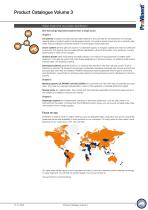
Product Catalogue Volume 3 Water treatment and water disinfection Non-technology-dependent solutions from a single source Chapter 1 UV systems for gentle and chemical-free water treatment. They are ideal for the disinfection of municipal drinking water or product water in the beverage industry. UV systems ensure swimming fun in perfectly clear water without undesired combined chlorine in swimming pool water treatment. Ozone systems are the optimum solution if undesirable organic or inorganic substances need to be effectively removed. The reactive ozone provides efficient disinfection without...
Open the catalog to page 3
Table of contents Water treatment and water disinfection 1 Disinfection Systems and Oxidation Systems 1.1.1 General Notes on UV Treatment 1.1.2 Performance Overview of UV Systems 1.1.3 Questionnaire for Designing a UV System 1.1.5 UV System DULCODES LP certified 1.1.7 UV System DULCODES LP-PE 1.1.11 Accessories for DULCODES UV Systems 1.1.12 DULCONNEX: IIoT Solution for Digital Fluid Management 1.2 1.2.2 Performance Overview of Ozone Systems 1.2.3 Questionnaire on the Design of an Ozone System 1.2.4 Ozone System OZONFILT OZVb 1.2.5 System Solution OZONFILT Compact OMVb 1.2.6 Ozone System OZONFILT...
Open the catalog to page 4
Table of contents Water treatment and water disinfection 1.4.4 Electrolysis System CHLORINSITU IIa 60 – 2,500 g/h 1.4.5 Electrolysis System CHLORINSITU IIa XL 1.4.6 Electrolysis System CHLORINSITU III 1.4.7 Electrolysis System CHLORINSITU III Compact 1.4.8 Electrolysis System CHLORINSITU IV Compact 1.4.9 Electrolysis System CHLORINSITU V 1.4.10 Electrolysis System CHLORINSITU V Plus 1.4.11 Questionnaire on the Design of a DULCOLYSE Electrolysis System 1.4.12 Electrolysis System DULCOLYSE Polymer Preparation and Metering Systems 2.1.1 Polyelectrolytes in Water Treatment 2.1.2 Performance Overview...
Open the catalog to page 5
Table of contents Water treatment and water disinfection 3.2.2 Questionnaire on the Design of a UF System 3.2.3 Ultrafiltration Systems DULCOCLEAN UF Nanofiltration Systems 3.3.1 Nanofiltration System DULCOSMOSE NF 3.4.1 Performance Overview of Reverse Osmosis 3.4.2 Questionnaire on the Design of an RO System 3.4.3 Reverse Osmosis System DULCOSMOSE TW 3.4.4 Reverse Osmosis System DULCOSMOSE BW 3.4.5 Reverse Osmosis System DULCOSMOSE SW Reverse Osmosis Systems Product Catalogue Volume 3
Open the catalog to page 6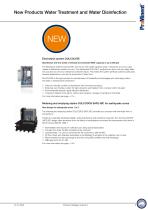
New Products Water Treatment and Water Disinfection Electrolysis system DULCOLYSE Disinfection with low levels of chlorate and chloride; NEW: capacity of up to 800 g/h The electrolysis system DULCOLYSE now has an even larger capacity range. It produces up to two cubic metres of disinfection solution an hour. The disinfectant DULCOLYT produced on-site is not only highly effective, but also has very low chlorate and chloride values. This makes the system perfectly suited to particularly sensitive applications, such as the production of baby food. DULCOLYSE is the right product for manufacturers...
Open the catalog to page 7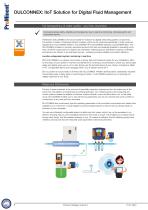
DULCONNEX: IIoT Solution for Digital Fluid Management Full transparency of water quality – any time, anywhere Improved process safety, reliability and transparency due to real-time monitoring, individual alarms and automated reports. ProMinent’s DULCONNEX is the cloud-based IIoT solution for digitally networking system components. The solution consists of individual solution modules, which can be combined specifically to meet customer requirements: DULCONNEX Platform DULCONNEX API DULCONNEX Gateway DULCONNEX Blue. The , , , DULCONNEX is based on robustly networked products that can be individually...
Open the catalog to page 8
DULCONNEX: IIoT Solution for Digital Fluid Management Reference Hotel Many factors are decisive for economic and hence successful operation of a hotel – one of them is clean and germ-free drinking water. Disinfection with chlorine dioxide offers a range of different benefits. Chlorine dioxide degrades biofilms in pipework and tanks, protecting your system against legionella attack. It also has a sustained-release effect due to its long-term stability in the piping system. Our chlorine dioxide systems also provide for disinfection independent of the pH value. Connecting your disinfection systems...
Open the catalog to page 9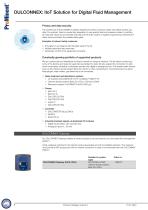
DULCONNEX: IIoT Solution for Digital Fluid Management Privacy and data security The architecture of DULCONNEX is already designed to achieve maximum safety and reliably protect your data. For example, there is a systematic separation of user-specific data and measured values. In addition, all measured values are anonymised internally and the entire system is regularly inspected by professional IT safety service providers for possible safety gaps. Examples of relevant safety measures: Encryption in accordance with the latest state of the art Multiple redundant data memories Systematic control...
Open the catalog to page 10
General Notes on UV Treatment Disinfection is a key stage in modern water treatment. UV disinfection is used to ever-increasing extent as a safe, chemical-free and reliable disinfection process. Extensive research projects and numerous systems operating without any issues prove the safety and reliability of UV disinfection. With UV disinfection, the water to be disinfected is irradiated with ultraviolet light. This is a purely physical, chemical-free process for water disinfection. UV-C radiation in particular, with a wavelength ranging from 240 to 280 nm, attacks the vital DNA of the germs directly....
Open the catalog to page 11All ProMinent Group catalogs and technical brochures
 Metering Technology 2026
410 Pages
 Product guide 2026
70 Pages
 DULCOMETER diaLog C
2 Pages

- ProMinent Group industrial pump
- ProMinent Group electric pump
- ProMinent Group stationary pump
- ProMinent Group water pump
- Centrifugal pump
- ProMinent Group self-priming pump
- ProMinent Group chemical pump
- Lubricant pump
- Volume flow monitor
- Liquid flow monitor
- Submersible pump
- Oil pump
- Transfer pump
- Measuring device
- ProMinent Group pump for the chemical industry
- ProMinent Group diaphragm pump