
- Catalogs
- ProMinent Group
- Water Treatment and Disinfection 2026


Water Treatment and Disinfection 2026
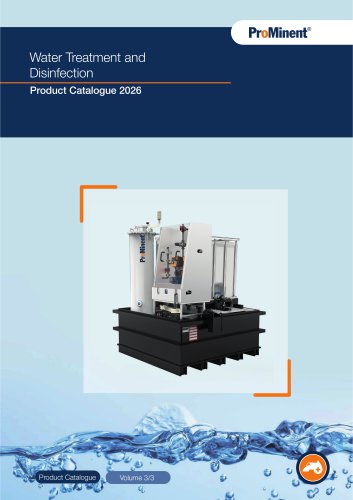
Water Treatment and Disinfection 2026
This document is the third volume of the ProMinent Product Catalogue 2026, focusing on water treatment and disinfection solutions. It provides detailed information on various systems and technologies offered by ProMinent GmbH, a company based in Heidelberg, Germany.
This section covers UV systems, ozone systems, chlorine dioxide systems, and electrolysis systems. Each system is designed for specific applications such as municipal drinking water, swimming pools, and the food industry. UV systems offer chemical-free disinfection, while ozone systems efficiently remove organic and inorganic substances. Chlorine dioxide provides long-lasting microbial protection, and electrolysis systems generate chlorine on-site, reducing the need for hazardous chemical transport.
ProMinent offers metering systems like ULTROMAT and DULCODOS, known for their ease of assembly and operation. These systems are crucial for separating colloidal solids from liquids and ensuring uninterrupted chemical supply. Storage tanks are also highlighted for their compliance with international standards.
This chapter discusses diaphragm systems for removing particles and dissolved substances. It also covers ultrafiltration, nanofiltration, and reverse osmosis systems, providing comprehensive solutions for water treatment needs.
ProMinent’s DULCONNEX is introduced as a smart solution for digitally networking system components, offering benefits like smart process monitoring and inventory management.
- UV disinfection provides immediate, chemical-free water treatment.
- Ozone systems offer efficient disinfection without by-products.
- Electrolysis systems eliminate the need for hazardous chemical storage.
- Digital solutions enhance system monitoring and management.
ProMinent provides extensive customer support through its global network, offering assistance in product selection and application optimization. Technical consulting and after-sales services are readily available.
The catalogue emphasizes ProMinent’s commitment to providing comprehensive, reliable, and innovative water treatment solutions, supported by a strong global presence and customer service network.
The document provides a detailed description of UV and ozone systems used for disinfection and oxidation in various applications, including water treatment and swimming pools. It highlights the benefits, technical specifications, and applications of these systems.
- Advantages: Cost-effective, hygienic design, remote control capabilities, optimized flow behavior, continuous performance monitoring, and reduced life cycle costs.
- Technical Details: High-quality stainless steel reactor, long-life VARIO-Flux lamps, electronic ballasts, and user-friendly control panels.
- Applications: Disinfection of sugar syrup and swimming pool water.
- Specifications: Various models with different flow rates, lamp power, and dimensions. Suitable for UV transmission > 38%/cm and 20%/cm.
- Control Type: Siemens SPS with touch panel.
- Operating Conditions: Permissible pressure and temperature ranges, IP54 enclosure rating.
- Features: Eliminates combined chlorine in pool water, energy savings, flexible installation, and easy maintenance.
- Technical Details: System control via fieldbuses, Eco!Mode for energy savings, compliance with international standards.
- Applications: Swimming pool water treatment.
- Includes drain kits, transmission photometers, reference radiometers, protective gear, sampling valves, cleaning systems, fittings, and overvoltage protection.
- Applications: Effective against germs, viruses, fungi, and parasites. Used for oxidation of undesirable substances in water and micro-flocculation.
- Benefits: Fewer by-products, on-site generation, and decomposition into oxygen.
- Applications: Drinking water, food and beverage industry, swimming pools, industrial processes, and municipal wastewater treatment.
- ProMinent ozone systems use silent electrical discharge for ozone production, optimized for maximum return and safety, conforming to DIN 19627 standards.
- Medium-frequency pressure systems use air or oxygen as feed gas, with integrated pressure swing dryers for compact design.
ProMinent offers a variety of ozone systems suitable for different applications, capable of introducing ozone directly into water systems with back pressures up to 4 bar for OZVb and 2 bar for OZMa and OZLa. This eliminates the need for additional booster pumps and injectors in many cases. The systems are designed for diverse applications, with capacities ranging from 2 to 6,000 g/h.
The OZONFILT OZVb system is a compact and efficient ozone generator ideal for disinfection and oxidation, with capacities ranging from 10 to 70 g/h. It operates using compressed air and features an integrated air treatment system. The system is designed for safe operation with continuous monitoring and a user-friendly touch panel interface. It is suitable for applications in drinking water supply, food and beverage industry, swimming pools, and industrial water treatment.
The OZVb systems are available in four sizes, each with specific ozone capacities and air consumption rates. They feature a compact design with integrated air treatment and cooling systems. The systems are equipped with various communication interfaces for remote monitoring and control.
This system is tailored for the beverage industry, offering a complete solution for ozone generation and metering. It features a modular design with components such as a central control unit, ozone generation, and a contact and outgassing tank. The system ensures a constant ozone concentration and includes safety features like residual ozone gas destruction and room air monitoring.
The systems are applicable in various sectors, including drinking water treatment, food and beverage industry, swimming pools, and industrial applications for disinfection and oxidation purposes.
- High oxygen concentration requirement up to 15% by weight.
- Robust design with low electrical component load.
- User-friendly interface with a 10" touch screen panel.
- Multiple communication interfaces for integration and remote monitoring (PROFIBUS® DP, PROFINET®, Modbus TCP).
- Available in 8 sizes, with modular systems supporting up to 16 generator blocks.
- Energy consumption below 8.0 Wh/g ozone at 10% concentration.
- Innovative water cooling system with efficient heat dissipation.
- Safety features include pressure control systems and safety valves.
- PLC control with data recording capabilities.
- Drinking water supply: Oxidation and disinfection.
- Wastewater treatment: Reduction of contaminants and sludge.
- Aquaculture: Water treatment for fish farming.
- Textile industry: Wastewater treatment.
- Food and beverage industry: Oxidation processes.
- Ambient conditions: Max 85% humidity, non-condensing, max temperature 30°C.
- Ozone capacity ranges from 360 to 5,760 g/h depending on the model.
- Electrical connection varies by model, with a standard enclosure rating of IP54.
- Cooling water consumption and specifications are detailed for each model.
- Compressors: Atlas Copco LFX and Dürr piston compressors with specific features and order numbers.
- Ozone gas distributor module for multi-point injection control.
- Static helical mixers for gas-liquid mixing with various sizes and materials.
- Residual ozone gas destructor for exhaust air treatment.
The residual ozone destructor is designed for swimming pool applications with a maximum ozone concentration of 1.5 g/m3 treated water. It features a maintenance-free MnO catalyst in a stainless steel housing with integrated heating. Various models are available with different capacities and dimensions, suitable for chlorine-free gas flows.
These systems are part of a product catalogue for disinfection and oxidation systems. The GMA 22 ozone gas detector monitors ozone gas leakages, with alarms set at specific ppm levels. It operates within a permissible ambient temperature range and has a maximum sensor life of 2 years. The GMA 22 oxygen detector monitors dangerous oxygen concentrations with multiple alarm levels.
The cooling water chiller is an alternative to freshwater cooling, featuring a single circuit system with an air-cooled refrigeration unit. It includes a microprocessor-controlled temperature controller and integrated circulation pump, with various models offering different cooling outputs.
Includes ozone-resistant gas masks, warning labels, emergency stop switches, and overvoltage protection for OZONFILT systems. These accessories ensure safety and compliance with relevant standards.
Chlorine dioxide is a reactive gas used for water disinfection, offering advantages over chlorine such as stability in pipework and no reaction with ammonia. It is used in various applications including municipal water treatment, healthcare facilities, and the food industry.
These systems generate chlorine dioxide using the chlorite/acid process, offering precise production and easy operation. Different models cater to various flow rates and applications, ensuring safe and economical handling of chemicals.
The document provides a performance overview of chlorine dioxide systems and a questionnaire for designing a system based on specific water treatment needs, including flow rates, pH values, and desired metering concentrations.
- The systems operate with a power supply of 100-230 V, 50/60 Hz, and feature multiple digital inputs and outputs for monitoring and control.
- Operating fluids include sodium chlorite and hydrochloric or sulfuric acid, with a protection class of IP 65.
- Chlorine dioxide generation capacities range from 6 g/h to 120 g/h, with operating temperatures between 10-40°C.
- Cost reduction due to minimal chemical use and efficient design.
- High operational safety and reliability with real-time monitoring via the DULCONNEX Platform.
- Environmentally friendly operation with a closed gas transport system to prevent chlorine dioxide escape.
- Inputs include configurable digital inputs for various metering functions and monitoring signals.
- Outputs include signal relays and voltage outputs for water meter integration.
- Field applications cover disinfection in sensitive environments, such as stainless steel systems, and various industrial processes.
- CDLb systems are available in different configurations, including those with internal or external storage and various metering capacities.
- Special variants like the CDLb H2SO4 are designed for low-chloride applications to minimize corrosion risks.
- A range of accessories, including corrosion-resistant injection points and back pressure valves, are available.
- Maintenance kits are offered for annual and triennial servicing, ensuring system longevity and performance.
- Suitable for disinfection in food and beverage processing, Legionella prevention, and water treatment in various industries.
- Customizable for multiple points of injection, enhancing flexibility and efficiency in large-scale operations.
The document provides detailed information on various chlorine dioxide systems under the Bello Zon brand, designed for the production and metering of ClO2. These systems are tailored to meet customer requirements, offering flexible solutions for multiple injection points.
- Concept 2: This involves an assembly kit of metering components pre-assembled on a panel, including the CDLb system and a metering panel.
- Concept 3: Features a plug-and-play system on a stainless steel frame, with all components mechanically and electrically mounted, including a control cabinet for power supply and system control.
- Multiple injection points as per requirements.
- High operating safety and reliability with intrinsically safe process control.
- Real-time system monitoring via the DULCONNEX Platform.
- External and internal storage options.
- Various configurations for terminal boxes and control cabinets.
- Disinfection in the food and beverage industry.
- Legionella control in hotels and hospitals.
- Market gardening and water treatment applications.
This system is designed for simple operation and clear construction, producing 5-200 g/h of chlorine dioxide. It features easy operation with minimal training required, low investment costs, and simple process integration.
- Power supply: 100-230 V, 50/60 Hz.
- Inputs and outputs for various control and monitoring functions.
- Operating substances include sodium chlorite and hydrochloric acid.
Designed for medium to large water volumes, this system offers user-friendly operation and meets DVGW specifications. It supports communication via bus systems and the DULCONNEX Platform.
- Power supply: 100-230 V, 50/60 Hz.
- Multiple inputs and outputs for comprehensive control and monitoring.
- Operating substances include sodium chlorite and hydrochloric acid.
Maintenance kits are available for various Bello Zon systems, containing all necessary wear parts for regular maintenance.
This system handles medium to large water volumes with concentrated chemicals, featuring a safety concept to protect users and the environment. It includes an intrinsically safe pre-dilution station for hydrochloric acid.
The document provides detailed technical specifications and operational guidelines for the Bello Zon Chlorine Dioxide Systems, designed for efficient chlorine dioxide production with user-friendly navigation and compliance with Industry 4.0 standards.
The system uses food-safe PVDF reactors for chemical mixing, ensuring maximum yield and safety. It supports communication via popular bus systems and the DULCONNEX platform. It complies with DVGW specifications W 224 and W 624 and operates with concentrated chemicals Bello Zon chlorite (24.5% NaClO2) and acid (25-37% HCl).
- Cost savings through optimized acid consumption.
- Enhanced communication interfaces and remote monitoring capabilities.
- Precise monitoring of chemical levels and configurable alarms for compliance and operational efficiency.
- Power supply: 100-230 V, 50/60 Hz.
- Inputs: 4 analogue and 4 digital inputs for various monitoring purposes.
- Outputs: Multiple signal relays and configurable analogue outputs.
- Operating substances: 24.5% sodium chlorite and 25-37% hydrochloric acid.
- Degree of protection: IP 65.
- Bus communication options include Modbus TCP, Modbus RTU, Profibus, Profinet, and DULCONNEX.
The system is suitable for municipal drinking water and wastewater treatment, as well as industrial process and cooling water.
The document provides detailed specifications for various models (CDKd 150 to CDKd 12000) including metering rates, operating pressure, temperature, and dimensions.
Includes identity code ordering system for CDKd systems and maintenance kits for regular upkeep. Additional spare parts are listed in the operating instructions.
- Storage Tank Accessories: External storage module with a capacity of 150 liters.
- Bypass Line Accessories: Flushing assembly and ball-check valves for system maintenance and pressure management.
- Chemical Supply Accessories: Suction lances and assemblies for various tank connections.
- Safety Accessories: Gas detector GMA 22 for monitoring chlorine dioxide concentrations.
Replacement sensors for chlorine, chlorine dioxide, and ozone are available, with storage recommended at 4°C to 10°C. Accessories include a 10 m connecting cable for additional sensors.
This section includes a flash light-horn with a combined horn and red warning lamp, suitable for chlorine dioxide systems. Warning labels are available in multiple languages for safety compliance.
These portable photometers are designed for measuring various substances including chlorine and ozone. They feature simple operation, calibration capabilities, and specific measuring ranges for different substances. The devices operate within a temperature range of 5°C to 40°C and require 4 AA batteries.
CHLORINSITU systems produce chlorine and sodium hydroxide from salt using electrolysis. The systems are categorized into open and membrane electrolysis, each with distinct benefits. Membrane systems offer higher efficiency and reduced chloride entrainment. The systems are designed for safe operation and conform to DIN 17818 standards.
The performance of various CHLORINSITU systems is outlined, highlighting their applications in drinking water, wastewater, and swimming pools. The systems offer different outputs and are adaptable to specific needs.
This compact system produces low-chlorate hypochlorite solutions with high efficiency. It features integrated ventilation, a hydrogen removal system, and real-time monitoring capabilities. The system is designed for easy operation and minimal maintenance.
Details include power supply requirements, output capacities, and environmental conditions for optimal operation. The system is efficient in salt and energy usage, with specific requirements for salt and water quality.
Ordering codes for different system configurations are provided, along with maintenance sets and spare parts for various output capacities.
This high-performance system is designed for large-scale hypochlorite production, offering ease of operation and process stability. It uses salt as the sole raw material and features a robust design for long service life.
- Modular design for easy customization and accessibility.
- Certified safety with reliable hydrogen discharge mechanisms.
- Remote control and diagnostic capabilities for efficient system management.
- Output ranges from 25 g/h to 10,000 g/h of chlorine, depending on the model.
- Energy efficiency varies between 4.2 kWh/kg (DC) and 4.9 kWh/kg (AC) chlorine.
- Product concentration is approximately 8 g/l chlorine with a pH value of around 9.5.
- Salt specifications require a minimum of 99.4% NaCl purity.
- Potable water treatment.
- Cooling water treatment.
- Swimming pool water treatment.
- Wastewater and process water treatment.
- CHLORINSITU III: Produces sodium hypochlorite with minimal chloride and chlorate content, suitable for larger applications.
- CHLORINSITU III Compact: Designed for smaller swimming pools, offering a compact and cost-effective solution.
- CHLORINSITU V Compact: Generates chlorine gas in a vacuum process, ideal for small-scale applications with integrated pH correction.
- CHLORINSITU V: Provides ultra-pure chlorine gas and sodium hydroxide solution, replacing traditional chlorine gas systems in swimming pools.
- Cost-effective operation using inexpensive sodium chloride.
- Reduced chemical consumption for pH adjustment.
- Safe and robust design with minimal maintenance requirements.
- High-purity hypochlorous acid production without temporary storage.
- Hypochlorite booster for handling peaks in demand.
- Remote system control and diagnosis via Remote Control Engineer.
- Long service life of membrane cells due to constant vacuum.
- Cost-effective operation using sodium chloride as a raw material.
- Complete disposal of diluted brine, ensuring no feedback into treated process water.
- Modern PLC with large display for system control.
- Optional features include analogue input, Modbus or PROFIBUS® connectivity, and multiple booster pumps.
- Power supply requirements and technical data for various system capacities are provided.
- Potable water treatment.
- Process water treatment.
- Swimming pool water disinfection.
- Cooling tower water treatment.
- Produces ultra-pure chlorine gas and sodium hydroxide solution on-site.
- Utilizes a vacuum process for safe production without dangerous chemicals.
- Features a Plus system for temporary storage of sodium hypochlorite to manage demand peaks.
- Produces DULCOLYT 400 disinfectant with minimal chlorate and chloride content.
- Ideal for sensitive applications in the food and beverage industry.
- Ensures environmentally friendly and highly effective disinfection.
- Includes water hardness measuring kits and spare cells for DULCOLYSE systems.
- Metering systems and recommended pumps for connection to DULCOLYSE product tanks are detailed.
- Stirrers and Motors: Different configurations of stirrers and motors are available, including PP and PS propellers with Innomotics/SI and AM motors, supporting various operational ranges.
- Electrical Connection: Options include 380-420 VAC, 50 Hz and 440-480 VAC, 60 Hz, both 3-phase.
- Control Systems: Siemens S7-1200 and Schneider TM 241 PLCs with various communication protocols like Profibus, Profinet, and Modbus TCP.
- Level Measurement: Options include pressure sensors and DULCOLEVEL radar sensors.
- Options: Include overflow sensors, external concentration settings, and control cabinets with IP65 protection.
- ULTROMAT ULPa: Features oscillating systems for batching flocculation aids with extraction rates from 400 to 4,000 l/h. It processes both liquid and powdered polymers, ensuring no mixing of fresh and matured polymers.
- ULTROMAT ULDa: A double-decker system for automatic preparation of polymer solutions, with extraction rates up to 2,000 l/h. It includes two separate tanks to prevent product carry-over.
- DULCODOS ULIa: An inline system for liquid polymers, featuring integrated mixing and maturing chambers, with draw-off volumes from 400 to 1,800 l/h against a maximum of 4.5 bar.
Three system types are available: basic (manual flow adjustment, manual flushing), medium (automatic flow control, manual flushing), and comfort (automatic flow control, automatic rinsing). An integrated post-dilution unit is optional. Peristaltic pumps DFXa 0530 and 0565 handle back pressures up to 4.5 bar. The system includes a Schneider Electric TM241 compact controller and STO735 4.3" touch panel, with optional Ethernet/Modbus TCP and PROFIBUS® connectivity.
The systems are suitable for sludge dewatering, sludge thickening, wastewater treatment (industrial and municipal), and drinking water treatment. They can process liquid polymers (0.05 – 1.0%) as emulsions or dispersions.
Components include preparation capacity, configuration versions, electrical connection, control versions with or without data communication, operating versions, monitoring of low liquid polymers, raw water booster pump, post-dilution unit, and language options.
Type 400 systems have a max extraction rate of 400 l/h, with post-dilution up to 1,800 l/h. Maturation time is 15 minutes, with water pressure ranging from 4 to 8 bar. The system dimensions are 1,200 mm in length, 800 mm in width, and 1,900 mm in height, with a water connection and discharge nozzle of DN 25 mm. The power supply is 220-240 V/50-60 Hz.
The DULCODOS ULIa inline systems offer various configurations, including design, electrical connection, control and data communication, operating version, metering pump for liquid polymer, liquid polymer tank level monitor, raw water booster pump, post-dilution unit, additional maturing/storage tank, stirrer, feed pump, and language options.
This manual polymer batching station is ideal for small quantities, offering a capacity range of 120 – 3,800 l/h. It features a round polypropylene batching tank, flushing system, and gentle mixing of the polymer solution. Applications include potable water treatment, wastewater treatment, and sludge dewatering.
Accessories include post-dilution units, powder conveyors, powder pre-storage tanks, and Big Bag emptying units. These components facilitate the handling and processing of powdered polymers.
The PolyRex system processes liquid and powdered polymers with a capacity range up to 10,200 l/h. It features a double-decker batching station, user-friendly powder handling, and a three-stage wetting process. Applications include drinking water treatment, wastewater treatment, sludge dewatering, paper production, mining, oil & gas, and aquaculture. Options include PROFIBUS® or Ethernet communication and various controllers.
The document details the PolyRex and PolyRex Big Bag systems, which are specialized for mixing powdered polymers. These systems are designed to ensure efficient and reliable polymer mixing with minimal powder consumption and dust-free operation.
- PolyRex Classic: Features a cyclonic wetting cone with heating elements for effective hydration of both powder and liquid polymers.
- PolyRex Optimo: A sealed system with a heated conical wetting area and integrated mixing pump, offering high efficiency and low powder consumption.
- PolyRex Aero Mix: A closed system with pneumatic powder conveyance, fans, and water nozzles, suitable for high humidity and temperature environments.
The document introduces the TOMAL® Multi-Screw Feeder, which is designed for precise and reliable metering of dry products. It features a capacity range of 0.4 – 215 m3/h and is suitable for various industries including wastewater treatment, chemical, and mining.
- Designed for safe and reliable metering of liquid chemicals, these stations support IBCs up to 1,000 liters and ensure almost complete residual drainage.
- Features include a robust construction, visual level indicators, and options for integration with metering pumps.
- Special designs are available for earthquake zones and outdoor installations.
- Retaining tanks are made of PE-HD with a total volume of 1,300 liters.
- Intermediate tanks are available in 200 liters or 60 liters capacities.
- Designed for indoor installation with temperature limits and specific chemical compatibility.
The systems are applicable in various fields such as chemical production, water treatment, food and beverage, and more.
The document provides detailed ordering codes for different configurations and options, including materials, sensors, and design adaptations for specific media and environments.
- The system complies with EC 1935/2004 and EC 10/2011 for food safety, ensuring no leaks at the installation site.
- Includes a buffer tank with an 80-liter volume for uninterrupted dosing during IBC changeover.
- Features a visual fill level indicator and integrated level measurement with alarm function.
- Optional compact metering station for precise dosing.
- Safety drip tray and IBC installation area made of PE-HD, compliant with EC 10/2011.
- Intermediate tank made of stainless steel with 80-liter volume, designed without dead space zones.
- Seals and O-ring seals in accordance with EC 1935/2004.
- Compatible with indoor installation at temperatures up to 35°C.
- Designed for food bases and additives with a density of up to 1.8 kg/dm3.
- PE/PP storage tanks available with capacities from 500 to 50,000 liters for indoor and outdoor installation.
- Manufactured according to customer-specific requirements and statutory specifications.
- Includes options for overfill protection, leakage sensors, and various accessories.
- Overfill protection and leakage sensors with approval marks.
- Transmitter and alarm indicator units for monitoring.
- Optional accessories like chemical filling stations, storage tank heaters, and radar liquid level sensors.
- Suitable for storing chemicals, drinking and process water treatment, wastewater technology, and more.
- Designed for compliance with the Federal Water Act (WHG) and other regulatory requirements.
The document outlines the specifications for storage tanks with a usable volume of 2000 liters, equipped with 4 lifting eyes. The tanks have various inner and outer dimensions depending on the volume capacity, ranging from 500 liters to 15,000 liters. Special dimensions and sizes are available upon request.
Membrane filtration is a cost-effective process for removing particles and salts from water. ProMinent offers systems for microfiltration, ultrafiltration, nanofiltration, and reverse osmosis, each targeting different particle sizes. The document provides a table detailing the separation limits for each process.
Ultrafiltration is used to separate undesired components from water, such as parasites, bacteria, and viruses. It is applicable in various water types, including drinking water and wastewater. The systems are customizable with robust UF membranes and include components like stainless steel racks, pre-filters, and PLC controls. Advantages include high retention rates for bacteria and viruses and easy integration with other systems.
Ultrafiltration is used in public and private water supplies, treating fresh, brackish, and seawater. It is also used in the food and beverage industry. The systems can handle filtration capacities from 1 to 80 m3/h.
These systems provide reliable removal of turbidity and microbiological contamination, with filtrate outputs ranging from 8 to 75 m3/h. They feature automated controls and are suitable for municipal water treatment and pre-treatment for desalination.
The DULCOSMOSE NF system is designed for partial desalination in industrial applications, offering low operating costs with high salt retention rates. It is a cost-effective alternative to reverse osmosis for specific desalination tasks and is used in various industries, including chemical and food processing.
Both ultrafiltration and nanofiltration systems are constructed on high-quality frames with efficient membranes and include features like pressure switches, flow meters, and optional PLC controls for process visualization. They are designed for easy operation and maintenance.
- DULCOSMOSE BW: Designed for potable water supply with a maximum salt content of 5,000 mg/l. Features include semi-automatic cleaning, level control inputs, temperature measurement, and active outputs for various functions. Systems range from 2,000 to 50,000 l/h capacity with varying membrane numbers and connected loads.
- DULCOSMOSE SW: Used for desalination of saltwater with a maximum salt content of 40,000 mg/l. Equipped with high rejection low-pressure membranes, energy recovery systems, and corrosion-resistant materials. Systems range from 780 to 29,000 l/h capacity, with options for energy recovery and custom configurations.
- Features: Provides real-time monitoring, alarms, and automated reports for fluid management. The platform supports various ProMinent products and third-party integrations via a cloud-based system.
- Components: Includes gateways, mobile apps, and APIs for data exchange and system monitoring. Offers configurable alarms and notifications for process safety and reliability.
- Applications: Suitable for water treatment in various sectors, including public supply, hotels, and industrial processes. Ensures compliance with hygiene standards and efficient operation through continuous data logging and process visualization.
- Reverse osmosis systems are available with different membrane configurations and capacities, tailored to specific water quality requirements.
- DULCONNEX platform offers a comprehensive overview of connected devices, with secure data handling and privacy measures in place.
1. DULCONNEX Blue
This mobile app for Android and iOS allows efficient and safe operation of pumps via Bluetooth. Key benefits include easy operation of gamma/X pumps, live monitoring, reliable remote control, and user-friendly interface. It supports solenoid-driven metering pumps and radar liquid level sensors, with multilingual support and availability on major app stores.
A web-based IIoT platform for digital fluid management, offering location-independent monitoring and documentation. It enhances system availability, optimizes process quality, and ensures safety through configurable alarms and comprehensive logging. The platform supports dashboards, alarms, logbooks, data history, visualization, and automated report generation.
This add-on monitors tank and inventory levels of chemicals across sites. It provides dashboards, reports, and geographic overviews, facilitating efficient tank level application management. It integrates easily with existing systems and offers specific reports for compliance.
Allows integration of raw data from the DULCONNEX Cloud into various systems like SCADA and MES. It supports detailed overviews, geographic visualization, and specific reports for tank level applications, enhancing transparency and compliance.
The DULCONNEX solutions increase transparency, ensure system availability, optimize processes, protect employees, and prove compliance. They offer real-time data access, minimize downtimes, and support regulatory documentation requirements.
Each DULCONNEX service has a monthly fee per connected device, with specific order numbers provided for each service.
Catalog excerpts
Water Treatment and Disinfection Product Catalogue 2026 Product Catalogue
Open the catalog to page 1
Issued by: ProMinent GmbH Im Schuhmachergewann 5–11 69123 Heidelberg Germany Phone: +49 6221 842–0 [email protected] www.prominent.com Technical changes reserved. All previous catalogues and price lists are superseded with the release of this product catalogue. You can view our general terms and conditions on our homepage.
Open the catalog to page 2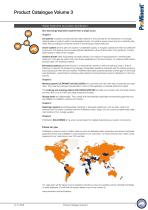
Product Catalogue Volume 3 Water treatment and water disinfection Non-technology-dependent solutions from a single source Chapter 1 UV systems for gentle and chemical-free water treatment. They are ideal for the disinfection of municipal drinking water or product water in the beverage industry. UV systems ensure swimming fun in perfectly clear water without undesired combined chlorine in swimming pool water treatment. Ozone systems are the optimum solution if undesirable organic or inorganic substances need to be effectively removed. The reactive ozone provides efficient disinfection without...
Open the catalog to page 3
Product Catalogue Volume 3 We are here for you The selection of a product depends on a wide variety of factors. If you have any questions about water treatment, our team will be happy to help you. Give us a call! We look forward to hearing from you. Monday to Friday 8.00 - 16.30 Sales ProMinent Germany 0049 6221 842 - 1800 [email protected] Technical consulting 0049 6221 842 - 1850 [email protected] On the phone, we support you in selecting the right products and, in many cases, in optimizing entire applications. For more complex requirements, our consultants will pass the task on to...
Open the catalog to page 4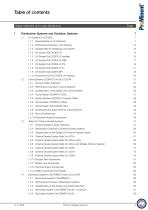
Table of contents Water treatment and water disinfection 1 Disinfection Systems and Oxidation Systems 7 1.1.1 General Notes on UV Treatment 7 1.1.2 Performance Overview of UV Systems 10 1.1.3 Questionnaire for Designing a UV System 12 1.1.5 UV System DULCODES LP certified 15 1.1.7 UV System DULCODES LP-PE 19 1.1.10 Accessories for DULCODES UV Systems 25 1.2 Ozone Systems OZONFILT and DULCOZON 27 1.2.1 Ozone in Water Treatment 27 1.2.2 Performance Overview of Ozone Systems 29 1.2.3 Questionnaire on the Design of an Ozone System 30 1.2.4 Ozone System OZONFILT OZVb 31 1.2.5 System Solution OZONFILT...
Open the catalog to page 5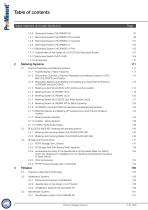
Table of contents Water treatment and water disinfection Page 1.4.6 Electrolysis System CHLORINSITU III 1.4.7 Electrolysis System CHLORINSITU III Compact 1.4.8 Electrolysis System CHLORINSITU V Compact 1.4.9 Electrolysis System CHLORINSITU V 1.4.10 Electrolysis System CHLORINSITU V Plus 1.4.11 Questionnaire on the Design of a DULCOLYSE Electrolysis System 1.4.12 Electrolysis System DULCOLYSE 2.1 Polymer Preparation and Metering Systems 2.1.1 Polyelectrolytes in Water Treatment 2.1.2 Performance Overview of Polymer Preparation and Metering Systems ULTRO-MAT, DULCODOS and PolyRex 2.1.3 Preparation...
Open the catalog to page 6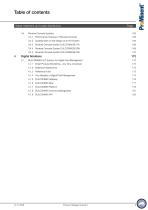
Water treatment and water disinfection Page 3.4 Reverse Osmosis Systems 3.4.1 Performance Overview of Reverse Osmosis 3.4.2 Questionnaire on the Design of an RO System 3.4.3 Reverse Osmosis System DULCOSMOSE TW 3.4.4 Reverse Osmosis System DULCOSMOSE BW 3.4.5 Reverse Osmosis System DULCOSMOSE SW 4.1 DULCONNEX: IloT Solution for Digital Fluid Management 4.1.1 Smart Process Monitoring - Any time, Anywhere 4.1.4 Your Benefits of Digital Fluid Management 4.1.8 DULCONNEX Inventory Management Product Catalogue Volume 3
Open the catalog to page 7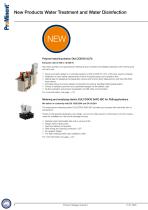
New Products Water Treatment and Water Disinfection Polymer batching station DULCODOS ULFb Extraction rate of 500 to 10,000 l/h Automatic operation and proportional metering ensure consistent and reliable preparation with minimal product carry-over. ■ Novel round tank design for 3-chamber systems of 500 to 2000 l/h. 97% of the tank volume is drained ■ Adaptation to new market requirements in terms of powder types and maturation time ■ Special app for displaying the preparation volume and function level. Measurement with DULCOLEVEL radar sensor. ■ Complete range of process-related components for...
Open the catalog to page 8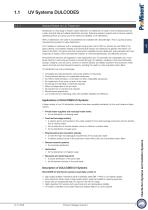
0) 1.1.1 General Notes on UV Treatment Disinfection is a key stage in modern water treatment. UV disinfection is used to ever-increasing extent as a safe, chemical-free and reliable disinfection process. Extensive research projects and numerous systems operating without any issues prove the safety and reliability of UV disinfection. With UV disinfection, the water to be disinfected is irradiated with ultraviolet light. This is a purely physical, chemical-free process for water disinfection. UV-C radiation in particular, with a wavelength ranging from 240 to 280 nm, attacks the vital DNA of the...
Open the catalog to page 9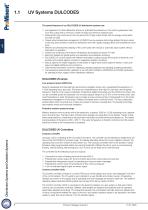
Disinfection Systems and Oxidation Systems The special features of our DULCODES UV disinfection systems are: ■ Homogeneous UV dose distribution thanks to optimised flow behaviour in the reactor guarantees maximum flow output with a minimum number of lamps and minimum pressure loss ■ Reduced life cycle costs due to the long service life of high-output lamps with low energy consumption and high UV yield ■ Unique active temperature management of VARIO-Flux low-pressure technology adapts the lamp output in seconds and provides for optimum disinfection even with rapidly changing flows and temperature...
Open the catalog to page 10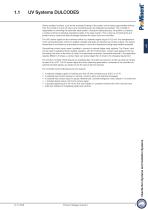
UV Systems DULCODES Various auxiliary functions, such as the automatic flushing of the system over a freely programmable flushing time, the control of a shut-off valve and a circulating pump are integrated as standard. The controller is responsible for controlling the automatic wiper system. During the wiping process, the position is checked a number of times for absolute operational safety of the wiper system. This is done by monitoring the end position and by continuous data exchanges between the wiper motor and controller. The UVC sensor signal can be monitored online via a standard signal...
Open the catalog to page 11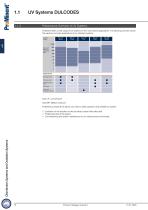
UV Systems DULCODES Performance Overview of UV Systems ProMinent offers a wide range of UV systems for the most diverse applications. The following overview shows the capacity and main applications of our standard systems: High flow Applications Drinking water Process water Swimming pool water Salt water Food and beverage industry Type LP: Low-pressure Type MP: Medium pressure ProMinent provides all the advice you need to safely operate a DULCODES UV system: Disinfection Systems and Oxidation Systems Evaluation of the situation on-site by trained, expert field sales staff Project planning of...
Open the catalog to page 12All ProMinent Group catalogs and technical brochures
 Metering Technology 2026
410 Pages
 Product guide 2026
70 Pages
 DULCOMETER diaLog C
2 Pages
- ProMinent Group industrial pump
- ProMinent Group electric pump
- ProMinent Group stationary pump
- ProMinent Group water pump
- Centrifugal pump
- ProMinent Group self-priming pump
- ProMinent Group chemical pump
- Temperature probe
- Volume flow monitor
- Lubricant pump
- Liquid flow monitor
- Submersible pump
- Oil pump
- Transfer pump
- Measuring device
- ProMinent Group pump for the chemical industry
- ProMinent Group diaphragm pump