
- Catalogs
- ProMinent Group
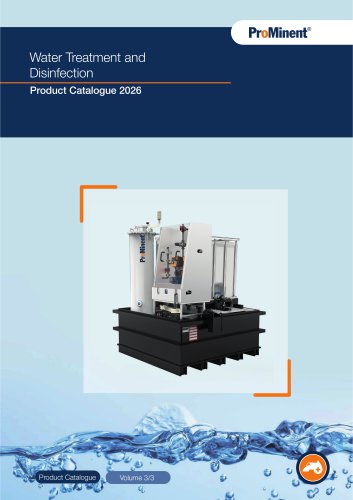
- ProMinent Product Catalogue 2025 - Volume 3: Water Treatment and Water Disinfection


ProMinent Product Catalogue 2025 - Volume 3: Water Treatment and Water Disinfection
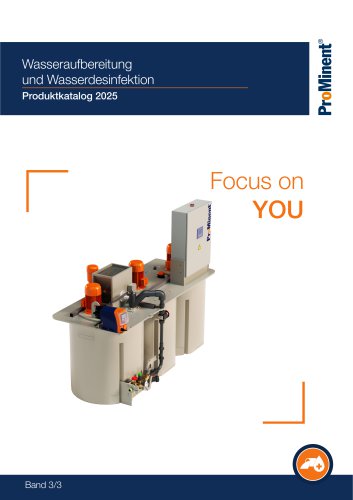
ProMinent Product Catalogue 2025 - Volume 3: Water Treatment and Water Disinfection
- UV Systems: DULCODES UV systems provide chemical-free disinfection, suitable for municipal drinking water and swimming pools, with energy efficiency and compliance with international standards.
- Ozone Systems: OZONFILT systems effectively remove organic and inorganic substances without by-products.
- Chlorine Dioxide Systems: Offer long-lasting microbial protection, especially in long pipelines and food industry applications.
- Electrolysis Systems: CHLORINSITU and DULCOLYSE systems produce chlorine on-site, eliminating the need for chemical transport and storage.
- ULTROMAT and DULCODOS: Designed for easy installation and operation, meeting high standards for separating colloidal solids from liquids.
- DULCODOS SAFE-IBC: Provides uninterrupted chemical supply with safe storage and emptying of IBCs up to 1,000 liters.
- Membrane Systems: Essential for removing particles and dissolved substances like salts, offering comprehensive water treatment solutions.
- DULCONNEX: A smart solution for digital networking of system components, offering process monitoring and management capabilities.
- Energy-efficient UV systems with electronic ballasts for precise lamp control.
- Advanced polymer preparation stations with proportional dosing and minimal product carryover.
- Seismic-resistant dosing and emptying stations for earthquake zones.
- Compliance with food and beverage industry standards for specific applications.
- Disinfection of drinking water and process water in the food and beverage industry.
- Reduction of chlorine dioxide, ozone, or chlorine in product water.
- Disinfection of sugar syrup and permeate in reverse osmosis systems.
- Support for disinfection in swimming pools and whirlpools.
- Low-Pressure VARIO-Flux Lamps: Patented high-performance lamps with a lifespan of 14,000 hours, adjustable to varying flow rates and temperatures.
- Medium-Pressure Powerline Lamps: Suitable for large flow rates and photochemical processes, with a lifespan of 8,000 to 10,000 hours.
- Compact Control: Manages all UV system functions, displaying irradiation intensity and operational hours, with programmable safety thresholds.
- Comfort Control UVCb: Offers intuitive operation with real-time monitoring and data logging capabilities, including integration with external systems via CAN-bus interface.
- Hydraulically optimized reactor design for minimal pressure loss.
- Dynamic lamp heating for quick adaptation to changing conditions.
- Real-time monitoring and data logging via the DULCONNEX platform.
- Continuous monitoring of reactor temperature using Pt 1000 temperature sensors.
- Available with either compact or comfort control systems.
- Integration with higher-level control systems through various analog and digital interfaces or a CANopen bus interface.
- Data logging capabilities with storage on an SD card for easy visualization.
- Dynamic lamp heating for optimal disinfection under varying flow rates and water temperatures.
- Homogeneous UV dose with minimal pressure loss.
- Reduced lifecycle costs due to fewer lamps and low energy consumption.
- Flexible installation options and real-time monitoring through the DULCONNEX platform.
- Drinking water treatment
- Food and beverage production
- Swimming pool water treatment
- Hygienic design for food and beverage industry applications.
- Corrosion-free design for saline water applications using high-density polyethylene reactors.
- Designed for preparing polymer solutions with a capacity of 400 to 4,000 l/h.
- Features two separate chambers to prevent product carryover, suitable for both liquid and powder polymers.
- Advantages include precise processing of liquid (0.05 – 1.0%) and powder polymers (0.05 – 0.5%), operator-guided input for concentration and calibration, and gentle mixing with an electric stirrer.
- Technical details include Siemens S7-1200 control, optional PROFIBUS®, Profinet, and Modbus TCP.
- Applications: Drinking water treatment, paper manufacturing.
- Automatic preparation system for polyelectrolytes, suitable for liquid and powder polymers.
- Features two stacked PP tanks to prevent product carryover, with the solution prepared in the upper tank.
- Advantages include high variant diversity, operator-guided input, and gentle mixing.
- Technical details include Siemens S7-1200 control, optional PROFIBUS®, Profinet, and Modbus TCP.
- Applications: Drinking water treatment, wastewater treatment, sludge dewatering, paper manufacturing.
- Inline system for preparing fully activated liquid polymer solutions with a capacity of 100 – 400 l/h against 4.5 bar.
- Features integrated mixing and maturation chambers, with precise processing of liquid polymers (0.05 – 1.0%).
- Advantages include efficient mixing, operator-guided concentration input, and compact design.
- Technical details include proportional dosing, optional integrated post-dilution unit, and Schneider Electric TM241 control.
- Applications: Sludge dewatering, wastewater treatment, drinking water treatment.
- Various configurations for tank size, electrical connections, and control systems.
- Options for powder feeders, liquid concentrate pumps, and monitoring systems.
- Standard features include pause function, operation notification, and transport lifting eyes.
- Identcode system for specifying type, tank size, and extraction rate.
- Options for normal or mirrored setup, electrical connections, and additional components.
- Stainless steel or high-quality coated steel frame
- Prefilter for membrane protection, optionally backwashable
- UF membrane modules
- Pneumatically controlled valves made of high-quality materials
- Electronic pressure measurement
- Filtration and backwash pumps, optionally with frequency converters
- Magnetic inductive flow measurement for flow regulation
- Integrated filling system for the rinse water tank
- SPS control with touchscreen panel or microprocessor control
- Filtrate values less than 0.1 NTU regardless of raw water turbidity
- Membrane cut-off (MWCO) around 100 kDa
- High retention rates for bacteria (99.9999%) and viruses (99.99%)
- Easy operation and integration with other systems
- Optimal operation through modern measurement and control technology
- Efficient operation with yields up to 85% and high salt retention rates
- Reduced maintenance and service costs
- Optional permeate rinsing to prevent deposits
- High-quality construction with corrosion-resistant frames
- Stainless steel, PP, or powder-coated steel frames
- 5 µm prefilter
- High-pressure pump protection with pressure switches
- Spiral-wound low-pressure membranes in GFK pressure tubes
- ProMinent conductivity sensor and control system
- Designed for feed water with a maximum salt content of 40,000 mg/l and a pH range of 3.0 to 10.0.
- Systems are available with 4” or 8” membranes, achieving over 99% salt retention.
- Energy recovery systems are optional, utilizing advanced pressure exchangers.
- Centralized control and monitoring of installations from any location using smartphones, tablets, or PCs.
- Configurable alarms and notifications for 24/7 updates on system status.
- Secure data storage and access via the DULCONNEX Cloud.
- Comprehensive overview of all devices and installations.
- Secure storage of historical data and alarms.
- Continuous documentation and automated reporting.
- Accessible via web without the need for additional apps.
- Real-time monitoring and control of connected devices, reducing the need for protective gear.
- Quick setup by transferring configurations between devices.
- Dashboard for monitoring device status and performance data.
- Automated logging of errors and events to minimize downtime.
- Compliance with regulatory documentation requirements through automated reporting.
Catalog excerpts
Wasseraufbereitung und Wasserdesinfektion Produktkatalog 2025
Open the catalog to page 1
Bei Fragen rund um die Dosiertechnik steht Ihnen unser Team gerne zur Seite. Rufen Sie uns an! Wir freuen uns auf Sie. Montag bis Freitag 8:00 – 16:30 Vertrieb ProMinent Deutschland 0049 6221 842 - 1800 [email protected] Unser Kundenservice Unsere Servicetechniker sind für Sie im Einsatz. Ob zur Erstinstallation oder für Wartungs- und Reparaturarbeiten. Wir sind gerne für Sie da! 0049 6221 842 - 1850 [email protected] Technische Kundenberatung 0049 6221 842 - 1850 [email protected] Herausgeber: ProMinent GmbH Im Schuhmachergewann 5–11 69123 Heidelberg Germany Telefon: +49 6221 842–0...
Open the catalog to page 2
Produktkatalog Band 3 Wasseraufbereitung und Wasserdesinfektion Technologieunabhängige Lösungen aus einer Hand Kapitel 1 UV-Anlagen zur schonenden und chemikalienfreien Wasserbehandlung. Sie eignen sich ideal zur Desinfektion von kommunalem Trinkwasser oder Produktwasser in der Getränkeindustrie. Bei der Badewasseraufbereitung sorgen die UV-Anlagen für ungetrübten Badespaß ohne störendes gebundenes Chlor. Ozonanlagen sind die optimale Lösung, wenn unerwünschte organische oder anorganische Stoffe wirkungsvoll entfernt werden müssen. Das reaktionsfreudige Ozon bietet ebenso eine effiziente Desinfektion...
Open the catalog to page 3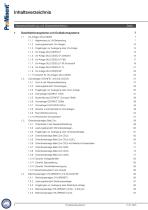
Inhaltsverzeichnis Wasseraufbereitung und Wasserdesinfektion 1.1.3 Fragebogen zur Auslegung einer UV-Anlage 12 1.1.5 UV-Anlage DULCODES LP zertifiziert 15 1.1.7 UV-Anlage DULCODES LP-PE Kunststoff 19 1.1.10 Zubehor fur UV-Anlagen DULCODES 25 1.2 Ozonanlagen OZONFILT und DULCOZON 27 1.2.3 Fragebogen zur Auslegung einer Ozon-Anlage 30 1.2.4 Ozonanlage OZONFILT OZVb 31 1.2.5 Systemlosung OZONFILT Compact OMVb 36 1.2.6 Ozonanlage OZONFILT OZMa 38 1.2.7 Ozonanlage DULCOZON OZLa 45 1.2.8 Zubehor und Ersatzteile fur Ozonanlagen 49 1.3.3 Fragebogen zur Auslegung einer Chlordioxidanlage 61 1.3.4 Chlordioxidanlage...
Open the catalog to page 4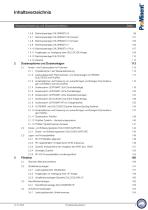
Wasseraufbereitung und Wasserdesinfektion Seite 1.4.6 Elektrolyseanlage CHLORINSITU III 99 1.4.7 Elektrolyseanlage CHLORINSITU III Compact 101 1.4.8 Elektrolyseanlage CHLORINSITU V Compact 103 1.4.10 Elektrolyseanlage CHLORINSITU V Plus 107 1.4.11 Fragebogen zur Auslegung einer DULCOLYSE Anlage 109 2.1 Ansetz- und Dosiersysteme fur Polymere 113 2.1.2 Leistungsubersicht Polymeransetz- und Dosieranlagen ULTROMAT, 114 2.1.3 Ansetzstationen und Dosierung von pulverformigen und flussigen Polymerlosun- 115 2.1.4 Dosiersystem ULTROMAT ULFb (Durchlaufanlage) 116 2.1.5 Dosiersystem ULTROMAT ULPa (Pendelanlage)...
Open the catalog to page 5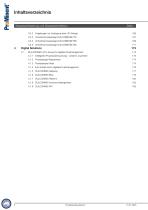
Inhaltsverzeichnis Wasseraufbereitung und Wasserdesinfektion Seite 3.4.2 Fragebogen zur Auslegung einer UO-Anlage 166 4.1 DULCONNEX: IIoT-Losung fur digitales Fluidmanagement 173 4.1.1 Intelligente Prozessuberwachung - anytime, anywhere 173 4.1.4 Ihre Vorteile durch digitales Fluidmanagement 176 4.1.8 DULCONNEX Inventory Management 182
Open the catalog to page 6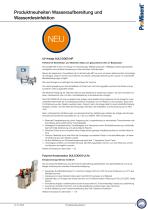
Produktneuheiten Wasseraufbereitung und Wasserdesinfektion UV-Anlage DULCODES MP Perfekte UV-Desinfektion und effizienter Abbau von gebundenem Chlor im Badewasser DULCODES MP ist eine UV-Anlage mit Hochleistungs-Mitteldrucklampen. Vielfältige Ausführungsvarianten ermöglichen eine einfache Anpassung an Ihre konkreten Anforderungen. Neben der klassischen Vorschalttechnik ist die Dulcodes MP nun auch mit einem elektronischen Vorschaltgerät verfügbar. Dadurch ist eine automatische und präzise Leistungsansteuerung der Lampen an wechselnde Betriebsbedingungen möglich. Das spart Energie und verlängert...
Open the catalog to page 7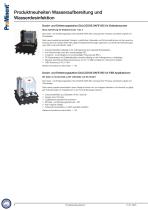
Produktneuheiten Wasseraufbereitung und Wasserdesinfektion Dosier- und Entleerungsstation DULCODOS SAFE-IBC fur ErdbebenzonenNeue Ausfuhrung fur Erdbebenzonen 1 bis 3 Die Dosier- und Entleerungsstation DULCODOS SAFE-IBC versorgt Ihren Prozess unterbrechungsfrei mit Chemikalien. Dank eines speziell entwickelten Designs, zusatzlicher Anbauteile und SchutzmaBnahmen ist die neue Ausfuhrung der DULCODOS SAFE-IBC gegen Erdbebeneinwirkungen geschutzt und erfullt die Anforderungen nach DIN 4149 und DIN EN 1998-1. ■ Zwischenbehalter befestigt in der Auffangwanne uber spezielle Bodenplatten ■ Anti-Rutschmatte...
Open the catalog to page 8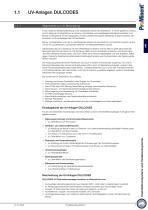
1.1 UV-Anlagen DULCODES In der modernen Wasseraufbereitung ist ein wesentlicher Schritt die Desinfektion. In immer groBerem Umfang kommt dabei die UV-Desinfektion als sicheres, chemiefreies und zuverlassiges Desinfektionsverfahren zum Einsatz. Umfangreiche Forschungsprojekte und eine Vielzahl storungsfrei arbeitender Anlagen beweisen die Sicherheit und Zuverlassigkeit der UV-Desinfektion. Bei der UV-Desinfektion wird das zu desinfizierende Wasser mit ultraviolettem Licht bestrahlt wodurch es sich um ein rein physikalisches, chemiefreies Verfahren zur Wasserdesinfektion handelt. Insbesondere die...
Open the catalog to page 9
UV-Anlagen DULCODES Die besonderen Merkmale unserer DULCODES UV-Desinfektionsanlagen sind: Homogene UV-Dosisverteilung dank optimiertem Strömungsverhalten im Reaktor garantiert maximale Durchflussleistung bei minimaler Lampenanzahl und minimalem Druckverlust Reduzierung der Lebenszykluskosten durch langlebige Hochleistungslampen mit geringem Energieverbrauch und hoher UV-Ausbeute Einzigartiges aktives Temperaturmanagement der VARIO-Flux-Niederdrucktechnologie passt Lampenleistung sekundenschnell an und sorgt für optimale Desinfektion auch bei schnell wechselnden Durchflüssen und Temperaturbedingungen...
Open the catalog to page 10
UV-Anlagen DULCODES DULCODES UV-Steuerungen Kompaktsteuerung Kompakte Einheit zur Steuerung aller Funktionen der UV-Anlage. Die Steuerung kann für Einlampenanlagen der DULCODES LP-Baureihe ausgewählt werden. Im Display werden die aktuelle Bestrahlungsintensität, die Betriebsstunden und die Zahl der Lampeneinschaltungen abwechselnd angezeigt. Die Kompaktsteuerung informiert den Betreiber bei Unterschreitung von jeweils frei programmierbaren Sicherheits- und Warnschwellen. Bedarfsabhängig können vielfältige Funktionen wie Inbetriebnahmespülung, Intervallspülung, Stillstandsspülung sowie eine Nachbrennzeit...
Open the catalog to page 11All ProMinent Group catalogs and technical brochures
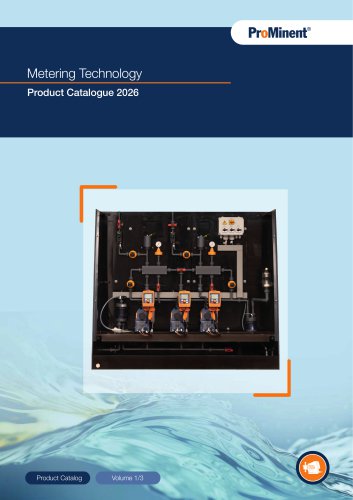 Metering Technology 2026
410 Pages
 Product guide 2026
70 Pages
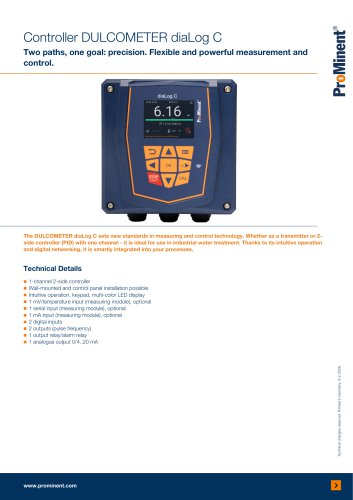 DULCOMETER diaLog C
2 Pages


- ProMinent Group industrial pump
- ProMinent Group electric pump
- ProMinent Group stationary pump
- ProMinent Group water pump
- Centrifugal pump
- ProMinent Group self-priming pump
- ProMinent Group chemical pump
- Flowmeter
- Lubricant pump
- Volume flow monitor
- Liquid flow monitor
- Submersible pump
- Oil pump
- Transfer pump
- Measuring device
- ProMinent Group pump for the chemical industry
- ProMinent Group diaphragm pump