
- Catalogs
- Promega Corporation
- AccuMAP™ Low pH Protein Digestion Kits

AccuMAP™ Low pH Protein Digestion Kits

AccuMAP™ Low pH Protein Digestion Kits
The document is a technical manual for the AccuMAP™ Low pH Protein Digestion Kit by Promega Corporation. It provides comprehensive instructions for using the kit to digest biotherapeutic proteins at low pH, minimizing nonenzymatic posttranslational modifications (PTMs) such as deamidation and disulfide bond scrambling.
- Prevents artificial deamidation, disulfide bond scrambling, and oxidation during sample preparation.
- Efficient reduction, alkylation, and digestion at low pH.
- Complete sample preparation in 4.5–5 hours with high reproducibility.
- Flexibility in procedural steps and reagent choices.
The kit is available in Mini (VA1040) and Maxi (VA1050) sizes, containing reagents for digesting 500µg and 5mg of protein, respectively. Components include denaturing solutions, reaction buffers, reducing and alkylating agents, oxidation suppressant, and enzymes. Store all components at –65°C or below.
Under Reducing Conditions
- Involves denaturation, reduction, alkylation, predigestion, and digestion steps.
- Guanidine HCl or urea can be used for denaturation.
- Digestion can be performed with AccuMAP™ Low pH Resistant rLys-C alone or with AccuMAP™ Modified Trypsin.
- Similar steps as reducing conditions but include blocking of free cysteines with NEM.
- Digestion with AccuMAP™ Low pH Resistant rLys-C: Add 220µl of NANOpure® water and 10µl of rLys-C, mix, and incubate overnight at 37°C.
- Combined Digestion with Trypsin and rLys-C: Add 200µl of water and 10µl of rLys-C, incubate overnight, then add 20µl of modified trypsin and incubate for 3 hours at 37°C.
- Reaction Termination: Add TFA to a final concentration of 2% to acidify the reaction, then store at –20°C or below.
- Nonenzymatic PTMs occur during protein manufacturing and storage, affecting efficacy and stability. The kit suppresses these PTMs by maintaining low pH and using an oxidation suppressing agent.
- Reduction and Alkylation: TCEP is used for reduction at low pH, and IAM for alkylation, which proceeds through the digestion reaction.
- Blocking Free Cysteines: NEM is used to block free cysteines to prevent disulfide bond scrambling.
- Trypsin digestion at low pH inhibits cleavages at lysine sites, which is compensated by using rLys-C.
- rLys-C generates peptides similar in length to tryptic peptides and is not prone to generating semi-specific peptides, reducing baseline noise.
The kit includes an oxidation suppressant to prevent protein oxidation during digestion. Methionine can be used as an alternative, though less effective.
- TCEP and IAM are recommended for reduction and alkylation, but DTT and IAA can also be used.
- Digestion steps can be extended if necessary, with precautions to avoid baseline noise.
- The kit operates at pH 5.6–5.8 for reduction and alkylation, and pH 5.2–5.4 for digestion.
- Guanidine HCl is used as a denaturing agent.
- Reduction is performed at 37°C to avoid nonenzymatic PTMs and protein precipitation.
- The reaction buffer is compatible with mass spectrometry and reverse phase chromatography.
Common issues such as incomplete digestion, presence of protease inhibitors, and PTMs are addressed. Solutions include verifying storage conditions of proteases, performing control digestion reactions, and ensuring proper sample clean-up.
Instructions for preparing and storing various reagents like AccuMAP™ Denaturing Solution, 10X Low pH Reaction Buffer, and 100X Oxidation Suppressant are provided. Proper thawing, mixing, and storage conditions are emphasized to maintain reagent activity.
The appendix includes tables summarizing sample and reagent volumes for different digestion protocols and references for further reading on related topics. It also lists related products available separately, such as additional mass spectrometry reagents and tools.
Catalog excerpts
TECHNICAL MANUAL AccuMAP™ Low pH Protein Digestion Kits Instructions for Use of Products VA1040 and VA1050
Open the catalog to page 1
AccuMAP™ Low pH Protein Digestion Kits All technical literature is available at: www.promega.com/protocols/ Visit the web site to verify that you are using the most current version of this Technical Manual. E-mail Promega Technical Services if you have questions on use of this system: [email protected] Promega Corpora on · 2800 Woods Hollow Road · Madison, WI 53711-5399 USA · Toll Free in USA 800-356-9526 · 608-274-4330 · Fax 608-277-2516 www.promega.com TM504 · 5/
Open the catalog to page 2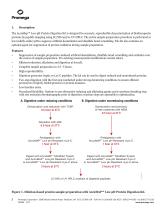
1. Description The AccuMap™ Low pH Protein Digestion Kit is designed for accurate, reproducible characterization of biotherapeutic proteins by peptide mapping using LC/MS and/or UV HPLC. The entire sample preparation procedure is performed at low (mildly acidic) pH to suppress artificial deamidation and disulfide bond scrambling. The kit also contains an optional agent for suppression of protein oxidation during sample preparation. Features • Suppression of sample preparation-induced artificial deamidation, disulfide bond scrambling and oxidation over the course of sample preparation. Pre-existing...
Open the catalog to page 3
2. Product Components and Storage Conditions PRODUCT SIZE CAT.# AccuMAP™ Low pH Protein Digestion Mini Kit 1 each VA1040 Contains sufficient reagents to prepare and digest 500pg of protein. Includes: • 1ml AccuMAP™ Denaturing Solution (contains GuHCl) Storage Conditions: Store all kit contents at -65°C or below until ready to use. Before using either kit, see Section 8.B for information on preparation of reagents and solutions. Promega Corporation ■ 2800 Woods Hollow Road ■ Madison, WI 53711-5399 USA ■ Toll Free in USA 800-356-9526 ■ 608-274-4330 ■ Fax 608-277-2516 3
Open the catalog to page 4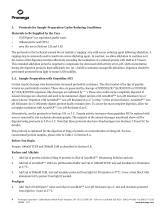
Protocols for Sample Preparation Under Reducing Conditions Materials to Be Supplied by the User • NANOpure® (or equivalent grade) water • • trifluoroacetic acid (TFA) urea (for use in Sections 3.B and 4.B) The protocols in this technical manual do not include a ‘capping’ step with excess reducing agent following alkylation. A capping step is commonly used to inactivate excess alkylating agent. In contrast, we allow alkylation to continue over the course of the digestion reaction effectively extending the incubation of a reduced protein with IAM to 4.5 hours. This extended alkylation period is required...
Open the catalog to page 5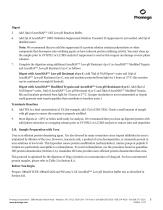
Add 10µl of AccuMAP™ 10X Low pH Reaction Buffer. Add 2µl of AccuMAP™ 100X Oxidation Suppressant Solution if needed. If suppressant is not needed, add 2µl of distilled water. Note: We recommend that you add the suppressant if a protein solution contains polysorbates or other compounds that decompose into oxidizing agents or have inherent protein oxidizing activity. You must clean up the sample prior to UV HPLC or LC/MS analysis if suppressant is used as this reagent can damage reverse phase columns. Complete the digestion using additional AccuMAP™ Low pH Resistant rLys-C or AccuMAP™ Modified Trypsin...
Open the catalog to page 6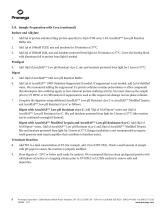
3.B. Sample Preparation with Urea (continued) Reduce and Alkylate 1. Add 5µl of protein solution (50µg protein quantity) to 42µl of 9M urea/1.4X AccuMAP™ Low pH Reaction Buffer mix. Add 1µl of 100mM TCEP, mix and incubate for 30 minutes at 37°C. Add 2µl of 300mM IAM, mix and incubate protected from light for 30 minutes at 37°C. Cover the heating block with aluminum foil to protect from light if needed. Add 10µl of AccuMAP™ Low pH Resistant rLys-C, mix and incubate protected from light for 1 hour at 37°C. Add 10µl of AccuMAP™ 10X Low pH Reaction Buffer. Add 2µl of AccuMAP™ 100X Oxidation Suppressant...
Open the catalog to page 7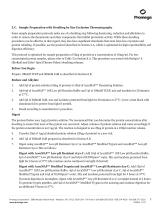
3.C. Sample Preparation with Desalting by Size Exclusion Chromatography Some sample preparation protocols make use of a desalting step following denaturing, reduction and alkylation in order to remove the denaturants and other components that inhibit proteolytic activity. While these desalting procedures can be effective in that regard, they also have significant drawbacks that stem from loss of protein and protein refolding. If possible, use the protocol described in Section 3.A, which is optimized for high reproducibility and digestion efficiency. This protocol is optimized for sample preparation...
Open the catalog to page 8
Add TFA to a final concentration of 2% (for example, add 11µl of 20% TFA). Check a small amount of sample with pH paper to ensure the reaction is properly acidified. Store digests at –20°C or below until ready for analysis. We recommend that you clean up digested protein with solid phase extraction or a trapping column prior to UV HPLC or LC/MS analysis to remove salts and impurities. 3.D. Sample Preparation of Proteolytically Resistant Proteins This protocol is optimized for the digestion of 50μg of protein at a concentration of 10mg/ml. For less concentrated protein samples, please refer to Table...
Open the catalog to page 9
Complete the digestion using AccuMAP™ Low pH Resistant rLys-C or AccuMAP™ Modified Trypsin and AccuMAP™ Low pH Resistant rLys-C as follows: Digest with AccuMAP™ Low pH Resistant rLys-C: Add 218µl of NANOpure® water and 10µl of AccuMAP™ Low pH Resistant rLys-C. Mix and incubate protected from light overnight at 37°C. Digest with AccuMAP™ Modified Trypsin and AccuMAP™ Low pH Resistant rLys-C: Add 198µl of NANOpure® water and 10µl of AccuMAP™ Low pH Resistant rLys-C. Mix and incubate protected from light overnight at 37°C. In the morning, add 20µl of AccuMAP™ Modified Trypsin. Mix and incubate for...
Open the catalog to page 10
4.A. Sample Preparation with Guanidine HCl (continued) Digest 4. Add 10µl of AccuMAP™ 10X Low pH Reaction Buffer. Complete the digestion using AccuMAP™ Low pH Resistant rLys-C or AccuMAP™ Modified Trypsin and AccuMAP™ Low pH Resistant rLys-C as follows: Digest with AccuMAP™ Low pH Resistant rLys-C: Add 80µl of NANOpure® water and 10µl of AccuMAP™ Low pH Resistant rLys-C. Mix and incubate for 3 hours at 37°C (the reaction can be continued overnight if desired). Digest with AccuMAP™ Modified Trypsin and AccuMAP™ Low pH Resistant rLys-C: Add 60µl of NANOpure® water, 10µl of AccuMAP™ Low pH Resistant...
Open the catalog to page 11All Promega Corporation catalogs and technical brochures
 Spectrum CE System
16 Pages
 Spectrum Compact CE System
12 Pages
 GloMax multi jr
6 Pages
 GloMax20/20
6 Pages
 2015 Catalog
432 Pages
 Quantus
2 Pages
 Maxwell® 16 Research System
4 Pages
 Maxwell® 16 Clinical System
4 Pages


Archived catalogs
 GloMax Discover and Explorer
14 Pages
 the 2013 Catalog
388 Pages
- Purification system
- Extractor
- Microplate reader
- Laboratory extractor
- Fluorometer
- Absorbance microplate reader
- Multi-mode microplate reader
- Fluorescence microplate reader
- Luminescence microplate reader
- Compact fluorometer
- Tube luminometer
- Acid purification system
- Electrophoresis unit
- Filter fluorometer
- Laboratory electrophoresis unit
- Microplate luminometer