- Catalogs
- profine GmbH, KÖMMERLING BU Platten
- Working directions - PVC Sheets

Working directions - PVC Sheets

Working directions - PVC Sheets
Introduction
Guidelines for working with PVC-U sheets are based on extensive trials and tests, though not universally binding for all applications.
Machining
Metal and wood tools are suitable for PVC-U sheets. High cutting speeds and low feed rates are recommended. Cooling is generally unnecessary unless making deeper cuts.
Drilling
Use twist drills with a 30° angle. The point angle can be up to 110°, and the lip relief angle should be 12–16°. Cutting and feed speeds vary with sheet thickness.
Sawing
High-speed bandsaws and circular saws are recommended. Sheets must be clamped to avoid vibration.
Turning
Use a slow feed rate and greater cutting depth for rough turning. Fine turning should have a max cutting depth of 2 mm.
Water-jet Cutting
Suitable for complex contours. Pure water jets for sheets up to 3 mm thick; thicker sheets require an abrasive agent.
Cutting, Punching, Perforating
Sheets up to 3 mm can be cut with guillotine shears. Thicker sheets require sawing.
Milling
Milling tools must be suitable for plastic. Fast feed rates and moderate cutting speeds yield good results.
Forming
Sheets can be formed by folding, bending, and other processes. Optimal forming temperature is above 90°C.
Thermoforming and Stretch Forming
Machines should be protected against draughts. Sheets can shrink by up to 0.5% during forming.
Folding, Bending, Compression Moulding
Bending radius should be at least two to three times the sheet thickness.
Hot-gas Welding
Involves plasticizing the sheet and welding rod with heated gas. Proper cleaning of the welding zone is essential.
Conclusion
Guidelines cover machining, forming, and welding processes for PVC-U sheets.
Welding and Finishing of PVC-U Sheets
Weld seams may require finishing. Care must be taken to avoid notching.
Heated-tool Welding
Efficient method producing stress-resistant joints. Adhere to specific conditions for optimal seam strength.
Folding and Welding
Involves heating along a folding line, then folding and welding the sheet.
Bonding
Solvent-based or solvent-free adhesives can be used. Solvent-free adhesives are moisture-resistant.
Printing and Lacquering
Suitable for PVC systems. Dark lacquers in sunlight may increase temperature.
Digital Direct Printing
UV lamp intensity and ambient conditions affect print quality.
Fixing and Storage
Consider thermal expansion when fixing sheets. Store in dry, air-conditioned environments.
Resistance and Weathering
PVC-U sheets are resistant to chemicals and suitable for outdoor use. Light-colored surfaces minimize solar radiation absorption.
Specifications and Material Properties
PVC-U sheets are moisture-resistant. Coefficient of linear thermal expansion is 0.08 mm/m·°C.
Installation Guidelines
Mounting systems should accommodate thermal expansion. Screws with holes or elongated slots are recommended.
Mounting Techniques
Suspended boards can be stabilized using metal U-sections. Frame fixing with metal U-section rails is suitable for large sign façades.
Examples of Installation
Examples illustrate mounting techniques considering temperature differences and expansion joints.
Environmental Considerations
Sheets are free from harmful substances and recyclable. Quality assurance is certified to DIN ISO 9001.
Catalog excerpts

Working Guidelines and Application Outdoors
Open the catalog to page 1
02. Working guidelines for PVC-U sheets and PVC-U sheets for outdoor applications When working with PVC-U sheets, there is a number of special guidelines and directions that must be complied with. The following data and values are provided for orientation purposes. Although they have been obtained by conducting a great variety of trials and tests, they cannot be assumed to be binding for every type of application. Almost all tools and machine tools used to work metal and wood can also be used to work our KomaCel, KomaTexNEW, KomaPrint and KomaDur PVC-U sheets. The cutting speeds are high, the...
Open the catalog to page 2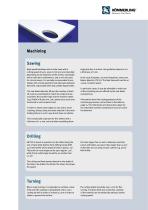
Machining Sawing High-speed bandsaws and circular saws with a cutting speed of up to 3000 m/min are recommended. Depending on the thickness of the sheets, saw blades with a tooth pitch of between 5 and 10 mm are used. For circular saws, it is normally recommended to use blades with a tooth geometry that alternates between flat teeth, trapezoidal teeth and carbide-tipped teeth. The saw blade diameter (Ø) and the number of teeth (t) must be coordinated to match the material to be machined, the machine type and the machine speed (e.g. KömaCel Ø 300 mm, t 96, speed 4000–5000 rpm, horizontal or vertical...
Open the catalog to page 3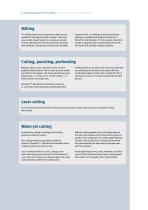
04 . Working Guidelines for PVC-U Sheets and PVC-U Sheets for Outdoor Applications Milling The milling tools have to be ground so that they are suitable for working the plastic material. They must also provide enough space for an adequate volume of chips. Working with a fast forward feed rate along with moderate cutting speed and deep cuts will lead to good results. 3-D milling can also be performed without any problem with KömaCel, KömaTexNEW, KömaPrint and KömaDur. For this purpose, the plotter system is equipped with a special ballnose end mill and linked with suitable computer software. Cutting,...
Open the catalog to page 4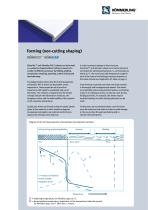
Forming (non-cutting shaping)KDMATEX" KOMADUR KomaTexNEW and KomaDur PVC-U sheets can be formed, i.e. worked or shaped without cutting, by means of a number of different processes: by folding, bending, compression moulding, upsetting, stretch forming and thermoforming. The diagram below shows that the forming properties of KomaDur PVC-U sheets are dependent on the temperature. These properties are of practical importance with regard to workability and use of the sheets. The modulus of elasticity and the tensile strength indicate the deformation resistance, the elongation at tear and the deformability...
Open the catalog to page 5
06. Working guidelines for PVC-U sheets and PVC-U sheets for outdoor applications KomaDur and KomaTexNEW sheets can be thermoformed or stretch-formed on all commercially available forming machines. The only proviso is that the machines are protected against draughts on all sides. Fast working cycle times can be achieved if the tools used for these forming processes are cooled. In the case of vacuum forming, sand-blasted surfaces have the advantage that the air can be completely extracted without leaving any air pockets. The diameter of the vacuum bores should not exceed 0.8 mm in order to prevent...
Open the catalog to page 6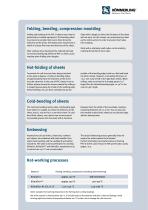
Folding, bending, compression moulding Folding and bending of the PVC-U sheets must only be performed on suitable equipment. The bending radius must never be smaller than two to three times the thickness of the sheet. The heated zone should have a width of at least five times the thickness of the sheet. After cooling, linear heating of the material will lead to stresses developing within the PVC-U, which cause warping when folding short lengths. Sides with a length 20 times the thickness of the sheet will not warp. For this reason, we recommend you heat up the entire section in order to prevent...
Open the catalog to page 7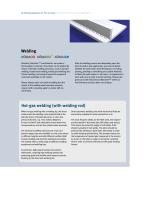
08. Working guidelines for PVC-U sheets and PVC-U sheets for outdoor applications Welding KömaCel, KömaTexNEW and KömaDur are made of thermoplastic materials. The sheets can be welded by means of familiar welding processes, such as hot-gas welding, heated-tool welding, folding and welding and friction welding, and using all pieces of equipment commonly available on the market. Please always make sure before welding that the sheets in the welding zone have been properly cleaned with a cleaning agent or, better still, by machining. After the welding process and depending upon the kind of product...
Open the catalog to page 8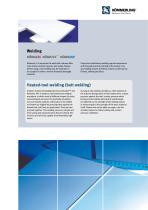
Welding KDMACEL KDMATEX" KDMADUR Moreover, it is important to weld with undrawn filler rods and at constant pressure and speed. Always before using a new welding rod, the weld has to be scraped in order to remove thermally damaged material. Proper and satisfactory welding requires experience and thorough practical training of the worker: hot-gas welding should, therefore, only be carried out by trained, skilled specialists. Another method of welding KomaCel, KomaTexNEW and KomaDur PVC-U sheets is the heated-tool welding procedure, in which tools of different shapes (circular, sword-shaped) are...
Open the catalog to page 9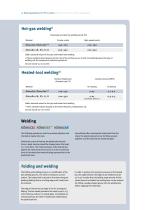
10. Working guidelines for PVC-U sheets and PVC-U sheets for outdoor applications 1 Hot-gas welding15 Temperatures inside the welding nozzle (°C) Material Circular nozzle High-speed nozzle Table: standard values for hot-gas and heated-tool welding 1) These standard values depend on the rate of hot-air flow (40-60 l/min), the welding speed, the type of welding rod, the temperature induction period, etc. Circular nozzle 15-20 cm/min Surface temperature of heated tool (°C) Material for heating for joining (contact press.) Table: standard values for hot-gas and heated-tool welding 2)...
Open the catalog to page 10
BondingKOMACEL KDMATEX"" KOMAPRINT KOMADUR KomaCel, KomaTexNEW, KomaPrint and KomaDur sheets, just like all other PVC-U materials, can be bonded both among one another and to other materials. Different adhesive types may be used depending on the requirements and the specific use. For bonding KomaCel, KomaTexNEW , KomaPrint and KomaDur sheets to one another, adhesives containing solvents (e.g. C 004) as well as solvent-free polyurethane adhesives (e.g. C 012) are suitable. C 004 is a PVC-U adhesive with colourless curing, which, because of its joint-filling characteristics, is able to align small...
Open the catalog to page 11All Profine GmbH, KÖMMERLING BU Platten catalogs and technical brochures
 KömaDur - Rigid PVC Sheets
10 Pages
 Sheet overview
20 Pages