

PI-MAX4

PI-MAX4
The PI-MAX®4 is an advanced intensified CCD (ICCD) camera by Princeton Instruments, designed for time-resolved imaging and spectroscopy. It features precision gating capabilities of less than 500 picoseconds and supports frequency domain measurements with RF modulation. The camera is managed via LightField® software for precise experiment control.
- Precision Gating: Offers gating of less than 500 picoseconds with a repetition rate of 1 MHz, outperforming most research-grade ICCD cameras.
- High Frame Rates: Capable of thousands of frames per second, suitable for dynamic processes.
- SuperHV Technology: Provides high-voltage gating for Gen II and Gen III intensifiers, maintaining image quality at a 1 MHz repetition rate.
- PIPs Technology: Enables picosecond gating without sacrificing quantum efficiency.
- LightField Software: A 64-bit platform for complete control over the PI-MAX4, facilitating experimental setup and data processing.
- PINS Technology: Ensures low noise levels and high-speed CCD readout.
- Gigabit Ethernet: Allows high-bandwidth data transmission and remote operation over 50 meters.
Available with different CCD sensors and configurations for spectroscopy and imaging, with various intensifier sizes and types.
Ideal for demanding gated imaging and spectroscopy applications, offering high precision and sensitivity, particularly beneficial for fluorescence lifetime imaging microscopy.
The PI-MAX4 represents a significant advancement in ICCD camera technology, providing tools for time-resolved optical diagnostics.
Offers easy interchangeability of mounts and is designed for convenient mounting on optical tables.
Manufactured using advanced methods for maintenance-free operation, leveraging over 50 years of expertise in scientific imaging and spectroscopy.
Princeton Instruments provides global support and extensive online resources for ICCD cameras and time-resolved imaging applications.
Supports a wavelength range of 120 nm to 1100 nm with various configurations to meet different experimental requirements.
Supports widefield FLIM measurements and advanced imaging techniques like FLIM and FRET, with built-in digital synthesizers for RF modulation.
Supports modulation frequencies from 1 MHz to 200 MHz and phase modulation from 0° to 359°, with features like PINS and SuperHV for high-voltage circuitry.
Offers innovations like the Double Image Feature (DIF) and Gate Monitor for precise timing, supporting Gigabit Ethernet for remote operation.
An interview with Ray Simpson highlights the PI-MAX4's design improvements, such as faster gating repetition rate and enhanced synchronization capabilities.
Image intensifiers enhance low-light imaging, consisting of a photocathode, MCP, and phosphor screen. They are categorized into generations based on technological advancements.
Gen III filmless intensifiers offer the highest quantum efficiency in the visible spectrum.
- Photocathode: Converts light photons into electrons.
- MCP: Multiplies electrons, enhancing image resolution.
- Phosphor Screen: Converts electrons back into light.
ICCD cameras integrate image intensifiers with CCDs for high sensitivity in ultra-low-light conditions.
ICCDs achieve temporal resolution through rapid gating, with coupling to CCDs via lenses or fiberoptics.
Princeton Instruments' PI-MAX4 ICCD cameras offer advanced features and flexibility for scientific research.
Recent advancements in intensifier and CCD technology have enhanced ICCD cameras' capabilities in spectroscopy and imaging applications.
- Gen I: Obsolete due to inefficiency.
- Gen II and Super-Gen II: Improved gain and resolution.
- Gen III: Enhanced NIR sensitivity with higher resolution and filmless designs.
An image intensifier tube consists of a photocathode, MCP, and phosphor screen.
Gen II intensifiers use a nickel underlayer for faster gating, while Gen III filmless intensifiers offer the highest QE in the NIR.
- Lens-Coupled ICCDs: Offer flexibility but lower light throughput.
- Fiberoptic-Coupled ICCDs: Provide superior sensitivity and SNR.
This document provides technical notes on selecting the best ICCD camera for low-light, time-resolved imaging and spectroscopy applications.
The performance of an ICCD system is influenced by the choice of intensifier tube, depending on QE and gate speed.
Offer the highest performance with up to 60% coupling efficiency.
Allows for the capture of transient phenomena and elimination of ambient light.
The choice of CCD is crucial for minimizing photobleaching and capturing data with minimal excitation pulses.
Fiberoptic-coupled ICCDs provide superior performance in low-light applications.
The document provides technical notes and application insights on the PI-MAX4 ICCD camera, highlighting its precision, intelligence, and ease of use.
Offers a dynamic range of over 15 bits, suitable for transient and continuous wave applications.
Details the use of ICCD cameras in various scientific applications, including combustion studies and nano-research.
Explores the formation and potential applications of single-wall carbon nanotubes (SWNTs).
Research conducted at Oak Ridge National Laboratory using laser ablation techniques is discussed.
The PI-MAX4 camera offers advanced features such as picosecond gating and RF modulation.
The document concludes with a summary of findings from ORNL's research, emphasizing the PI-MAX4 camera's capabilities.
This document discusses the use of high-performance ICCD cameras for studying plasma turbulence.
The tokamak is a toroidal magnetic confinement device used in fusion experiments.
The Princeton Plasma Physics Laboratory's magnetic nozzle experiment (MNX) is used to test PLIF.
Choosing the right ion for PLIF involves considering laser pump wavelength and fluorescence signal intensity.
Uses a Princeton Instruments PI-MAX camera for high spatial resolution and remote operation.
PLIF imaging has shown promise in measuring plasma structures and turbulence.
The PI-MAX4 ICCD camera offers advanced features suitable for various applications.
The document highlights the potential of PLIF in advancing the understanding of plasma turbulence.
The HTGL facility simulates high total-enthalpy conditions, replicating Mach 10 to Mach 13 environments.
Experiments utilized Schlieren imaging and OH-PLIF to visualize shock waves and combustion regions.
Employs a Princeton Instruments PI-MAX® ICCD camera system for capturing OH-PLIF.
Simultaneous OH-PLIF and Schlieren images reveal the presence of OH molecules and combustion zones.
The experiments successfully simulate high-enthalpy flows, aiding the development of hypersonic propulsion systems.
The PI-MAX4 ICCD camera offers advanced features for various scientific applications.
Catalog excerpts
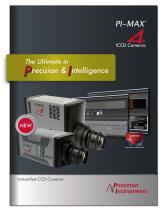
ICCD Cameras recision & ntelligence
Open the catalog to page 1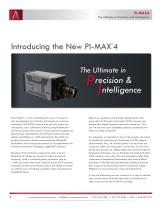
The Ultimate in Precision and Intelligence recision & ntelligence The PI-MAX® 4 is the culmination of years of research and development by Princeton Instruments to create an intensified CCD (ICCD) camera that not only meets, but anticipates, users’ continually evolving requirements for sensitivity, speed, and control in time-resolved imaging and spectroscopy applications. The PI-MAX4 offers precision gating capabilities to <500 picoseconds, the ability to perform frequency domain measurements utilizing RF modulation, and unsurpassed control of all experiments via Princeton Instruments’ intelligent...
Open the catalog to page 2
The Ultimate in Precision and Intelligence offer picosecond gating capabilities, RF modulation capabilities, and complete control via LightField software First intensified photodiode array First scientific-grade gated ICCD camera for imaging and spectroscopy I-PentaMAX camera: revolutionized low-light-level, single-molecule fluorescence applications PI-MAX: the first ICCD camera to have a built-in delay generator for precise timing MCP gating: combined fast gating with the high QE of slow-gate Gen II intensifiers; ideal for PLIF imaging in combustion PI-MAX2: readout speed 5x faster than original...
Open the catalog to page 3
The Ultimate in Precision and Intelligence Ultimate in Precision Video and higher frame rates: Camera achieves near-video frame rates (even at full 1k x 1k resolution); thousands of spectra per second can be acquired while in spectroscopy mode; provides ability to capture a gated image or spectrum for every pulse of a high-repetition-rate laser. PIPs (Princeton Instruments Picosecond) gating technology: Without sacrificing the quantum efficiency of a standard Gen II or Gen III image intensifier, new PIPs technology allows image capture with precision gating to <500 psec. Image courtesy of Drs....
Open the catalog to page 4
The Ultimate in Precision and Intelligence SuperSynchro: New timing-generator technology precisely controls intensifier gating; allows gate widths and delays to be set for 10 psec resolution with <35 psec jitter; offers wide variety of options to synchronize camera with external trigger sources such as pulsed lasers. PINS (Princeton Instruments Noise Suppression) technology: Next-generation electronics ensure the best combination of CCD readout speed and the lowest possible noise levels in an ICCD camera; offers near-video frame rates at full 1k x 1k resolution with 16-bit digitization. SyncMaster:...
Open the catalog to page 5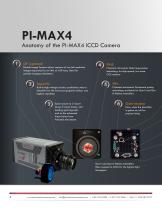
Anatomy of the PI-MAX4 ICCD Camera 1 Double Image Feature allows capture of two full-resolution images separated by as little as 450 nsec; ideal for particle imaging velocimetry Built-in high-voltage circuitry positioned close to intensifier for the lowest propagation delays and highest repetition Easily mounts to C-mount lenses, F-mount lenses, and leading spectrographs such as the advanced Acton Series from Princeton Instruments Princeton Instruments Noise Suppression technology for high-speed, low-noise CCD readout Princeton Instruments Picosecond gating technology available for Gen II and...
Open the catalog to page 6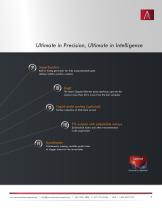
Ultimate in Precision, Ultimate in Intelligence 7 Built-in timing generator for fully programmable gate delays/widths; auxiliary outputs The latest Gigabit Ethernet data interface; operate the camera more than 50 m away from the host computer Liquid-assist cooling (optional) Further reduction of CCD dark current TTL outputs with adjustable delays Synchronize lasers and other instrumentation in the experiment Continuously running, variable pulse trains to trigger lasers for the lowest jitter www.princetoninstruments.com | [email protected] | USA TOLL-FREE +1.877.474.2286 | USA +1 609.587.9797...
Open the catalog to page 7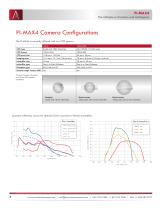
The Ultimate in Precision and Intelligence PI-MAX4 Camera Configurations The PI-MAX4 is currently offered with two CCD sensors... 1024i Kodak KAI:1003 (interline) 1024x1024 12.8 µm x 12.8 µm 13.1 mm x 13.1 mm (18 mm dia.) 18 mm Gen II or Gen III filmless P43, P46, or P47 Yes 1024x256 e2v CCD30-11 (full frame) 1024x253 26 µm x 26 µm 18 mm x 6.6 mm or 25 mm x 6.6 mm 18 mm or 25 mm Gen II or Gen III filmless P43, P46, or P47 No Imaging 1024i with 18 mm intensifier CCD type CCD format CCD pixel size Imaging area Intensifier size Intensifier type Phosphor type* Double Image Feature (DIF) Spectroscopy...
Open the catalog to page 8
The Ultimate in Precision and Intelligence JtR ihTAKfi VENT? JUR E*H*U5T V£hTS Your PI-AAAX4 is ready to tackle demanding gated imaging and spectroscopy applications - as soon as it arrives. We configure the camera with your choice of mount, CCD, and intensifier, and then put it through the most rigorous testing protocols available to ensure the highest performance possible. Camera (C-mount, F-mount, Gigabit Ethernet adapter card Gigabit Ethernet cable to access timing signals Power supply Operation Manual Quick Start Guide Princeton Instruments LightField software Princeton Instruments WinView...
Open the catalog to page 9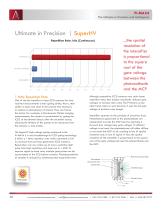
The Ultimate in Precision and Intelligence Ultimate in Precision | SuperHV ...the spatial resolution of the intensifier is proportional to the square root of the gate voltage between the photocathode and the MCP Repetition Rate, kHz (Continuous) One of the key benefits of using ICCD cameras for timeresolved measurements is their gating ability, that is, their ability to open and close at the precise time necessary to capture a phenomenon of interest. They can freeze the action. For example, in fluorescence lifetime imaging measurements, the camera is synchronized by gating the ICCD at incremental...
Open the catalog to page 10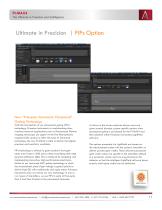
The Ultimate in Precision and Intelligence Ultimate in Precision | PIPs Option New “Princeton Instruments Picosecond” Gating Technology With the introduction of our picosecond gating (PIPs) technology, Princeton Instruments is revolutionizing timeresolved research applications such as fluorescence lifetime imaging microscopy yet again! As the first fiberoptically coupled ICCD camera to offer this type of advanced technology, the new PI-MAX4 is able to deliver the highest precision and sensitivity available. PIPs technology is utilized to gate standard fast-gate tubes even faster (<500 psec) without...
Open the catalog to page 11All Princeton Instruments Acton catalogs and technical brochures
 Cosmos-Datasheet
16 Pages


Archived catalogs
 PIXIS-XO Product Flyer
2 Pages
 PhotonMAX
2 Pages
 2D-OMA V Product Flyer
2 Pages
 PIXIS Product Flyer
2 Pages
- Digital imager
- Visible imager
- CMOS camera module
- Analysis software solution
- Infrared imager
- Full-color camera system
- Monitoring camera system
- Windows software
- GigE Vision camera
- HD camera module
- Temperature-controlled camera
- Camera with global shutter
- CCD video camera
- Laboratory spectrometer
- High-performance imager
- Spark optical emission camera module
- High-sensitivity video camera
- Data acquisition software
- Megapixel imager