

Vr emmotion tracking sensors

Vr emmotion tracking sensors
The document "VR EM Motion Tracking Sensors & Applications II" by PREMO S.A. explores the role of innovative magnetics in virtual and augmented reality systems, emphasizing the company's contributions to the 4th Industrial Generation through VR tracking sensors.
This chapter outlines the evolution of motion tracking systems, categorizing them into optical and non-optical systems. Optical systems include passive markers, active markers, and markerless systems, each with specific advantages and limitations. Non-optical systems encompass electromagnetic, mechanical, and inertial systems, each offering unique benefits and challenges.
This section highlights the use of magnetic sensing for tracking multiple fingertips, enhancing VR experiences by providing more natural interaction systems.
The document discusses various technologies for tracking hand and finger movements, including infrared cameras, depth of field cameras, and fisheye lens cameras. It also explores body sensing techniques like electromyography and bio-acoustic sounds.
Magnetic fields are used for accurate finger movement tracking, with the Finexus system offering solutions to occlusion problems. Developed by the University of Washington and Oculus Research, Finexus uses electromagnets and magnetic sensors for precise tracking.
Finexus is applicable in gaming, multimedia, education, and clinical medicine, supporting complex inputs and offering reliable tracking without interference.
The document projects the VR market to reach $150 billion by 2020, impacting industries like healthcare and education. It emphasizes the role of key figures in driving innovation and investment.
Tracking systems have improved surgical procedures and are used in the automotive industry for simulations and autonomous vehicle testing. The document discusses optical and electromagnetic tracking systems, highlighting their applications and limitations.
PREMO offers solutions in electric vehicles, car access technology, and passive security. Their contributions to VR/AR include immersive driving experiences and motion tracking technologies.
Mobile solutions like Notch Interfaces and Kaia Health apps provide real-time data capture and posture correction. VR goggles like Samsung Gear VR and HTC Vive offer high-resolution experiences.
The document emphasizes the transformative potential of VR and AR technologies across various sectors, highlighting ongoing innovations and their future applications.
Catalog excerpts

Publisher: PREMO S.A. Authors: Ezequiel Navarro, Antonio Rojas, Claudio Cabeza, Lucía Vera, Juan Esteo, Marcos Martínez, Premo Tech Team. English revision: Rob Pagones and Sergio Lorenzi Agustín. Design and layout: María de Andrés Arranz. Print: Altagrafics Inversiones Gatellco 3 Sl / Avenida de la Aurora 28, 29002 Málaga PUBLISHING HOUSE First edition All rights reversed Málaga, Spain, March 2019 PREMO S.A. Severo Ochoa 47 Parque Tecnológico de Andalucía 29590 Campanillas - Málaga - Spain [email protected] www.grupopremo.com 3dcoil.grupopremo.com +34 951
Open the catalog to page 2
VR/EM MOTION TRACKING SENSORS & APPLICATIONS Innovative Magnetics have a significant role in sensing and tracking position and motion in immersive Virtual and Augmented Reality systems. Premo is committed to contribute with World Class Innovative components to the Key Enabling Technologies of the 4th Industrial Generation. 4 patents have been filed for VR Tracking sensors in less than 6 months. With this book we start a series of publications on our contribution to a coming better world from our experience, vision and value proposition. This is a recognition and tribute to our team of Innovators...
Open the catalog to page 3
TRACKING SYSTEMS IN VIRTUAL REALITY: WHICH IS THE BEST CHOICE? VR EM MOTION TRACKING SENSORS & APPLICATIONS II VR EM MOTION TRACKING SENSORS & APPLICATIONS II
Open the catalog to page 4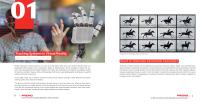
01 Tracking Systems in Virtual Reality: which is the best choice? Motion tracking has been present in our lives since the 1970s, when they were used for the first time as a photogrammetric analysis tool in researches related to biomechanics. Some examples of these first systems were developed by the Weber brothers [1] in 1936, who established a model for quantitative studies of human locomotion, Marey in 1873 and Muybridge in 1878, who used photographic techniques to quantify patterns of human movement. In the 1980s, there was a relevant research activity around motion tracking in other fields...
Open the catalog to page 5
Which devices do we know so far? The following next shows a possible classification of Motion Tracking Systems [4]. OPTICAL SYSTEMS PASSIVE MARKERS ACTIVE MARKERS For a correct operation, at least two cameras must capture the marker at the same time; otherwise, the marker could not be tracked, most of the times due to some occlusion problems. As the markers are all the same, there is no difference between them, so the device provides a set of unlabeled points in a three-dimensional workspace. A post-processing task is required to identify, classify and provide a meaning to those 3D points in...
Open the catalog to page 6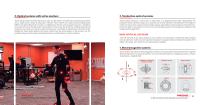
2. Optical systems with active markers 3. Markerless optical systems These optical systems resemble the previous ones, but the markers are called active markers because they act as a light source instead of being only a reflector. These markers are usually infrared emitting diodes (IREDs). The light emitted by the markers is multiplexed so that the camera speed frequency is divided by the number of sensors that the system need to detect. In these case, the system has a limited measurement frequency, but needs less post-processing time because it is possible to identify each individual marker....
Open the catalog to page 7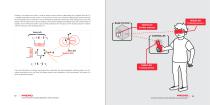
Faraday’s Law states than when a receiver sensor moves inside an alternating (AC) magnetic field B (r,T), a voltage proportional to the vector or cross product of the cross sectional winding area and the intensity of the magnetic field, is induced in every winding and generates N times the total voltage across the coils (being N the number of turns of the winding). This induced voltage immediately gives the measurement of rotation (ɵ)vs the reference emitter coils and the position (as the modulus of the resulting vector) in relation with the modulus of the emitting vector (r). From the information...
Open the catalog to page 8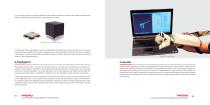
For a tracking system, an emitter antenna as base station is required to measure the distance between the object and the base by placing a tracking sensor in each object. Image from www.grupopremo.com This approach offers advantages thanks to its flexibility to locate the sensor because there are no occlusion issues, and the portability of the system depends only on the transmitter. Conversely, the area is limited to a small region around the transmitter (base station) and the location could be distorted if there are metallic objects in the surrounding space. Mechanical systems were among the...
Open the catalog to page 9
Which is the best choice? The following table provides an overview of tracking systems, their advantages and disadvantages. Tracking System Characteristics Advantages Disadvantages Optical Passive Markers Use of cameras and reflective markers. - Precision <lmm - Wireless - Less burden - Position only - Limited measurement space - Occlusions - Post-processing latency As we can see in this post, there are many types of tracking systems and devices used to track and follow the position of an object. There is not a perfect solution and the best choice depends on the application. According to the...
Open the catalog to page 10
References and links >>[1] Weber W, Weber E: Mechanik der menschlichen Gehwerkzeuge. Göttingen: Dieterich 1836. >>[2] Muybridge E: Animal locomotion. Philadelphia: J.B. Lippincott Company; 1887 >>[3] Marey E: Animal Mechanism: A Treatise on Terrestrial and Aerial Locomotion. London: Henry S. King & Co.; 1874. >>[4] M. Field D. Stirling F. Naghdy Z. Pan “Motion capture in robotics review” IEEE International Conference on Control and Automation (ICCA), pp. 1697-1702 Dec. 2009 >>[5] Roetenberg. Towards a Real-Time Bayesian Imitation System for a Humanoid Robot. 2007 IEEE International Conference...
Open the catalog to page 11
USING MAGNETIC SENSING FOR TRACKING MULTIPLE FINGERTIPS 20 VR EM MOTION TRACKING SENSORS & APPLICATIONS II VR EM MOTION TRACKING SENSORS & APPLICATIONS II
Open the catalog to page 12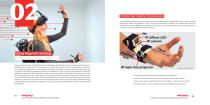
COMPUTER VISION TECHNIQUES This technology is related to the use of cameras and image analysis for tracking the user’s hand and finger movements inside the application. In this case, the most common solutions use Infrared (IR) cameras to capture and recognize different hands gestures. Also there are some other alternatives, all of them based on computer vision using different kinds of cameras: Using Magnetic Sensing or Tracking Multiple Fingertips Due to rapid advances in Virtual Reality (VR) and Augmented Reality (AR) and the resurgence of head-mounted displays to enhance the AR/VR experience,...
Open the catalog to page 13All PREMO catalogs and technical brochures
 SMD Telecoil TC0502
1 Page
 MICU 300A-S/LF
1 Page
 KGEA-BFCR
1 Page
 general catalogue
20 Pages
 premo innovation
137 Pages
 Tracking Sensors & Applications
226 Pages
 BLOCKING FILTER SOLUTIONS
2 Pages
 NFC ANTENNA SOLUTIONS
2 Pages
 Company Presentation 2017
36 Pages
 TR1102CAP
1 Page
 TP0702UCAP
1 Page
 TP0702U
1 Page
 TP0602
1 Page
 TP0502
1 Page
 RCA-ROD
2 Pages
 KGEA-HB
1 Page
 KGEA-TH
1 Page
 KGEA-BFCWX
1 Page
 SEA
SEA1 Page
 4DC15NF
3 Pages
 2D1D15
2 Pages
 SDTR1103-HF2
1 Page
 3DC11CAP
1 Page
 ZAC1203
1 Page
 SDTR1103
1 Page
 TR1102
1 Page
 TP0702CAP
1 Page
 TP0702
1 Page
 EMC FILTERS
110 Pages
 RFID TRANSPONDERS
72 Pages
 INDUCTORS/ CHOKES
173 Pages
 SMD Power Inductors
11 Pages
 FVDT
FVDT87 Pages
 PLC Components and accessories
56 Pages
 Transformers
89 Pages
 Ferrite Cores
42 Pages
 TAGS
TAGS41 Pages
 Transponder
32 Pages
 SMD Inductors
57 Pages


Archived catalogs
 emitter antennas
2 Pages
 PREMO PLC CATALOGUE
29 Pages
 PREMO EMC FILTERS CATALOGUE
131 Pages
 PREMO IC CATALOGUE 2009
165 Pages
 PREMO RFID CATALOGUE 2009
77 Pages
- Transformer
- Dry transformer
- Current transformer
- Encapsulated transformer
- Power transformer
- Electronic filter
- Radio antenna
- Industrial transformer
- Passive electronic filter
- AC electronic filter
- Low-pass electronic filter
- Cast resin transformer
- Outdoor antenna
- Coupler
- Compact transformer
- External antenna
- Choke coil
- AC transformer
- Passive antenna