
- Catalogs
- PRECITEC OPTRONIK
- Plastics: Thickness Measurements


- Products
- Catalogs
- News & Trends
- Exhibitions
Plastics: Thickness Measurements
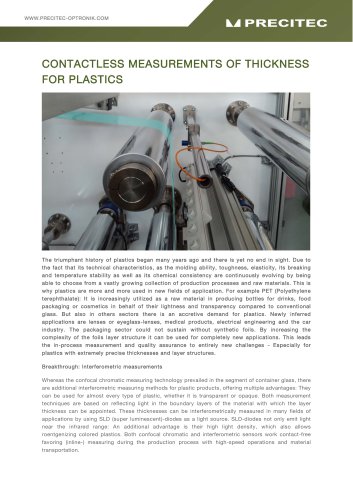
Plastics: Thickness Measurements
The document discusses the evolving use of plastics due to their versatile technical characteristics, such as molding ability, toughness, and chemical consistency. Plastics are increasingly used in various sectors, including packaging, medical products, and the automotive industry.
Interferometric Measurements
Interferometric measurement techniques offer advantages for measuring plastic thickness, applicable to both transparent and opaque materials. These techniques use SLD-diodes for high-density light emission, allowing for contact-free, inline measurements during production.
Measuring Plastic Foils
Plastic foils are used in various applications, including packaging and protective layers. Interferometric systems can measure multilayer foils, ensuring precise thickness and functionality. These systems are capable of measuring layers from micrometers to millimeters, with high tolerance for varying distances.
Measuring PET Bottles
For PET bottles, interferometric methods are preferred due to their ability to measure colored bottles at high speeds. These methods help in reducing wall thickness, thus lowering material input and transportation costs.
Additional Applications
The technology is also applicable in medical technology for measuring wall thicknesses of balloons used in angioplasty, coatings on plastic eye-lenses, and thickness control for head-up-display foils. It can measure fluid layers, such as varnishes and oil films, and is useful in the automotive industry.
Conclusion
Interferometric measurements offer a versatile, contact-free solution for measuring plastic thicknesses. The compact optical probes allow for easy integration into production lines, even in high-speed environments. The technology promises a bright future in the plastics industry, building on experiences from the glass sector.
Catalog excerpts
CONTACTLESS MEASUREMENTS OF THICKNESS FOR PLASTICS The triumphant history of plastics began many years ago and there is yet no end in sight. Due to the fact that its technical characteristics, as the molding ability, toughness, elasticity, its breaking and temperature stability as well as its chemical consistency are continuously evolving by being able to choose from a vastly growing collection of production processes and raw materials. This is why plastics are more and more used in new fields of application. For example PET (Polyethylene terephthalate): It is increasingly utilized as a raw material in producing bottles for drinks, food packaging or cosmetics in behalf of their lightness and transparency compared to conventional glass. But also in others sectors there is an accretive demand for plastics. Newly inferred applications are lenses or eyeglass-lenses, medical products, electrical engineering and the car industry. The packaging sector could not sustain without synthetic foils. By increasing the complexity of the foils layer structure it can be used for completely new applications. This leads the in-process measurement and quality assurance to entirely new challenges - Especially for plastics with extremely precise thicknesses and layer structures. Breakthrough: Interferometric measurements Whereas the confocal chromatic measuring technology prevailed in the segment of container glass, there are additional interferometric measuring methods for plastic products, offering multiple advantages: They can be used for almost every type of plastic, whether it is transparent or opaque. Both measurement techniques are based on reflecting light in the boundary layers of the material with which the layer thickness can be appointed. These thicknesses can be interferometrically measured in many fields of applications by using SLD (super luminescent)-diodes as a light source. SLD-diodes not only emit light near the infrared range: An additional advantage is their high light density, which also allows roentgenizing colored plastics. Both confocal chromatic and interferometric sensors work contact-free favoring (inline-) measuring during the production process with high-speed operations and material transportation.
Open the catalog to page 1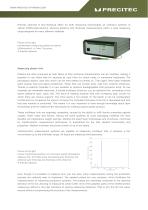
Precitec Optronik in Neu-Isenburg offers for both measuring technologies an extensive portfolio of optical CHRocodile-sensors, allowing distance and thickness measurements within a wide measuring range designed for many different materials. Picture to the right: Interferometric measuring system for plastics (CHRocodile K). In Front: The probe. © Precitec Optronik Measuring plastic foils Plastics are often produced as foils. Many of their technical characteristics can be modified, making it possible to use these foils for example as card films for check cards or membrane keyboards. The packaging...
Open the catalog to page 2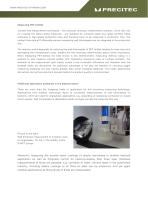
Measuring PET-bottles Contact-free measurement techniques – the confocal chromatic measurement systems, which also rely on x-raying the object being measured - are standard for container glass (e.g. glass bottles), being produced in high-speed production lines and therefore have to be measured in production time. The contact-free optical CHRocodile-sensors measuring wall thicknesses can be integrated in the production line. The industry works especially on reducing the wall thicknesses of PET-bottles leading to lower input and decreasing the transportation costs, thereby the wall thickness determination...
Open the catalog to page 3
Summary Apparently, there are almost no boundaries for interferometric measurements in the plastics sector. The contact-free measuring principle paired with infrared light sources with a high light density can roentgenize nearly every plastic and therefore being capable of measuring complex unilateral layer thicknesses up to the micrometer range. The optical probes needed for interferometric determinations are not only very compact but they can also be arranged at various customer-specific measuring distances. This allows low expense installations of inline measurement systems. Even in mass productions...
Open the catalog to page 4All PRECITEC OPTRONIK catalogs and technical brochures
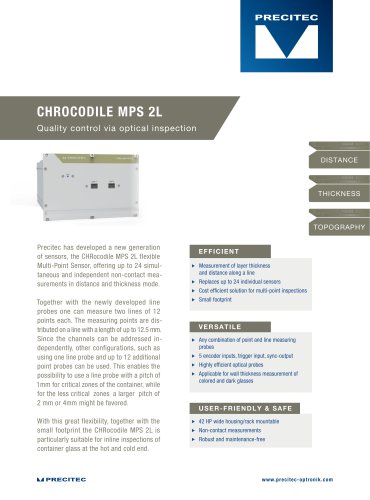 CHRocodile MPS 2 L
2 Pages
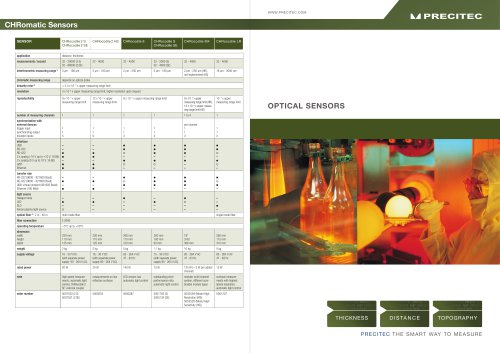 CHRomatic Sensors
2 Pages
 Heads
Heads2 Pages
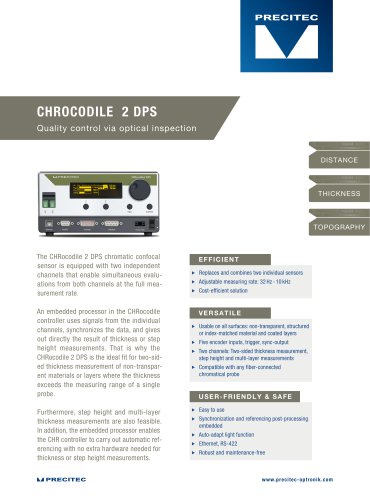 CHRocodile 2 DPS
2 Pages
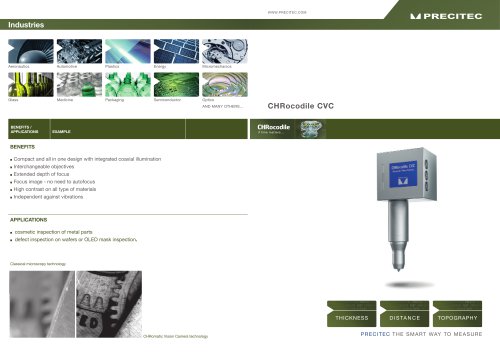 CHRomatic Vision Camera
2 Pages
 Flying Spot Scanner
2 Pages
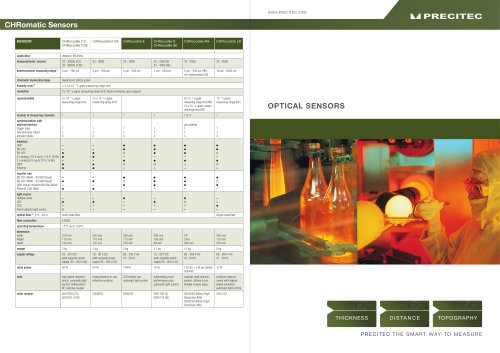 Measuring Sensors
2 Pages
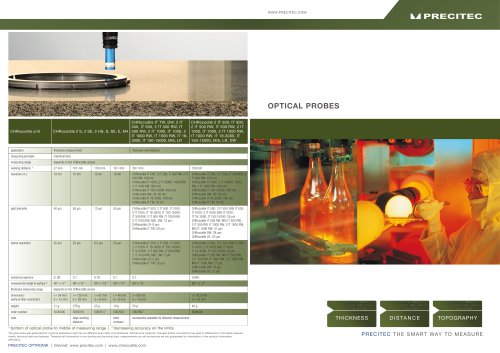
 Optical Probes
2 Pages









- Visible imager
- Industrial camera module
- Full-color camera system
- Image processing camera module
- GigE Vision camera
- Compact imager
- Inspection imager
- Additive manufacturing machine
- Thickness gauge
- High-speed camera module
- Portable thickness gauge
- Industrial 3D printer
- Distance sensor
- Measurement monitoring module
- Measurement scanner
- Environmental monitoring system
- Inspection scanner
- Coating thickness gauge
- Production monitoring system
- Online monitoring module