
- Catalogs
- PRECITEC OPTRONIK
- 3D-Coordinate Metrology in Medicine


- Products
- Catalogs
- News & Trends
- Exhibitions
3D-Coordinate Metrology in Medicine

3D-Coordinate Metrology in Medicine
Overview of Endoprosthesis Measurement Challenges
Endoprostheses, due to their often complex and multiply curved geometries, present significant challenges for traditional measurement machines. These intricate shapes require advanced measurement techniques to accurately assess their condition.
Contact-Free Sensor Technology for Wear Measurement
A contact-free sensor system is utilized to measure the ball component of a hip joint endoprosthesis after three and a half years of use. This non-contact method allows precise detection of wear without damaging the component.
Wear Visualization and Quantification
The wear depth is visually represented using different colors, facilitating an intuitive understanding of wear distribution across the surface. The total wear volume measured is 18 mm3, indicating the extent of material loss over the usage period.
Key Points
- Complex geometries of endoprostheses challenge traditional measurement methods.
- Contact-free sensors enable accurate, non-invasive wear assessment.
- Color coding effectively visualizes wear depth variations.
- Wear volume quantified at 18 mm3 after 3.5 years of use.
Catalog excerpts
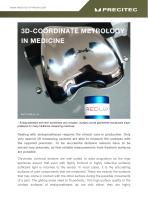
Dealing with endoprostheses requires the utmost care in production. Only very special 3D measuring systems are able to measure the surfaces with the required precision. To be successful distance sensors have to be moved very precisely, so that reliable measurements from freeform surfaces Chromatic confocal sensors are well suited to data acquisition as the high apertures ensure that even with highly inclined or highly reflective surfaces sufficient light is returned to the sensor. In most cases, it is the articulating surfaces of joint components that are measured. These are exactly the surfaces that may come in contact with the other surface during the possible movements of a joint. The gliding areas need to fit perfectly. This high surface quality of the contact surfaces of endoprostheses do not only shine, they are highly
Open the catalog to page 1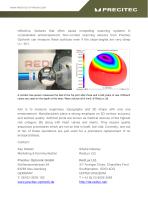
reflective, features that often cause competing scanning systems in considerable embarrassment. Non-contact scanning sensors from Precitec Optronik can measure these surfaces even if the slope-angles are very steep Aim is to measure roughness, topography and 3D shape with only one measurement. Manufacturers place a strong emphasis on 3D contour accuracy and surface quality. Artificial joints are known as medical devices of the highest risk category (III) along with heart valves and stents. They require quality assurance procedures which are not an end in itself, but vital: Currently, one out...
Open the catalog to page 2All PRECITEC OPTRONIK catalogs and technical brochures
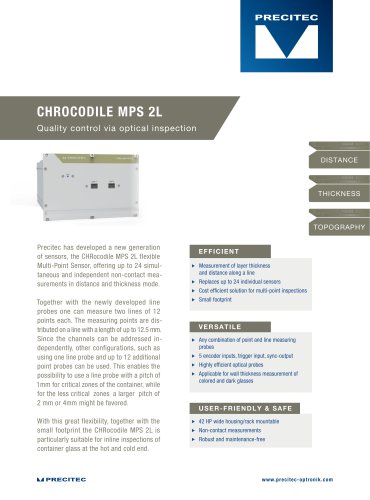 CHRocodile MPS 2 L
2 Pages
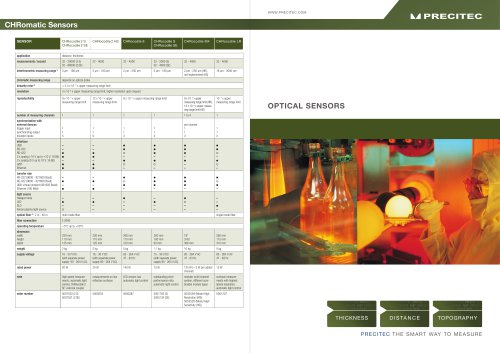 CHRomatic Sensors
2 Pages
 Heads
Heads2 Pages
 CHRocodile 2 DPS
2 Pages
 CHRomatic Vision Camera
2 Pages
 Flying Spot Scanner
2 Pages
 Measuring Sensors
2 Pages
 Optical Probes
2 Pages









- Visible imager
- Industrial camera module
- Full-color camera system
- Image processing camera module
- GigE Vision camera
- Compact imager
- Inspection imager
- Additive manufacturing machine
- Thickness gauge
- High-speed camera module
- Portable thickness gauge
- Industrial 3D printer
- Measurement monitoring module
- Measurement scanner
- Environmental monitoring system
- Inspection scanner
- Coating thickness gauge
- Production monitoring system
- Online monitoring module