
- Catalogs
- Power-Sonic
- Power-Sonic Technical Manual

Power-Sonic Technical Manual

Power-Sonic Technical Manual
This document provides comprehensive technical information on Power-Sonic Sealed Lead Acid (SLA) batteries, focusing on their features, construction, operation, capacity, charging methods, and best practices for use and maintenance.
Power-Sonic batteries are maintenance-free with a valve-regulated, spill-proof design. They can be used in various orientations, except upside-down, and have a low self-discharge rate, allowing for up to a year of storage. They are designed for deep discharge recovery, are economical, and operate over a wide temperature range.
The batteries feature relief valves, various terminal types, and immobilized dilute sulfuric acid as the electrolyte. They use non-woven glass fiber cloth separators and lead-calcium alloy plates, ensuring a leak-proof design for safe handling and shipping.
The electrochemical reaction involves lead dioxide and sponge lead converting to lead sulfate during discharge and reversing during charging. Oxygen recombination is crucial for maintenance-free operation, preventing drying out and capacity loss.
Capacity depends on discharge current, temperature, final voltage, and battery history. A table provides capacities for various discharge rates for different models.
Charging techniques include constant voltage, constant current, and taper-current charging. Overcharging and undercharging are addressed, with specific methods for cycle and standby operations. Temperature compensation and charging efficiency are also discussed.
Guidelines for handling, installation, and charging are provided to ensure safe and effective use of the batteries.
The document lists capacities for different Power-Sonic battery models, expressed in ampere-hours (AH), measured over 20 hours of constant current discharge at 20°C to a cut-off voltage of 1.75 volts per cell.
Key performance aspects include discharge characteristics, open-circuit voltage, and the effect of temperature on capacity. Capacity decreases at higher discharge rates and lower temperatures.
Power-Sonic batteries retain 60-70% capacity after one year at 20°C. Recharging within six months of storage is crucial to prevent permanent capacity loss due to sulfation.
Battery life depends on discharge rate, depth of discharge, and ambient temperature. Guidelines for maximizing battery life through proper charging and storage practices are provided.
To optimize performance and longevity, use appropriate charging methods, avoid over-discharge, and store batteries at optimal temperatures. Regular cycling or float charging is advised.
Definitions of key terms such as ampere-hour, battery, charge/discharge rate, capacity, cell, charge, closed circuit voltage test, cutoff voltage, cycle, deep cycle, direct current, discharge, electrode, electrolyte, end of charge voltage, energy density, gas recombination, high rate discharge, impedance, internal resistance, nominal voltage/capacity, open circuit voltage, overcharge, parallel connection, polarity, rated capacity, recombination, series connection, self-discharge, separator, SLA battery, service life, shelf life, standby service, state of charge, sulfation, thermal runaway, and VRLA battery are provided.
Catalog excerpts

Sealed Lead-Acid Batteries Technical Manual SONIC We've Got The Power.
Open the catalog to page 1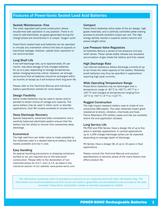
Sealed/Maintenance–Free The valve regulated spill proof construction allows trouble-free safe operation in any position. There is no need to add electrolyte, as gases generated during the charge phase are recombined in a unique “oxygen cycle”. Power-Sonic sealed lead acid batteries can be operated in virtually any orientation without the loss of capacity or electrolyte leakage. However, upside down operation is not recommended. Long Shelf Life A low self-discharge rate, up to approximately 3% per month, may allow storage of fully charged batteries for up to a year, depending on storage temperatures,...
Open the catalog to page 3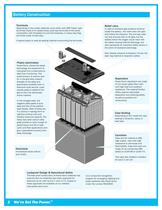
We’ve Got The Power.™ Battery Construction Relief valve In case of excessive gas pressure build-up inside the battery, the relief valve will open and relieve the pressure. The one-way valve not only ensures that no air gets into the battery where the oxygen would react with the plates causing internal discharge, but also represents an important safety device in the event of excessive overcharge. Vent release pressure is between 2-6 psi; the seal ring material is neoprene rubber. Terminals Depending on the model, batteries come either with AMP Faston type terminals made of tin plated brass, post...
Open the catalog to page 4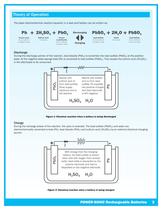
POWER-SONIC Rechargeable Batteries Discharge During the discharge portion of the reaction, lead dioxide (PbO2) is converted into lead sulfate (PbSO4) at the positive plate. At the negative plate sponge lead (Pb) is converted to lead sulfate (PbSO4). This causes the sulfuric acid (2H2SO4) in the electrolyte to be consumed. Figure 1: Chemical reaction when a battery is being discharged Charge During the recharge phase of the reaction, the cycle is reversed. The lead sulfate (PbSO4) and water are electrochemically converted to lead (Pb), lead dioxide (PbO4) and sulfuric acid (2H2SO4) by an external...
Open the catalog to page 5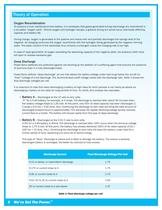
We’ve Got The Power.™ Oxygen Recombination To produce a truly maintenance-free battery, it is necessary that gases generated during overcharge are recombined in a so-called “oxygen cycle”. Should oxygen and hydrogen escape, a gradual drying out would occur, eventually affecting capacity and battery life. During charge, oxygen is generated at the positive and reacts with and partially discharges the sponge lead of the negative. As charging continues the oxygen recombines with the hydrogen being generated by the negative, forming water. The water content of the electrolyte thus remains unchanged...
Open the catalog to page 6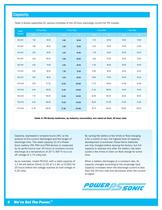
Capacity Capacity, expressed in ampere-hours (AH), is the product of the current discharged and the length of discharge time. The rated capacity (C) of a Power- Sonic battery (PS, PSH and PSG-Series) is measured by its performance over 20 hours of constant current discharge at a temperature of 20°C (68°F) to a cut off voltage of 1.75 volts/cell. As an example, model PS-610, with a rated capacity of 1.1 AH will deliver 55mA (1/20 of 1.1 AH, or 0.05C) for 20 hours before the voltage reaches an end voltage of 5.25 volts. By cycling the battery a few times or float charging it for a month or two,...
Open the catalog to page 8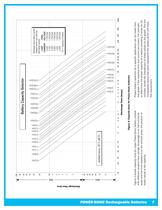
POWER-SONIC Rechargeable Batteries Figure 3 shows capacity lines for major Power-Sonic battery models with different ampere-hour ratings. Amperage is on the horizontal scale and the time elapsed is on the vertical scale; the product of these values is the capacity. Proper battery selection for a specific application can be made from this graph if the required time and current are known. For example, to determine the proper capacity of a battery providing 3 amps for 20 minutes, locate the intersection of these values on the graph. The line immediately above that point represents the battery which...
Open the catalog to page 9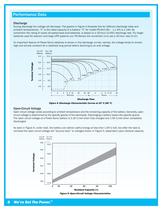
We’ve Got The Power.™ Performance Data Discharge During discharge the voltage will decrease. The graphs in Figure 4 illustrate this for different discharge rates and ambient temperatures. “C” is the rated capacity of a battery: “C” for model PS-61O (6V – 1.1 AH) is 1.1AH. By convention the rating of nearly all sealed-lead acid batteries, is based on a 20-hour (0.05C) discharge rate. For larger batteries used for telecom and large UPS systems (our PG-Series) the convention is to use a 10-hour rate (0.1C). An important feature of Power-Sonic batteries is shown in the discharge curves; namely, the...
Open the catalog to page 10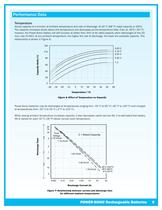
POWER-SONIC Rechargeable Batteries Temperature Actual capacity is a function of ambient temperature and rate of discharge. At 20°C (68°F) rated capacity is 100%. The capacity increases slowly above this temperature and decreases as the temperature falls. Even at -40ºC (-40°F), however, the Power-Sonic battery will still function at better than 30% of its rated capacity when discharged at the 20- hour rate (0.05C). At any ambient temperature, the higher the rate of discharge, the lower the available capacity. This relationship is shown in Figure 6. Power-Sonic batteries may be discharged at temperatures...
Open the catalog to page 11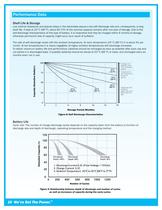
10 We’ve Got The Power.™ Performance Data Shelf Life & Storage Low internal resistance and special alloys in the electrodes assure a low self discharge rate and, consequently, a long shelf life. If kept at 20°C (68°F), about 60-70% of the nominal capacity remains after one year of storage. Due to the self-discharge characteristics of this type of battery, it is imperative that they be charged within 6 months of storage, otherwise permanent loss of capacity might occur as a result of sulfation. The rate of self discharge varies with the ambient temperature. At room temperature (20°C (68°F)) it...
Open the catalog to page 12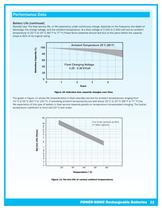
POWER-SONIC Rechargeable Batteries 11 Performance Data Battery Life (continued) Standby Use: The float service life, or life expectancy under continuous charge, depends on the frequency and depth of discharge, the charge voltage, and the ambient temperature. At a float voltage of 2.25V to 2.30V/cell and an ambient temperature of 20°C to 25°C (60°F to 77°F) Power-Sonic batteries should last four to five years before the capacity drops to 60% of its original rating. The graph in Figure 11 shows life characteristics in float (standby) service for ambient temperatures ranging from 15°C to 55°C (60°F...
Open the catalog to page 13All Power-Sonic catalogs and technical brochures
 PS-12200
2 Pages
 PS-1220
2 Pages
 PS-12180S
2 Pages
 PS-12180HD-M5
2 Pages
 PS-12170VdS
2 Pages
 PS-121400S FR
2 Pages
 PS-12140
2 Pages
 PS-1212VdS
2 Pages
 PS-12120VdS
2 Pages
 PS-12120S
2 Pages
 PS-12120L
2 Pages
 PS-12120
2 Pages
 PS-1212
2 Pages
 PS-121100S
2 Pages
 PS-12100H
2 Pages
 PS-121000S
2 Pages
 PS-12100
2 Pages
 PS-1208WL
2 Pages
 PS-1208JST FR
2 Pages
 POWERSPORT
20 Pages
 POWERMODULAR
4 Pages
 POWERLEVEL T3
5 Pages
 POWERLEVEL
4 Pages
 POWERCLEVER
4 Pages
 FC Series Chargers
2 Pages
 PG-12V75 FR
2 Pages
 PSH-1255 FR
2 Pages
 PS-832
2 Pages
 PS-6200
2 Pages
 PS-6120 Toy
2 Pages
 PS-6120FP
2 Pages
 PS-6100
2 Pages
 PS-682
2 Pages
 PSH-655FR
2 Pages
 PSG-650
2 Pages
 PS-650LS & LF
2 Pages
 PS-628
2 Pages
 PSG-625
2 Pages
 PS-612
2 Pages
 PS-610
2 Pages
 PS-605
2 Pages
 PS-4100
2 Pages
 PSG-480
2 Pages
 PS-260
2 Pages
 ISO Certification
1 Page


- Battery charger
- Lithium battery
- 12 V battery
- On-line UPS
- Lead battery
- Lead battery charger
- AC buffered power supply
- High-performance battery
- Automatic battery charger
- Electric vehicle battery
- UL battery
- Rectangular battery
- UPS with LCD display
- UPS battery
- Desktop battery charger
- Network UPS
- CE battery charger
- Eco mode UPS
- Battery for medical applications