
- Catalogs
- POSITAL FRABA
- POSITAL Wiegand Sensors


POSITAL Wiegand Sensors

POSITAL Wiegand Sensors
Wiegand sensors are utilized as pulse generators in various applications, requiring no external power source and having no moving parts. They leverage the properties of a small diameter wire invented by John Wiegand. A significant output pulse is generated when the magnetic state of the Wiegand wire changes, which can power energy self-sufficient revolution counters. POSITAL's sensors benefit from a decade of experience in Wiegand-effect based revolution counters, using SMD mounting technology for applications like absolute rotary encoders.
- No external power or batteries required, leading to a longer lifespan.
- Operates effectively in harsh environments with non-contact measurement, eliminating mechanical wear.
- Applicable in multiple fields such as flow meters, contactless switches, and rotary encoders.
Modified versions are available for instrumentation, including UTS, UFS, and WFS versions.
- Designed for energy harvesting multiturn encoders using the Wiegand effect.
- Optimized for multiturn counter modules iC-PMZ and iC-PMX from iC-Haus.
- Compatible with surface mounted technology and RoHS 2 standards.
- Available in versions for 2.5 mm and 5 mm wire distances.
- High pulse energy with an average of 170 nJ.
- Machine-readable serial numbers ensure traceability.
The Wiegand effect utilizes unique magnetic properties of specially processed ferromagnetic wire. John Wiegand discovered a method to reverse the magnetic field of this wire, generating a sharp voltage pulse known as a Wiegand Pulse. The process involves several stages of magnetic field application and reversal, resulting in a complete cycle of pulse generation.
POSITAL has a global network with centers in Cologne (EMEA), Hamilton (Americas), Singapore (APAC), and Shanghai (China).
Catalog excerpts
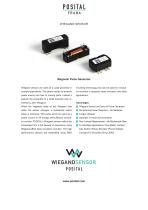
POSITAL FRABA WIEGAND SENSOR Magnetic Pulse Generator Wiegand sensors are used as a pulse generator in multiple applications. The sensor needs no external power source and has no moving parts. Instead it exploits the properties of a small diameter wire invented by John Wiegand. When the magnetic state of the Wiegand wire within the sensor changes, a substantial output pulse is produced. This pulse which be used as a power source in an energy self-sufficient revolution counter. POSITAL‘s Wiegand sensors reflect the knowledge from a full decade of experience using Wiegand-effect base revolution counters. The high performance sensors are assembled using SMD mounting technology and can be used for revolution counters in absolute rotary encoders and other applications. Advantages □ Wiegand Sensor as Power & Pulse Generator □ No External Power Required - No Batteries □ Longer Lifespan Q Operates in Harsh Environments Q Non Contact Measurement - No Mechanical Wear □ For Multiple Applications: Flow Meter, Contactless Switch, Rotary Encoder (Proven Design Concept For Encoders Since 2005)
Open the catalog to page 1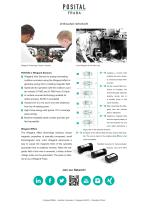
WIEGAND SENSOR Wiegand Technology Center in Aachen John Wiegand at His Work Lab POSITAL’s Wiegand Sensors A pplying a reverse field Wiegand Wire Sensor for energy harvesting switches the core’s polari- multiturn encoders using the Wiegand effect to ty, producing a large voltage spike. generate energy from a rotating magnetic field Optimized for operation with the multiturn coun- As the reverse field con tinues to increase, the ter module iC-PMZ and iC-PMX from iC-Haus shell eventually switches surface mounted technology suitable for In polarity, giving rise to reflow process, RoHS 2 compatible...
Open the catalog to page 2All POSITAL FRABA catalogs and technical brochures
 POSITAL Accessories
2 Pages
 POSITAL Sensor Overview
6 Pages
 POSITAL Incremental Encoders
4 Pages
 POSITAL Product Catalog
108 Pages
 Safety Rotary Encoders
2 Pages
 Sensors for Mobile Machines
8 Pages


Archived catalogs
 POSITAL Sensor Overview
4 Pages
 catalog
48 Pages
 Inclinometers Vs Encoders
12 Pages

- Display module
- Incremental encoder
- Incremental rotary encoder
- Shaft shaft coupling
- LED display panel
- Tilt sensor
- Solid-shaft rotary encoder
- Optical rotary encoder
- Industrial rotary encoder
- Hollow-shaft rotary encoder
- Magnetic rotary encoder
- Flange coupling
- Programmable display system
- Metal stand
- IP65 rotary encoder
- Torque coupling
- Compact rotary encoder
- IP67 rotary encoder