
- Catalogs
- Portescap S.A.
- STARTING EARLY: WHY YOU SHOULD CONSULT YOUR MOTION SYSTEM ENGINEERS AT THE ONSET OF NEW OEM PROJECTS


- Company
- Products
- Catalogs
- News & Trends
- Exhibitions
STARTING EARLY: WHY YOU SHOULD CONSULT YOUR MOTION SYSTEM ENGINEERS AT THE ONSET OF NEW OEM PROJECTS

STARTING EARLY: WHY YOU SHOULD CONSULT YOUR MOTION SYSTEM ENGINEERS AT THE ONSET OF NEW OEM PROJECTS
Electric motors are essential components in machines with motion axes. Involving motion system engineers early in the design phase of new OEM projects can optimize equipment performance and streamline development.
Miniature Motors and Precision Control
Miniature motors, often under 1 kW and 90 mm in diameter, are crucial for precise control in applications like surgical robots and medical equipment. These systems require careful design consideration to meet speed, accuracy, size, and cost requirements.
Early Involvement of Motion System Experts
OEMs should consult motion system engineers during the ideation phase to avoid constraints in design choices. Early involvement ensures that precision, speed, and reliability objectives are met effectively.
Establishing Specifications at the Concept Phase
During the concept stage, OEMs should define motion system specifications, including motor size and feedback devices, to determine if off-the-shelf solutions are sufficient or if customization is needed. This decision impacts project time and cost.
Confirming Design Before Feasibility Phase
By the feasibility stage, the motion system's design should be confirmed to avoid significant rework. Early decisions streamline development, improve time to market, and reduce costs.
Conclusion
Engaging motion system specialists early in the project is crucial for optimizing performance and meeting design objectives efficiently.
Contact Information
For more information, contact Portescap at their West Chester, PA office or visit their website.
Catalog excerpts

WHITE PAPER STARTING EARLY: WHY YOU SHOULD CONSULT YOUR MOTION SYSTEM ENGINEERS AT THE ONSET OF NEW OEM PROJECTS Electric motors — along with their power transmission, feedback and control devices — are critical to machines that rely on motion axes. Original equipment manufacturers (OEM) embarking on a new product’s development should therefore involve the motion specialists as early as possible in the project’s design. Since the motor and its output have a broad impact on the equipment’s overall design, early inclusion of the motion system experts will optimize the performance of the equipment and also streamline project development. This is especially the case for precision equipment that requires a miniature motor and motion system. MINIATURE MOTORS ENABLE MORE PRECISE CONTROL By controlling the torque, speed, acceleration and shaft position, the electric motor is the fundamental component that brings to life a variety of systems — from surgical robots to industrial machines. Some of these applications don’t require more than 1 kilowatt (kW) of power, necessitating small, lightweight motion systems. Compact motion systems — which typically generate less than 1 kW and measure roughly 90 millimeters (mm) or less in diameter — must often meet complex application requirements. The motors and control systems that guide satellites or power the joints of a surgical robot, for example, need to provide pinpoint precision. Similarly, the motors that control medical equipment, such as patient infusion systems, must ensure absolute reliability. Such reliability is also a typical requirement for mission-critical military applications. Image 1: Brush DC micro motors from Portescap No matter the equipment, a motion system’s design requires careful consideration. These aspects will impact the equipment’s ability to fulfill its tasks according to the application’s speed and accuracy requirements. They will also affect the equipment’s ultimate size and weight, as well as its time to market and development costs, making it highly beneficial for OEMs to include the motion system experts at the earliest possible stage of a new project. WHITE PAPER | Page 1 of 3
Open the catalog to page 1
INCLUDE THE MOTION SYSTEM EXPERTS AT THE IDEATION PHASE When OEM engineers turn their attention to concept development — and preferably, when they’re still in a product’s ideation phase — they should consider the motion system. Even if the discussions only include general assumptions of the motion system’s design, consulting the motion system engineers at this point will ensure later design choices aren’t constrained. Every OEM project has design objectives that are, more or less, set in stone. These attributes often relate to precision, speed and reliability — all of which significantly depend...
Open the catalog to page 2
CONFIRM THE MOTION SYSTEM’S DESIGN PRIOR TO THE FEASIBILITY PHASE The feasibility stage is often the longest period in a project’s design. However, at this point the motion system’s form factor and performance requirements shouldn’t change in any significant way so long as the OEM has already made the appropriate decisions during earlier phases. Instead, motion system engineers should use the feasibility stage to fine-tune their motion solution to optimize the system’s performance and efficiency. If the motion system design hasn’t been confirmed at an earlier stage, the decisions taken now —...
Open the catalog to page 3All Portescap S.A. catalogs and technical brochures
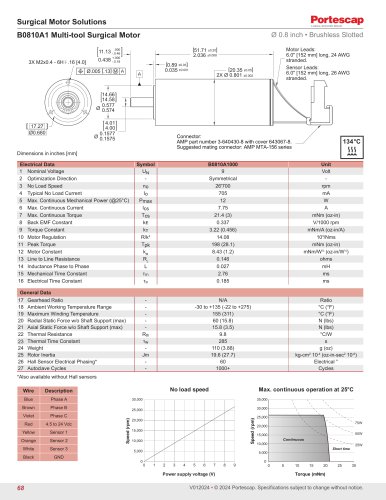 specifications_b0810a1
1 Page
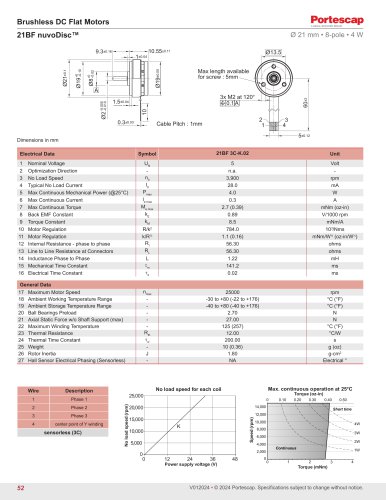 specifications_21bf
1 Page
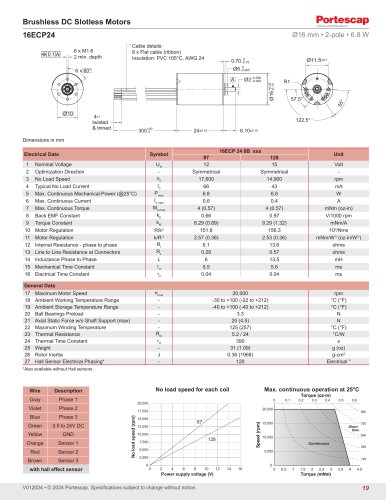 specifications_16ecp24
1 Page
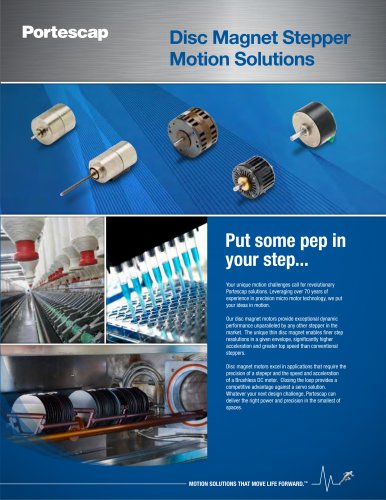
Archived catalogs
 Portescap Medical Brochure
20 Pages
 Industrial Power Tools
8 Pages
 22ECT 35 - 48
2 Pages
 SMS ENCODER
1 Page
 35ecs
35ecs4 Pages
 White Paper Tattoo Machines
5 Pages
 Portescap Product Catalog
214 Pages
 BRUSH DC motor
12 Pages
 BRUSHLESS DC MOTORS
7 Pages
 CANSTACK stepper motors
7 Pages
 TurboDisc™ Stepper Motors
8 Pages
 B16C-0-24
1 Page
 16ECP24
1 Page
 Ultra EC Brushless Motors
8 Pages
 16ECP Ultra EC
2 Pages
 Miniature Motors
16 Pages


- DC electromotor
- Synchronous motor
- Actuator
- Multipole motor
- Electric gearmotor
- Angular encoder
- Linear actuator
- Asynchronous motor
- Planetary gearbox
- Electric actuator
- Coaxial gearhead
- Incremental encoder
- EC motor
- Electromotor for industrial applications
- Three-phase motor
- Precision gearhead
- 24 V motor
- Incremental rotary encoder
- Compact gearhead