
- Catalogs
- Portescap S.A.
- Slotted Motor Design Challenges and Opportunities


- Company
- Products
- Catalogs
- News & Trends
- Exhibitions
Slotted Motor Design Challenges and Opportunities

Slotted Motor Design Challenges and Opportunities
Introduction:
Miniature brushless DC (BLDC) slotted motors are crucial in applications like robotics and consumer electronics due to their high torque density and enhanced cooling capabilities. The absence of brushes in these motors offers advantages such as improved efficiency, high-speed operation, and longer lifespan. The choice between slotted and slotless configurations impacts performance, with slotted designs offering higher torque and better cooling.
Sizing Slotted BLDC Motors:
Designing slotted BLDC motors involves challenges such as accurate core loss calculation and managing material saturation and magnet demagnetization at high temperatures. The motor's torque is influenced by electrical and magnetic loadings, rotor and stator dimensions, and material selection. Optimizing core and copper losses is essential for efficiency, with torque being proportional to motor size and slot-pole combinations.
Slot-Pole Combinations:
The slot-pole combination affects the motor's magnetic field interactions. Various combinations, such as Integral Slot Concentrated Windings (ICSW) and Fractional Slot Concentrated Windings (FSCW), offer different benefits and challenges. For instance, a high Least Common Multiple (LCM) between slots and poles reduces cogging torque, while a high Great Common Divisor (GCD) enhances radial symmetry.
Specifying Miniature Slotted BLDC Motors:
The motor's torque is linked to its volume, magnetic and electrical loading, and slot-pole combination. Off-the-shelf designs offer reliability but may not optimize magnetic circuit utilization. Bespoke designs, tailored to specific applications, can enhance performance and efficiency, potentially reducing total costs.
Conclusion:
For optimal performance, seeking engineering integration support is crucial, especially for high-volume OEMs. Bespoke motor designs can provide significant advantages over standard options, offering faster time to market and cost-effectiveness.
For more information, contact Portescap at www.portescap.com.
Catalog excerpts
WHITE PAPER CHALLENGES AND OPPORTUNITIES IN MINIATURE SLOTTED MOTOR DESIGN The high torque density and enhanced cooling capability of miniature brushless DC (BLDC) slotted motors are instrumental in numerous applications ranging from robotics to consumer electronics. However, to optimize the efficiency, performance, and reliability of the application, their specification requires careful consideration. Engineering integration advice in the selection of off-the-shelf slotted BLDC motors is advantageous, and considerations on bespoke design will benefit the application’s performance in the long term. With the absence of brushes for the process of commutation, miniature brushless DC motors have advantages over their brushed counterparts, including improved efficiency, high speed operation, longer lifespan, and opportunities for improved control. Within BLDC motors, there is a design choice for either slotted or slotless configurations. The stator, which is the outer stationary part surrounding the rotor, contains the windings that channel the flow of electric current. This generates a magnetic field that interacts with the rotor’s magnets, causing it to rotate and create motion. In a slotless BLDC motor, the windings are typically secured in the stator by resin or are held in place by a tape or mechanical retention device. Alternatively, in a slotted design, windings are retained within slots or grooves. Slotless motors are generally more compact, and these designs are also beneficial for applications that require the smoothest operation and high speed. However, slotted BLDC motors enable an increase in the amount of magnetic flux density in the airgap, which results in higher torque generation; this helps improve the motor’s dynamics, making this design more reliable. The slots also help to dissipate heat, enabling improved cooling. WHITE PAPER | Page 1 of 4 ©2023 Portescap. All rights reser
Open the catalog to page 1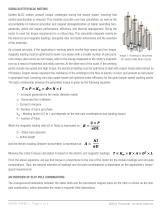
SIZING SLOTTED BLDC MOTORS Slotted BLDC motors present unique challenges during the design phase, meaning that careful specification is required. This includes accurate core loss calculation, as well as the accountability of material saturation and magnet demagnetization at higher operating temperatures, which can impact performance, efficiency, and thermal management. Sizing the motor to meet the torque requirement is a critical step. This calculation depends mainly on the electrical and magnetic loadings, alongside rotor and stator dimensions and the selection of the materials. As a broad principle,...
Open the catalog to page 2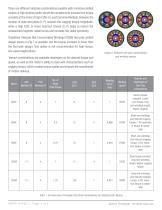
There are different slot/pole combinations possible with miniature slotted motors. A high winding factor should be considered to increase the torque constant of the motor. A high LCM, or Least Common Multiple, between the number of slots and poles (S, P), reduces the cogging torque magnitude, while a high GCD, or Great Common Divisor (S, P) helps to reduce the unbalanced magnetic radial forces and increase the radial symmetry. Traditional Intergral Slot Concentrated Windings (ICSW) two-pole slotted design shown in Fig.1 is possible, but the torque constant is lower than the four-pole design;...
Open the catalog to page 3
In addition to the slot-pole combination, another configuration known as fractional slot concentrated windings (FSCW) is also possible. FSCW includes multipole ring magnet configurations with short magnetic circuits, and this design is suitable for low-speed, high-torque applications. Table 1 identifies the various slot-pole combinations and their benefits. SPECIFYING MINIATURE SLOTTED BLDC MOTORS The motor’s generated torque is proportional to its volume, the magnetic and electrical loading, and its slot-pole combination. Specifying these characteristics is dependent not only on the application’s...
Open the catalog to page 4All Portescap S.A. catalogs and technical brochures
 specifications_b0810a1
1 Page
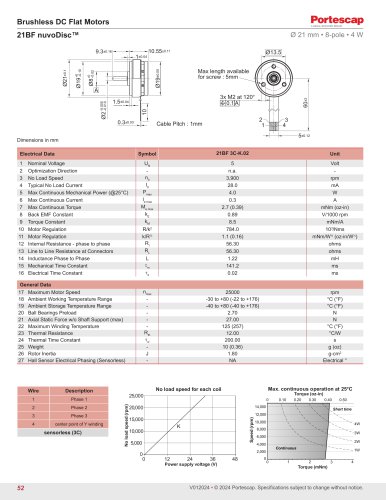 specifications_21bf
1 Page
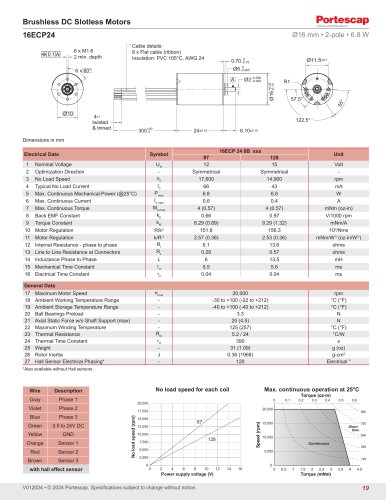 specifications_16ecp24
1 Page
Archived catalogs
 Portescap Medical Brochure
20 Pages
 Industrial Power Tools
8 Pages
 22ECT 35 - 48
2 Pages
 SMS ENCODER
1 Page
 35ecs
35ecs4 Pages
 White Paper Tattoo Machines
5 Pages
 Portescap Product Catalog
214 Pages
 BRUSH DC motor
12 Pages
 BRUSHLESS DC MOTORS
7 Pages
 CANSTACK stepper motors
7 Pages
 TurboDisc™ Stepper Motors
8 Pages
 B16C-0-24
1 Page
 16ECP24
1 Page
 Ultra EC Brushless Motors
8 Pages
 16ECP Ultra EC
2 Pages
 Miniature Motors
16 Pages


- Electromotor
- Synchronous motor
- Actuator
- Multipole motor
- Electric gearmotor
- Angular encoder
- Linear actuator
- Asynchronous motor
- Planetary gearbox
- Electric actuator
- Coaxial gearhead
- EC motor
- Incremental encoder
- Electromotor for industrial applications
- Three-phase motor
- Precision gearhead
- 24 V motor
- Compact gearhead
- Incremental rotary encoder